
Subtotal $0.00


So, what exactly is cloud migration? In simple terms, it's the process of moving a company's digital operations—applications, data, and core IT infrastructure—from private, on-premise servers to a cloud provider's data centres. It’s a strategic shift away from owning and managing physical hardware to, essentially, renting computing services from giants like Amazon Web Services (AWS) or Microsoft Azure.
Understanding Cloud Migration Fundamentals
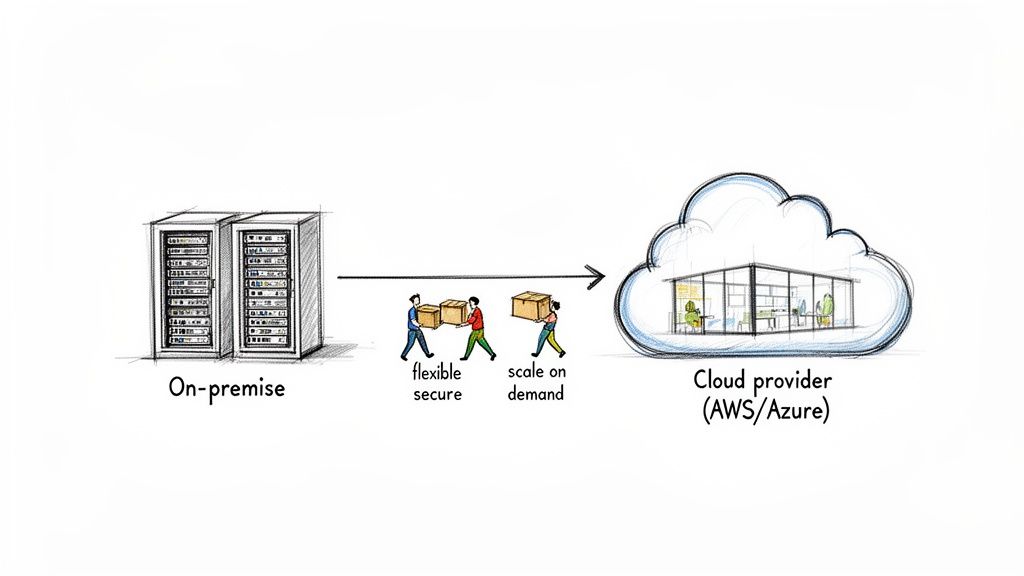
Think of your current IT setup like owning a standalone office building. You are responsible for everything: the building's maintenance, security, utilities, and any future expansions. This is what it's like running your IT on-premises; your company owns, manages, and pays for all the physical servers, storage, and networking equipment.
Cloud migration is the digital equivalent of moving your business into a modern, fully-serviced business centre. Instead of owning the entire building, you rent precisely what you need, whether that's a single desk or an entire floor. The business centre handles all the background complexities—security, maintenance, utilities—and you can scale your space up or down in minutes as your needs change.
In this model, the cloud provider (like Azure or AWS) is that serviced business centre. They own and operate all the hardware, and you simply pay to use their resources. This move frees up your team from the heavy burden of managing physical infrastructure, allowing them to focus on initiatives that drive business value.
The Core Concept of Moving to the Cloud
At its heart, migrating to the cloud is about changing where your applications run and who manages the underlying hardware. It's much more than just copying files from one computer to another; it's a fundamental shift in how your business delivers and consumes IT services.
This transition involves several key components:
- Applications: The software your business depends on, from your CRM system to bespoke internal tools.
- Data: Every piece of your organisational information, including customer records, financial figures, and operational files.
- Infrastructure Components: The digital architecture, such as databases, virtual machines, and network configurations.
By moving these assets, businesses unlock a level of efficiency, agility, and resilience that is incredibly difficult and expensive to achieve with a traditional on-premise setup.
To help you visualise the difference, here's a quick comparison:
On-Premises vs Cloud Infrastructure at a Glance
This table provides a high-level comparison between traditional on-premises IT and cloud-based infrastructure, helping you quickly grasp the fundamental differences.
| Aspect | On-Premises Infrastructure | Cloud Infrastructure |
|---|---|---|
| Upfront Costs | High capital expenditure (CapEx) for hardware and software | Low to no CapEx; pay-as-you-go operating expense (OpEx) |
| Scalability | Limited and slow; requires purchasing new hardware | Rapid and flexible; scale resources up or down on demand |
| Maintenance | Your internal IT team is responsible for all maintenance | The cloud provider manages all hardware and infrastructure |
| Accessibility | Typically limited to the physical network | Accessible from anywhere with an internet connection |
| Security | You are fully responsible for physical and network security | Shared responsibility model; provider secures infrastructure |
| Deployment | Slower; requires manual setup and configuration | Fast; resources can be provisioned in minutes |
This table makes it clear that the cloud offers a fundamentally different operational model, one built for speed and flexibility in modern business environments.
Why It Is a Strategic Business Decision
The decision to migrate is almost never just about the technology; it's a strategic move driven by clear business objectives. Companies aren't just moving servers for the sake of it; they're positioning themselves for future growth, enhanced security, and far greater operational flexibility.
A successful cloud migration should result in an IT infrastructure that is scalable, resilient, and secure, adapting seamlessly to changing business needs while supporting innovation and growth.
For many UK businesses, this shift isn't just an option—it's becoming essential to stay competitive. It allows them to redirect valuable resources towards their core mission, rather than being bogged down in the costly and time-consuming job of maintaining hardware. This is where structured IT support often becomes a crucial part of the journey, ensuring the migration is planned and executed flawlessly to deliver long-term value without disrupting business operations.
Why Cloud Migration Is a Business Imperative
Knowing what cloud migration is represents the first step. However, understanding why it has become a strategic necessity for UK organisations is where you unlock its real business value. This is no longer a conversation for the IT department; it’s a boardroom decision about building a more resilient, innovative, and competitive business.
The core motivation has evolved from simple IT efficiency to outright business transformation. Whether you're a small business needing to scale without a massive upfront investment, a regulated firm requiring strict data governance, or a larger enterprise aiming for unified global operations, the cloud provides the platform to make it happen. It’s about future-proofing your organisation and preparing it for what comes next.
Driving Growth and Operational Excellence
At its core, migrating to the cloud is about freeing your business from the limitations of physical hardware. On-premise infrastructure is inherently rigid; you’re constrained by the capacity you’ve purchased. This often leads to either costly over-provisioning or frustrating performance bottlenecks during busy periods. The cloud completely flips this model on its head.
It provides the elasticity to scale resources up or down in minutes, not months. This agility means you can respond instantly to customer demand, launch new services much faster, and experiment with new ideas without committing to expensive equipment. This operational freedom is a powerful competitive advantage.
Cloud migration isn't just an infrastructure upgrade; it's a strategic pivot that enables a business to operate with greater speed, intelligence, and security. It aligns technology directly with business outcomes, turning IT from a cost centre into a growth engine.
This is where the tangible benefits become clear. For UK businesses, moving to the cloud is unlocking remarkable savings and efficiency gains. Recent data indicates that firms are achieving average annual cost reductions of around £127,000, alongside a 78% boost in their security posture and a 65% reduction in IT operational costs. When you can roll out new services 92% faster, the impact on innovation is undeniable. You can explore the full analysis of UK cloud migration benefits to see more on these findings.
Enhancing Security and Ensuring Compliance
Security is, quite rightly, a primary concern for any business. There's a common misconception that moving to the cloud is less secure than keeping data on-site. In reality, for most organisations, the opposite is true. Major cloud providers like Microsoft Azure and Amazon Web Services (AWS) invest billions annually in security measures that far exceed what a typical company could afford.
This robust foundation, when combined with expert configuration, allows businesses to build highly secure environments that meet the most stringent compliance standards. Key benefits include:
- Advanced Threat Detection: Cloud platforms offer sophisticated, AI-driven tools that monitor for threats in real-time, providing a level of protection that’s incredibly difficult to replicate in-house.
- Simplified Compliance: Providers offer tools and frameworks to help businesses adhere to regulations like GDPR and achieve certifications such as Cyber Essentials, which is increasingly vital for UK government contracts.
- Centralised Security Management: Security policies can be consistently applied and managed across the entire organisation from a single dashboard, reducing complexity and the risk of human error.
By moving to the cloud, you are not outsourcing responsibility—you are partnering with a global security leader. This strategic approach, often guided by proven expertise, ensures your security posture isn't just maintained but significantly strengthened, protecting both your data and your reputation.
Creating a Foundation for Future Innovation
Beyond the immediate cost and security benefits, cloud migration prepares your business for the next wave of technology. Game-changing tools like artificial intelligence (AI), machine learning, and big data analytics all depend on the immense processing power and data storage that only the cloud can provide.
Attempting to build and maintain the infrastructure for these capabilities on-premise is often prohibitively expensive and complex. The cloud democratises access to these powerful tools, allowing businesses of all sizes to innovate. Whether it's deploying AI-powered customer service bots, analysing sales data to predict trends, or supporting a secure remote workforce, the cloud provides the essential, scalable foundation to make it a reality.
Choosing Your Migration Path: The 6 R's Explained
Embarking on a cloud migration without a clear strategy is like setting off on a road trip with no map. You might get somewhere eventually, but it's guaranteed to be a longer, more expensive, and far more stressful journey than necessary. A successful migration starts with choosing the right path, and in the world of cloud, this is commonly defined by the "6 R's."
These six strategies—Rehost, Replatform, Repurchase, Refactor, Retain, and Retire—provide a framework for determining what to do with every application, dataset, and piece of infrastructure you currently own. They cover everything from simple moves to complete overhauls, each with its own pros, cons, and ideal use cases.
Understanding these options is vital. It enables more productive conversations with your IT team or a migration partner, ensuring the final plan aligns perfectly with your budget, timeline, and long-term business goals.
The decision tree below offers a high-level view of the initial choice many businesses face when considering the future of their infrastructure.
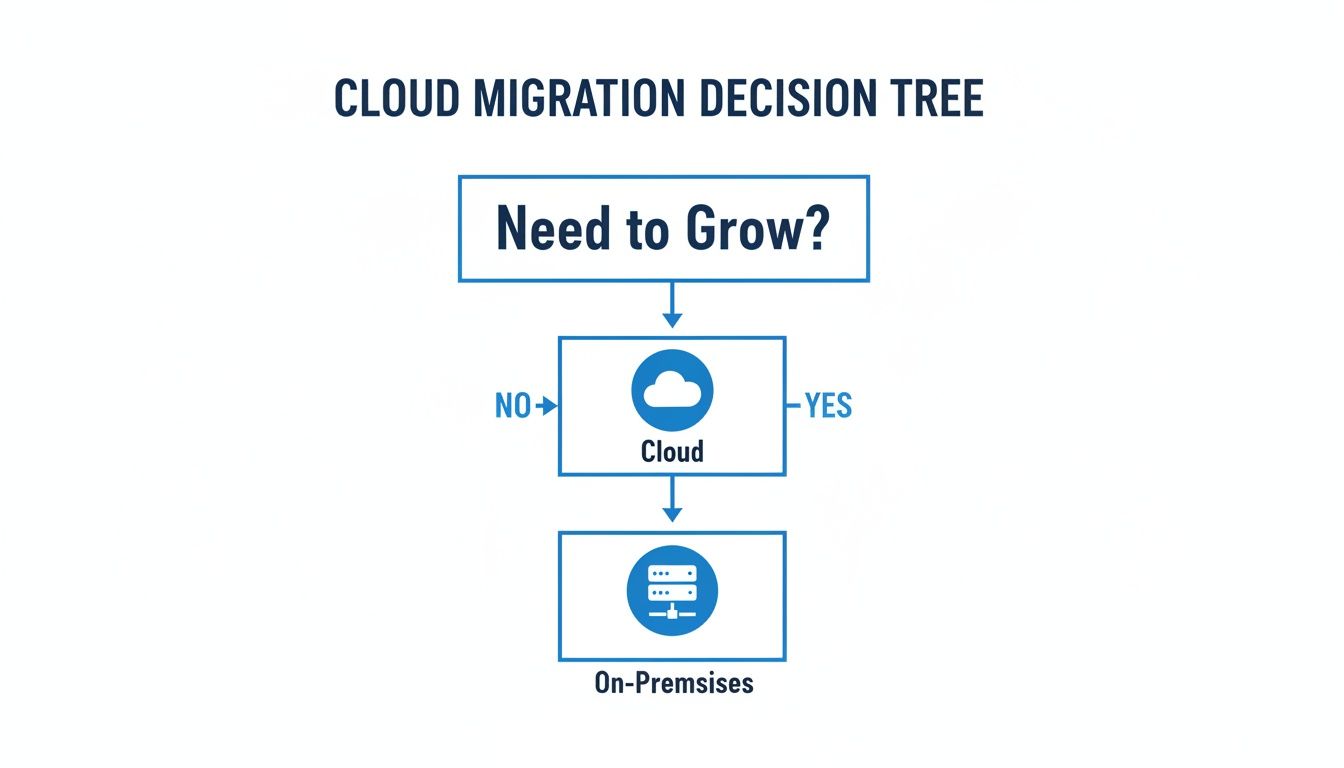
As it illustrates, for any organisation targeting growth, the cloud is almost always the default path. Those with more static needs might consider retaining their on-premises setup, but for most, the question isn't if but how to move. That's where the 6 R's come in.
Let's dive into each strategy to see what they mean for your business. We've put together a handy table that compares them side-by-side for a quick overview.
Comparing the 6 R's of Cloud Migration
| Strategy | Description | Best For | Complexity & Cost |
|---|---|---|---|
| Rehost (Lift and Shift) | Moving an application to the cloud with minimal or no changes to its architecture. | Quick data centre exits, testing the cloud, migrating legacy apps without modification. | Low Complexity & Cost. Fastest and simplest approach. |
| Replatform (Lift and Reshape) | Moving an app to the cloud while making a few small optimisations to leverage cloud services. | Gaining quick wins like better performance or managed services without a full rewrite. | Low-to-Medium Complexity & Cost. More involved than rehosting but delivers tangible benefits. |
| Repurchase (Drop and Shop) | Discarding an existing application and moving to a new, cloud-native SaaS product. | Replacing commodity software like HR, CRM, or finance systems with off-the-shelf solutions. | Low-to-Medium Complexity & Cost. Primarily involves data migration and licensing costs. |
| Refactor (Rearchitect) | Fundamentally rewriting or re-architecting an application to become fully cloud-native. | Core business applications where scalability, agility, and performance are critical. | High Complexity & Cost. Requires significant development resources and time. |
| Retain | Keeping a specific application in its current on-premises or hosted environment. | Apps with major compliance constraints, high-cost migrations, or late in their lifecycle. | No direct migration cost, but ongoing on-premises costs remain. |
| Retire | Decommissioning applications that are no longer needed or are redundant. | Any obsolete or low-value application discovered during the planning phase. | Cost savings. Frees up infrastructure and licensing resources. |
Each of these strategies plays a distinct role in a well-structured migration plan. You'll likely use a combination of them depending on the specific application and its value to your business.
A Deeper Look at the Strategies
1. Rehost (Lift and Shift)
The simplest and fastest option is Rehosting, better known as "lift and shift." Imagine you're moving house. With this approach, you take every piece of furniture with you and place it in roughly the same position in your new home. You're not redecorating or buying anything new; you're simply changing your address.
In technical terms, this means moving your applications and their data directly to cloud infrastructure with almost no changes. You are simply shifting your servers from your on-site data centre to a virtual environment in the cloud. Most businesses begin by understanding the fundamentals of Infrastructure as a Service in our detailed guide, as IaaS is the model that makes rehosting possible.
While it’s fast and causes minimal disruption, the main drawback is that you don't take advantage of cloud-native features like auto-scaling or serverless computing. This can mean your operational costs are higher than they need to be in the long term.
2. Replatform (Lift and Reshape)
Replatforming takes things a step further. Returning to our moving analogy, this is like moving all your existing furniture but deciding to swap out an old gas cooker for a modern electric one. You’re making small, targeted upgrades to gain immediate benefits without committing to a full renovation.
Here, you move an application to the cloud but make a few optimisations to leverage cloud capabilities. A classic example is switching from a self-managed database to a managed cloud service like Amazon RDS or Azure SQL. It strikes a good balance between speed and optimisation, delivering quick wins without a massive overhaul.
3. Repurchase (Drop and Shop)
With Repurchase, you move away from a legacy application entirely and switch to a cloud-based Software-as-a-Service (SaaS) solution. This is like deciding your old, custom-built wardrobe is too much hassle, leaving it behind, and subscribing to a modern, managed storage service instead.
Common examples include moving from a local CRM to Salesforce, or replacing an on-premise email server with Microsoft 365. You essentially "drop" your old software and "shop" for a ready-made cloud alternative, freeing your team from managing the underlying infrastructure.
4. Refactor (Rearchitect)
Refactoring is the most intensive strategy, but it also unlocks the greatest rewards. This is the full home renovation. You're not just moving furniture; you're knocking down walls, rewiring the electrics, and redesigning the layout to be more modern and efficient.
This involves significantly altering or completely rewriting an application to be fully cloud-native, often using microservices or serverless architectures. It’s the difference between running in the cloud and being built for the cloud. This path is ideal for core business applications where scalability, performance, and the ability to add new features quickly are critical. It is the most expensive and time-consuming approach, but the long-term payoff is substantial.
5. Retain and Retire
Finally, it’s important to remember that not everything has to move. The last two R's acknowledge this reality.
- Retain: Some applications might need to remain in their on-premises environment. This could be due to strict regulatory rules, complex dependencies with other systems, or simply because the cost to migrate an old legacy system outweighs any potential benefit.
- Retire: As you assess your applications, you will almost certainly find some that are no longer used or have been superseded. Retiring these applications is an easy win. It immediately frees up resources and reduces your overall IT footprint.
Choosing the right mix of these strategies is a critical part of planning. It requires a deep understanding of your application portfolio and your business objectives—which is where the guidance of an experienced IT partner can prove invaluable.
Your Practical Cloud migration Checklist
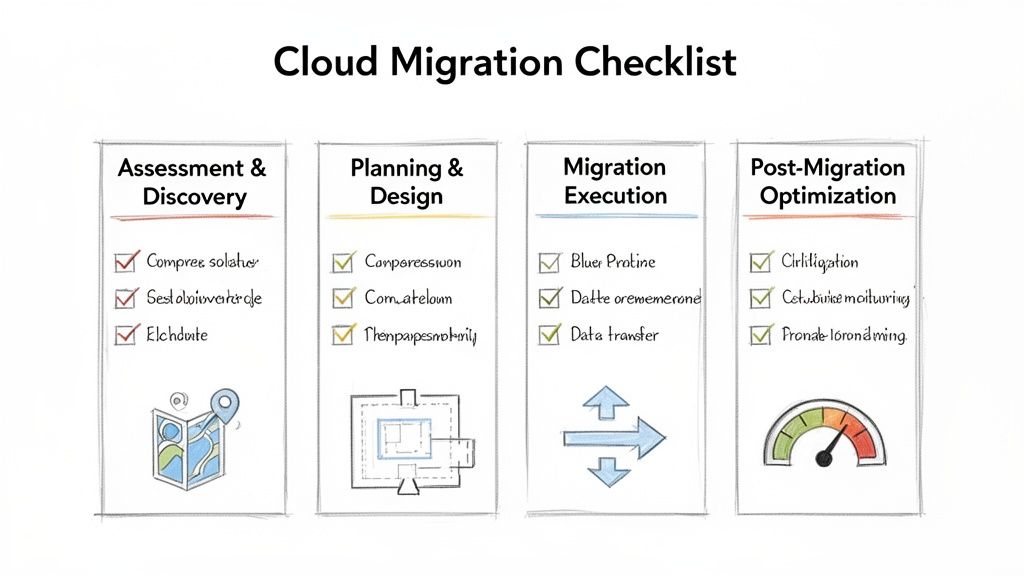
Now that you understand the strategies, it's time to get practical. A successful cloud migration isn't a single leap of faith; it's a journey built on a structured, methodical plan that leaves nothing to chance.
One of the most common and costly mistakes we see is organisations rushing in without a detailed roadmap. This checklist breaks the entire process down into four distinct, manageable phases. Each one builds on the last, ensuring every dependency, risk, and objective is accounted for before you move a single byte of data.
Following a framework like this transforms what could be a chaotic project into a controlled, predictable, and successful business initiative.
Phase 1: The Assessment And Discovery Stage
Think of this as the foundation for your entire project. It is arguably the most critical phase because the knowledge you gain here informs every subsequent decision. The goal is simple: create a complete inventory of your current IT environment and understand precisely how it supports your business operations.
Key tasks in this stage include:
- Inventory Your Assets: You need to catalogue everything: every physical and virtual server, every application, every database, and every network device. Documenting software versions and patch levels is also essential.
- Map Application Dependencies: Determine how your applications and systems communicate. A classic pitfall is moving an application and only then realising it relies on a database left behind, causing an immediate outage.
- Analyse Performance Baselines: Collect hard data on your current resource usage—CPU, memory, storage I/O. This is essential for right-sizing your cloud instances later, which is key to avoiding unexpected costs.
- Identify Stakeholders: Involve the right people from the beginning. Engage key players from across the business, from finance to operations, to understand their needs and manage expectations.
Phase 2: The Planning And Design Stage
With a crystal-clear picture of your current setup, you can start designing your future in the cloud. This is where you translate business requirements into a technical blueprint. Meticulous planning here prevents expensive rework and frustrating delays down the line.
Your planning checklist should cover:
- Select Your migration Strategy: Using the ‘6 R’s’ framework, decide the best approach for each application. Will you rehost it as is, replatform it, or is it time to refactor or retire it completely?
- Define Security and Compliance Requirements: Document every regulatory need, such as GDPR data residency rules. This is where you design your cloud security architecture, ideally incorporating modern principles like Zero Trust.
- Create a Detailed Budget: Look beyond simple monthly hosting costs. You need to factor in data transfer fees, licensing for third-party tools, and the cost of training your team or engaging external expertise.
- Establish Key Performance Indicators (KPIs): Define what success looks like. Will you measure it by cost reduction, improved application performance, or faster deployment times? These KPIs will prove the project’s value later.
A common oversight is underestimating network complexities. Moving large volumes of data to the cloud isn't instantaneous and requires careful planning around bandwidth, potential latency, and secure connectivity options like VPNs or dedicated connections.
Phase 3: The migration Execution Stage
This is the hands-on phase where the actual move happens. If your planning was thorough, this stage should feel less like a frantic scramble and more like a systematic execution of your blueprint. It is vital to proceed with caution and test everything at every step.
Key execution steps involve:
- Build the Landing Zone: Prepare the foundational cloud environment. This means setting up your network, defining identity and access management (IAM) policies, and deploying security monitoring tools before you move anything over.
- Conduct a Pilot migration: Start small. Select a low-risk, non-critical application for your first move. This allows your team to test the process, tools, and workflows, ironing out any issues on a small scale before touching business-critical systems.
- Execute in Waves: Don't try to move everything at once. Migrate applications in logical, pre-defined groups. This phased approach minimises disruption and allows your team to apply lessons learned from one wave to the next.
Phase 4: Post-migration Optimisation And Management
Reaching the cloud isn't the finish line; it’s the starting line. The real, long-term value comes from what you do once you’re there. This final phase is an ongoing cycle of monitoring, tuning, and refining your environment to ensure it continues to meet your business goals securely and cost-effectively.
Continuous optimisation activities include:
- Validate KPIs: Revisit the goals you set in the planning phase. Did you achieve the expected cost savings? Have you seen the performance gains you were aiming for? Measure everything.
- Implement Cost Optimisation (FinOps): Your cloud bill is not static. Continuously monitor your spending, use tools to right-size instances, shut down unused resources, and take advantage of savings plans or reserved instances.
- Refine Security Posture: The threat landscape is always evolving, and your cloud security must adapt. Regularly review security logs, patch systems, and adjust your controls to counter new threats.
This structured process highlights why many businesses seek out expert guidance. Navigating these phases, especially in complex environments, requires deep experience. It’s why structured Azure migration services can provide the strategic framework needed to ensure a smooth, disruption-free transition.
Navigating Security, Compliance, and Cost in the Cloud
Moving to the cloud opens up a world of new capabilities, but it also introduces new considerations. For any cloud migration to be a true success, you have to master three critical areas: security, compliance, and cost. For many UK businesses, these are the areas that cause the most concern. But with the right approach, they are not obstacles—they are genuine opportunities to build a stronger business.
These three elements are not separate silos; they are completely intertwined. Strong security is the foundation for meeting compliance rules, and a poorly managed cloud setup can easily lead to both security vulnerabilities and unexpected costs.
Fortifying Your Defences with a Modern Security Approach
There’s a common myth that moving to the cloud is riskier than keeping everything in your own data centre. The truth is, major cloud providers like Microsoft and Amazon invest billions into their security infrastructure, providing a level of protection most companies could never afford on their own. The key is to understand the shared responsibility model.
Think of it this way: the cloud provider is responsible for the security of the cloud (the physical data centres, the core network), while you're responsible for security in the cloud (managing access, securing your data). You aren’t just handing over security; you’re partnering with a global expert to build a much more robust defence.
To get this right, modern businesses are embracing a Zero Trust architecture.
Zero Trust operates on a simple but powerful principle: never trust, always verify. It discards the outdated notion of a "safe" internal network and instead demands strict verification from every user and device trying to access any resource, regardless of their location.
Putting this into practice typically involves:
- Strong Identity Controls: Using measures like multi-factor authentication (MFA) to ensure users are who they claim to be.
- Least Privilege Access: Granting employees access only to the specific data and tools they need to perform their jobs, and nothing more.
- Network Segmentation: Dividing your cloud environment into smaller, isolated zones. If one area is ever breached, the damage cannot easily spread.
This isn’t just about building a higher wall around your data. It’s a smarter, more resilient way to approach security from the inside out.
Upholding Compliance in a Regulated World
If your business operates in a sector like finance or healthcare, or you handle any personal data, compliance is non-negotiable. Regulations like the General Data Protection Regulation (GDPR) have very strict rules about how you store, process, and protect information.
The good news is that the cloud can actually make it easier to meet these demands. Providers offer tools and audited services specifically designed to help you stay compliant. For example, you can choose to keep your data exclusively in UK or EU data centres, which is a key requirement of GDPR. Getting the configuration right from the start is vital, and this is often where expert guidance makes all the difference.
Mastering Cloud Costs with FinOps
Perhaps the biggest concern for businesses moving to the cloud is receiving a massive, unexpected bill. Unlike the predictable, fixed cost of buying servers, cloud spending is operational and can fluctuate. This is precisely where FinOps (Financial Operations) comes in.
FinOps is about bringing financial discipline to the flexible spending model of the cloud. It allows teams to make smart, real-time decisions that balance speed, quality, and cost. It’s not just about cutting costs; it’s about getting the most value out of every pound you spend.
While cloud adoption in the UK is expected to reach 96% by 2025, it’s not without its challenges. Reports show that 47% of organisations are hit with surprise costs, and 32% still have security concerns. But the solutions are improving. The use of FinOps tools has doubled in just one year, and implementing the right security frameworks can lead to 60% lower cyber insurance premiums. You can discover more about UK cloud adoption trends and statistics to see how the landscape is changing.
A few practical FinOps tips include:
- Right-Sizing Resources: Continuously monitor usage data. Are you paying for large virtual machines that are barely being used? Scale them down.
- Setting Budget Alerts: Set up automatic notifications that alert you when you’re approaching a spending limit. No more surprises.
- Leveraging Savings Plans: If you know you'll be using certain resources long-term, you can commit to a one or three-year plan for a significant discount.
By embracing FinOps, you stop reacting to bills and start proactively managing your cloud spend as the strategic asset it is.
Building a Future-Ready Business in the Cloud
We've covered a lot of ground, and if there's one key takeaway, it's this: cloud migration is far more than a technical project. It’s a foundational shift in how you operate, compete, and grow. By moving to the cloud, you're not just updating your IT; you're unlocking significant cost savings, stronger security, and the freedom to innovate at a speed your competitors can't match.
The bottom line is simple: the cloud is the platform where modern, successful businesses are built.
The Strategic Value of a Well-Executed Migration
A successful move to the cloud ensures your investment pays dividends for years. The journey requires careful planning, but it's entirely achievable with the right strategy and expertise. The focus should always be on tying technology back to core business goals, ensuring every decision supports your long-term vision.
The market data supports this. The UK cloud migration market is projected to skyrocket from USD 566.77 million in 2024 to a staggering USD 4,975.56 million by 2033. This growth is fuelled by a huge demand for flexible hybrid and multi-cloud setups, with 26% of UK organisations expected to adopt them in the next three years. You can discover more about the growing UK cloud market from this report.
This isn't just a trend; it's a clear signal. Remaining on-premises is no longer a safe bet—it's a choice that risks leaving your business trailing more agile rivals.
A well-planned migration isn't about reaching a destination; it's about building a foundation for continuous improvement, innovation, and growth. It turns your IT infrastructure from a rigid cost centre into a dynamic engine for business success.
Ultimately, the goal is to create systems that are scalable, secure, and ready for the future. Working with specialists who offer strategic guidance and structured support is often the key to navigating complexity and achieving the best return on investment. A comprehensive cloud transformation strategy ensures your organisation doesn't just move to the cloud, but is truly prepared to thrive there.
Cloud Migration: Your Questions Answered
Even with the best plan, questions will inevitably arise. To help provide clarity, here are some of the most common queries we address when guiding businesses through their cloud journey. Think of this as practical advice from the front lines.
How Long Does a Typical Cloud Migration Take?
This is the classic "how long is a piece of string?" question. The timeline depends entirely on the complexity of your current IT setup, the number of applications you're moving, and the strategy you choose for each one.
A straightforward 'lift and shift' (Rehost) of a few non-critical applications might take just a few weeks. However, if you are undertaking a major project to refactor legacy systems into modern, cloud-native applications, the project could be measured in months, or even a year. The key to a realistic timeline is a thorough and honest assessment at the very beginning.
Will My Business Experience Downtime During the Migration?
Minimising, or even completely avoiding, downtime is always the primary goal of any professionally managed cloud migration. While zero risk can never be guaranteed, a well-executed plan ensures the transition is virtually invisible to your customers and staff.
An experienced partner will first build a parallel, fully functional environment in the cloud. Everything is tested extensively behind the scenes. Only when the new system is verified and ready does the final switch-over happen, keeping your services online throughout the process.
We rely on strategies like phased migrations—moving applications in carefully planned waves—and rigorous testing protocols to ensure business continues as usual.
Is the Cloud Really More Secure Than On-Premises Servers?
For the vast majority of UK businesses, the answer is a resounding yes. Major cloud providers like Microsoft Azure and AWS invest billions of pounds annually in their security infrastructure and employ thousands of the world's top security experts. This is a level of resource that is practically impossible for most individual companies to match.
When you combine that robust foundation with a correctly configured security model like Zero Trust and proactive management, you achieve a level of threat detection and protection that is incredibly difficult to replicate with your own on-site hardware.
What Is the Most Common Cloud Migration Mistake?
Without a doubt, the biggest and most costly mistake we see is a rushed or incomplete planning and discovery phase. Many organisations feel the pressure to "just get to the cloud" and begin without truly understanding their application dependencies, their real performance needs, or what their operational costs will actually look like.
This almost always leads to a painful mix of poorly performing applications, spiralling cloud bills, and significant security gaps. A successful, cost-effective migration is always built on a deep-dive discovery phase. That initial work informs the detailed, strategic roadmap that follows. Working with an expert ensures this critical first step is given the attention it deserves.
A successful cloud migration is a massive step towards building a more agile, secure, and competitive business. But the journey demands a clear strategy and real expertise. ZachSys IT Solutions provides the structured IT support and strategic guidance that UK organisations trust to navigate this process, ensuring your systems are scalable, secure, and ready for whatever comes next.
To start your journey with confidence, book a free consultation with our team today.