
Subtotal $0.00


So, what exactly is Cyber Essentials? At its core, it’s a straightforward, UK government-backed scheme designed to shield your organisation from the most common cyber threats. More than just a badge, it’s a clear statement to clients, partners, and competitors that you take cybersecurity seriously by verifying you have five key technical controls in place.
A Digital MOT For Your Business Security
The easiest way to think about Cyber Essentials is as a ‘digital MOT’ for your company. Just like a vehicle MOT ensures your car meets minimum safety standards for the road, this certification confirms your IT environment meets a fundamental, government-approved level of security.
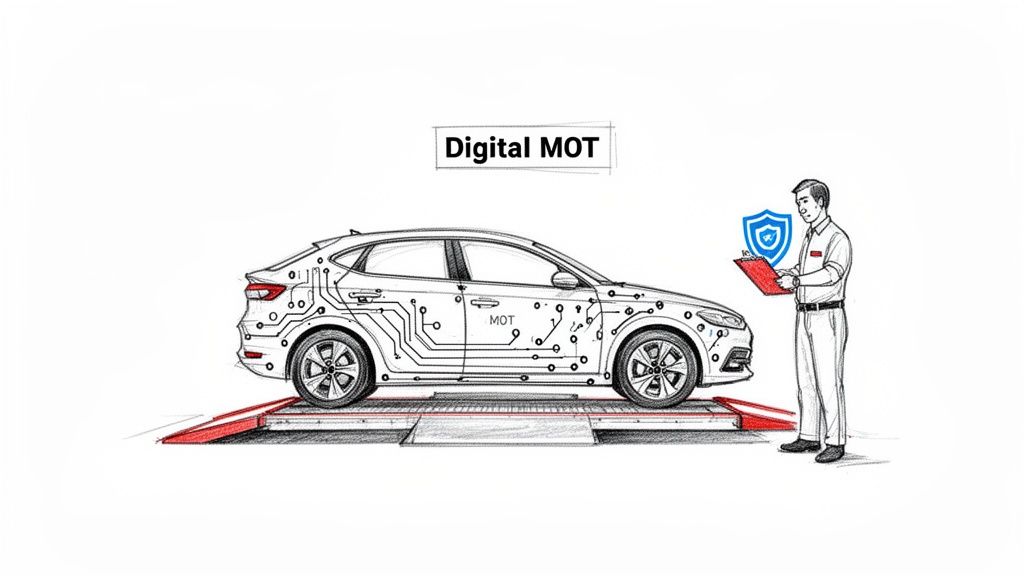
This isn’t about building an impenetrable digital fortress. Instead, it's a practical, government-endorsed framework that proves you’re protected against the vast majority of common, low-skill cyber attacks that represent the bulk of threats businesses face today.
Developed by the National Cyber Security Centre (NCSC), the framework provides a clear, achievable path for businesses to dramatically improve their cyber hygiene. It all centres on five fundamental technical controls that, when implemented correctly, create a surprisingly powerful defensive wall.
Two Levels of Assurance
The scheme is split into two distinct levels, giving you the flexibility to choose the one that best fits your business needs, supply chain requirements, and risk profile:
- Cyber Essentials (Basic): This is the foundational, self-assessed certification. Your organisation completes a detailed questionnaire to confirm you have all five controls properly implemented. It’s the essential first step on the ladder to demonstrating security best practice.
- Cyber Essentials Plus: This is a much more rigorous, independently audited certification. Here, a third-party assessor actively performs technical tests on your systems to verify that your controls are not just present, but are working as intended in a real-world scenario.
Managed by IASME, this UK government-backed scheme mandates five non-negotiable controls: firewall protection, secure device configurations, user access control, malware defence, and patch management. While certifications are on the rise—with over 13,000 badges awarded in Q1 2024 alone—fewer than 1% of the UK’s 5 million businesses currently hold one. This presents a massive opportunity for proactive companies to stand out.
You can dive deeper into these adoption trends and the scheme's impact from recent industry analysis. Ultimately, this framework isn't just a box-ticking exercise; it's a structured approach to building genuine, demonstrable cyber resilience.
Choosing Between Cyber Essentials Basic And Plus
So, which Cyber Essentials certification is the right fit for your organisation? The answer boils down to your specific security goals, client requirements, and your position in the supply chain. The two tiers—Basic and Plus—offer very different levels of assurance, and understanding that difference is key to making the right strategic decision.
Let’s use an analogy. Think of it like getting a driving licence.
Cyber Essentials Basic is the theory test. It’s a foundational, self-assessed check where you confirm that you have the five core security controls in place. You’ll work through an online questionnaire, and a certification body will review your answers. This level shows you understand the rules of the road and have the basic knowledge to keep your business safe.
Cyber Essentials Plus, on the other hand, is the full practical driving test. It covers everything in the Basic level, but with one critical difference: a hands-on technical audit from an independent expert. A certified assessor actively tests your systems to ensure your controls aren't just there on paper, but are actually working correctly and can fend off simulated attacks.
How The Verification Differs
The validation method is the single biggest difference between the two tiers. For the Basic level, the process relies on you self-attesting that you've got everything in place. For many businesses, achieving this foundational certificate is a manageable first step toward formalising their security posture. You can learn more about what the process for Cyber Essentials Basic certification entails to see if it’s a good starting point.
For Plus, the verification is a different ball game. It’s far more thorough. The assessor will run a series of live tests, which typically include:
- External vulnerability scans to spot any weaknesses visible from the internet.
- Internal scans of your computers to check that software is up-to-date and configured properly.
- Email tests where they send simulated malicious attachments to see if your defences block them.
- Web browser tests to check what happens when a user visits a known malicious website.
We've put together a table to make the key differences crystal clear.
Comparing Cyber Essentials Basic And Cyber Essentials Plus
| Feature | Cyber Essentials (Basic) | Cyber Essentials Plus |
|---|---|---|
| Assessment Type | Self-assessed questionnaire | Independent technical audit |
| Verification Method | Online submission reviewed by a certifier | Hands-on testing by a certified assessor |
| Level of Assurance | Foundational | High |
| Best For | SMEs, start-ups, meeting basic tender requirements | Organisations with higher risk, public sector contracts, handling sensitive data |
| Effort Required | Lower; primarily administrative | Higher; requires technical readiness |
This hands-on approach with Cyber Essentials Plus gives everyone—you, your clients, your partners—a much higher degree of confidence that your security measures actually work in the real world.
Cyber Essentials Plus isn't just a fancier badge; it's tangible proof that your defences have been independently stress-tested. This verified trust is often exactly what larger clients and public sector bodies require from their supply chain partners.
Ultimately, deciding between Basic and Plus is a business decision. Basic is a fantastic and affordable starting point for smaller businesses or those just beginning to formalise their security. Plus is essential for any organisation that handles sensitive data, needs to meet strict contractual demands, or wants to prove its commitment to robust cybersecurity.
The Five Controls That Protect Your Business
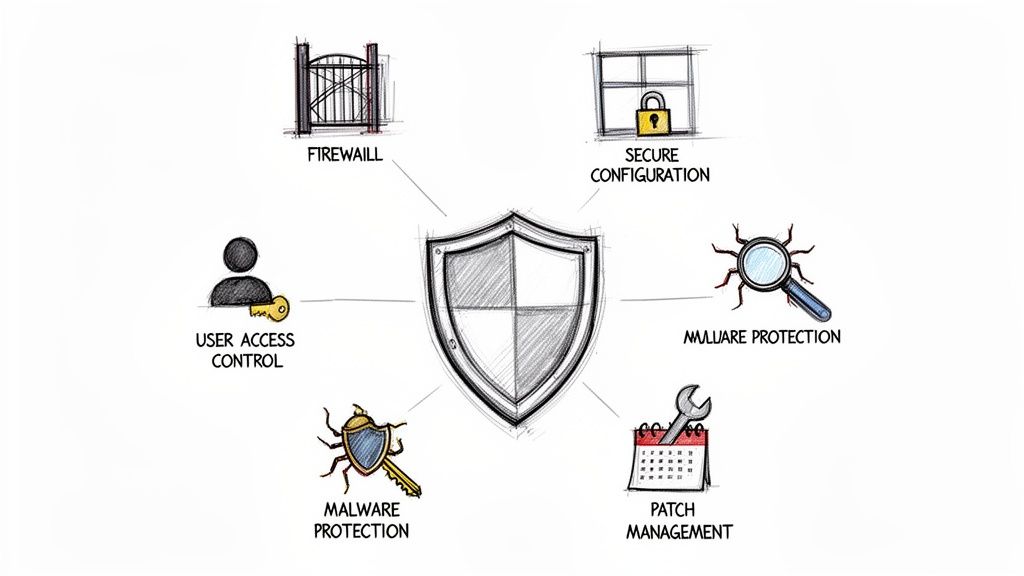
At the very heart of the Cyber Essentials certification are five fundamental technical controls. These aren't just abstract ideas; they are practical, high-impact actions designed to fend off the vast majority of common cyber attacks. Think of them not as five separate locks, but as an integrated security system for your entire business.
Get these right, and you'll neutralize threats like ransomware, phishing, and malware before they can cause serious disruption. Let's break down exactly what each control is and why it's so critical in a modern IT environment.
1. Firewalls
Imagine a firewall as the digital bouncer for your network. Its job is to stand at every internet entry point, inspecting all data trying to get in or out. Only legitimate, approved traffic is allowed past. This is your first and most essential line of defence against unsolicited connections from the internet. A properly configured firewall prevents malicious actors from scanning your network for open doors into your systems, creating a secure boundary for your business technology.
2. Secure Configuration
If the firewall is your bouncer, secure configuration is ensuring every door and window in your building is properly installed and locked from the inside. This control is about "hardening" your devices—servers, laptops, and routers—by changing default passwords, removing unnecessary software, and disabling insecure features. Many devices and software packages ship with default settings designed for ease of use, not security. Cyber Essentials mandates a systematic approach to strengthening these configurations, dramatically shrinking your attack surface.
Each of these five controls works in concert. A firewall is great, but it can't help if an employee with excessive privileges clicks a malicious link. This layered defence is what makes the framework so effective.
3. User Access Control
This control operates on the principle of least privilege. In practical terms, this means people should only have access to the data and systems they absolutely need to perform their jobs—and nothing more. It’s like giving employees specific keycards that only open the rooms they are authorised to enter, instead of a master key to the entire building. Proper user access control drastically reduces the potential damage if an account is compromised. A core part of this is clamping down on powerful administrative privileges—a central concept in modern security like a Microsoft Zero Trust implementation.
4. Malware Protection
Think of this as your company’s digital immune system. Malware protection involves using antivirus and anti-malware software to detect, isolate, and remove malicious code from your devices and network. It's your critical defence against viruses, spyware, and ransomware that can enter via email attachments, malicious downloads, or compromised websites. This isn't a "set it and forget it" task; effective protection means ensuring security software is active and constantly updated across every company device.
5. Patch Management
Finally, patch management is the ongoing maintenance that keeps your digital doors and windows secure against new threats. Software developers constantly find security vulnerabilities and release updates, or "patches," to fix them. This control requires you to apply these critical patches as quickly as possible. Attackers actively hunt for systems running outdated software with known flaws, making timely patching one of the most powerful and cost-effective ways to protect your business.
Why Certification Is A Strategic Business Move
Viewing Cyber Essentials as just another compliance certificate is a common pitfall. In reality, it’s one of the sharpest strategic moves a modern business can make, delivering tangible value that translates to new revenue streams and a significant competitive edge.
This is especially true for winning public sector work. Government departments, particularly those handling sensitive data like the Ministry of Defence, often make Cyber Essentials a non-negotiable requirement for their suppliers. Holding that certificate means you are instantly qualified for these high-value contracts—doors that would otherwise be firmly shut.
Reducing Risk and Building Trust
But the benefits extend far beyond government contracts. The certification sends a powerful signal to partners and clients in the private sector. In a world where supply chain security is a major concern, being able to prove you have mastered the basics of cyber hygiene is a massive differentiator. It tells stakeholders that you are a responsible partner who takes protecting shared data seriously.
This commitment to security has a direct impact on your bottom line, particularly when it comes to cyber insurance. Insurers see certified organisations as a much lower risk, often rewarding them with better policy terms and lower premiums. Why? Because the framework’s controls are proven to work.
The data is clear: organisations that properly implement the five core controls can block around 80% of common cyber attacks, including phishing and ransomware. It’s a simple but incredibly effective way to build a proactive defence.
The Proven Impact on Business Resilience
The positive effects are well-documented. Recent analysis shows that certified businesses suffer fewer successful breaches and, as a result, file fewer insurance claims. According to the 2025 Cyber Security Breaches Survey, while more small and medium-sized businesses are stepping up their security, critical gaps are still common—only 40% use two-factor authentication, for instance. You can discover more insights on how certification strengthens your security baseline and its proven impact.
Implementing a solid security framework isn’t just about ticking boxes; it requires a clear strategy. Expert guidance on implementing and managing tools like the Microsoft security stack helps ensure your controls are not only compliant but are properly tuned to your business operations. This transforms a simple certificate into a cornerstone of your company's long-term resilience and growth—a smart investment in your reputation, risk management, and future opportunities.
Your Path To Achieving Cyber Essentials Certification
Getting started with Cyber Essentials can feel like a major project, but it’s a logical process that can be broken down into clear, manageable stages. Understanding the roadmap from the beginning helps you align the right people and resources, and sets clear expectations for everyone involved.
Your first move is to choose an accredited Certification Body. These are independent organisations officially approved by the NCSC to assess and award the certification. Selecting the right partner is crucial, as they will guide you through the entire journey.
Preparing Your IT Environment
Once you have a partner, the real work begins with a gap analysis. This is a deep dive into your current security setup, comparing it directly against the five core controls of the Cyber Essentials framework. Think of it as creating a detailed action plan that shows you exactly where you're already compliant and, more importantly, where the gaps are. For many businesses, this step is a real eye-opener.
Following the analysis is remediation. This is where you systematically fix the identified weak spots to bring your systems up to standard. This could involve reconfiguring a firewall, patching software, or tightening user access controls. Making these technical changes requires careful planning, as a poorly executed fix can cause business disruption. This is often where structured IT support proves invaluable, ensuring everything is implemented correctly and efficiently.
The infographic below shows how this effort translates directly into tangible business wins, proving why the certification is such a smart strategic move.
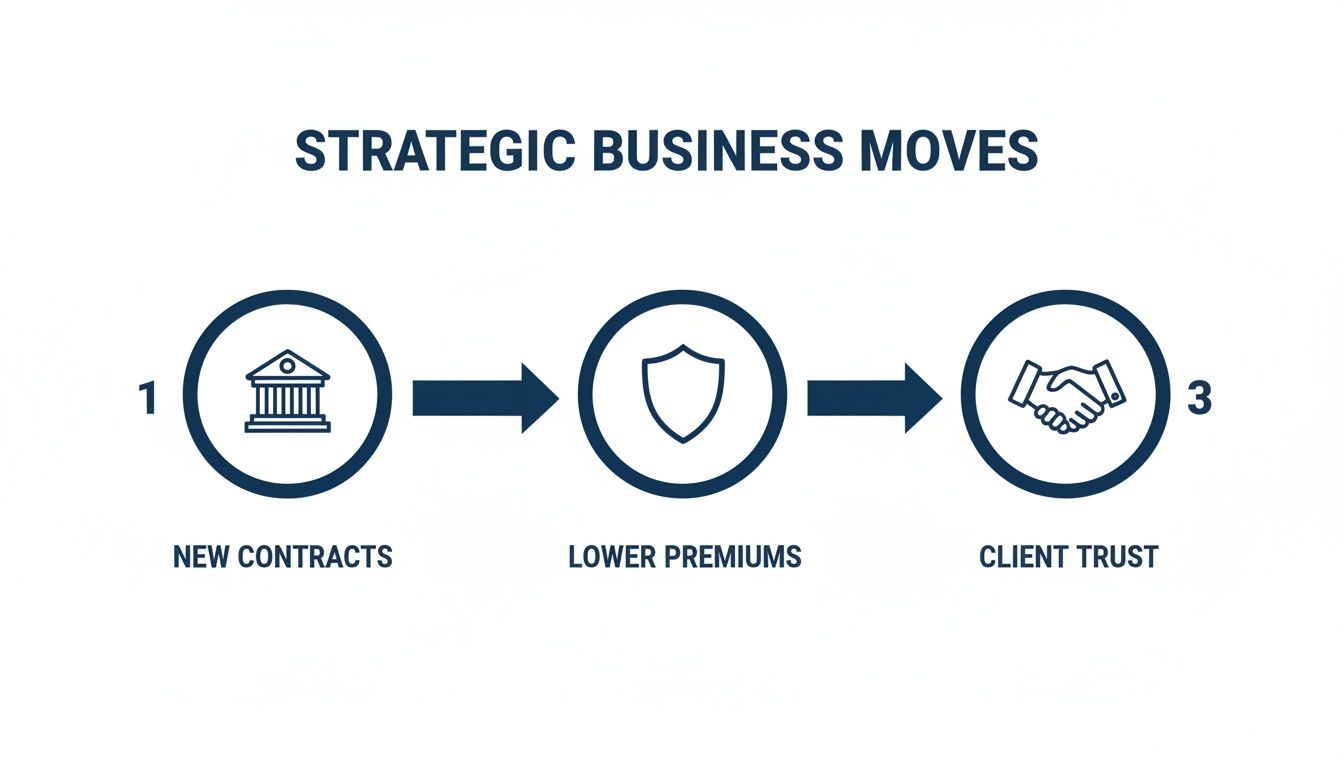
As you can see, getting certified isn't just a technical exercise; it's a direct route to winning new contracts, getting better insurance rates, and building that all-important trust with your clients.
The Assessment and Verification Process
With the preparatory work complete, you’re ready for the formal assessment. From here, the path splits depending on the certification level you're targeting:
-
For Cyber Essentials (Basic), you will complete a detailed Self-Assessment Questionnaire (SAQ). This is an online form where you confirm that you have all five controls in place across your organisation. Your chosen Certification Body then reviews your submission.
-
For Cyber Essentials Plus, the process goes much deeper. After passing the Basic assessment, you will schedule an independent technical audit. A certified assessor will then run a series of vulnerability scans on your systems, both externally and internally, to prove your controls are actually working as intended.
A common pitfall is underestimating the technical detail required for the self-assessment. Vague or inaccurate answers can lead to an automatic fail, causing delays and additional costs. Preparation is everything.
The entire journey, from initial gap analysis to having the certificate in hand, can take anywhere from a few weeks to several months. The timeline depends heavily on the complexity of your IT environment and the amount of remedial work required. Working with experienced consultants who have navigated this process many times can make a world of difference, helping you sidestep common mistakes and achieve certification far more efficiently.
Upcoming Changes To The Cyber Essentials Scheme
The world of cybersecurity moves fast, and the Cyber Essentials scheme evolves with it. To remain effective against the latest threats, the framework is regularly updated. This means your business needs to be prepared to adapt its security controls to meet new, higher standards.
A significant set of updates is on the horizon, largely driven by the shift to cloud services and modern ways of working. These aren't just minor adjustments; they represent a necessary step up to tackle today's attack methods and provide stronger protection for all.
What To Expect From April 2026
The next major update introduces stricter rules that require immediate attention. One of the biggest changes, effective from April 2026, is that multi-factor authentication (MFA) will become mandatory for all cloud services. Whether the service is free, paid, or part of another platform, a lack of MFA will mean an automatic fail. This moves MFA from a 'highly recommended' practice to a non-negotiable requirement for any assessments started after 27th April 2026.
You can dive into the full details of the upcoming changes to see exactly how they might impact your organisation.
In addition, the timeframe for applying security patches is being reduced. The new rules will demand that businesses fix high-risk vulnerabilities within just 14 days, a significant decrease from the previous window. This change directly addresses the speed at which attackers now exploit newly discovered flaws.
Being proactive is everything. If you wait until the last minute to figure out your MFA situation or check your patching process, you could easily put your certification at risk. The time to start planning for these changes is today.
These updates demonstrate the scheme's commitment to real-world security. For businesses, staying Cyber Essentials certified will demand a more hands-on and responsive approach to IT management. Obtaining expert guidance can make all the difference, ensuring your systems are not only compliant today but are prepared for future security challenges.
Your Cyber Essentials Questions Answered
Achieving certification for the first time can seem complex. To provide clarity and help you plan, we've answered the questions we hear most often from businesses preparing for the journey.
How Long Does The Certification Last?
Think of Cyber Essentials as an annual MOT for your cybersecurity. Your certificate is valid for 12 months from the date of issue.
This isn't a one-and-done activity. To maintain certification, you must undergo a fresh assessment each year. This annual renewal ensures your security measures remain effective against evolving threats, embedding good security as a continuous business practice rather than a one-off project.
What Happens If We Fail The Assessment?
First, don't panic. Failing an assessment is not the end of the road; it's a common part of the process that highlights areas for improvement.
If you don't pass the Cyber Essentials Basic assessment, you typically receive a remediation period—usually two working days—to fix the non-compliant issues and resubmit your answers at no extra charge. For Cyber Essentials Plus, the process is similar. Your assessor will provide a clear report detailing what went wrong, giving you a chance to resolve the issues before a retest.
Is This Only For UK-Based Companies?
While Cyber Essentials is a UK government scheme, it is recognised globally and is open to organisations worldwide. Any business, regardless of its location, can become certified.
Certification is particularly important if you handle data belonging to UK citizens or wish to bid on UK public sector contracts, where it is often a mandatory requirement. Holding the certificate is a powerful way to demonstrate your commitment to security to the UK market.
What Is The Typical Cost?
The cost depends on the certification level you choose, as well as the size and complexity of your organisation's IT infrastructure.
As a general guide, Cyber Essentials Basic assessment fees typically start around £300 + VAT. For Cyber Essentials Plus, the cost is higher, usually starting from £1,400 + VAT, because it includes a hands-on technical audit. It's important to remember these are just the assessment costs—they don't cover any internal remediation work required to get your systems ready.
Navigating the technical requirements for Cyber Essentials can be challenging, but ZachSys IT Solutions provides the structured IT support and strategic guidance organisations rely on to build secure, compliant, and future-ready systems. Learn more about how we can help at https://zachsys.com.