
Subtotal $0.00



Think of structured cabling as the central nervous system of your building. It’s a standardised and organised infrastructure of low-voltage cables designed to be the clean, reliable foundation for all your data, voice, and video communications. It's the physical layer that determines how well—or how poorly—your entire IT operation functions.
Unlocking Performance with a Planned Cabling Foundation
Picture a typical office IT setup: PCs, phones, servers, and Wi-Fi access points. How do they all talk to each other? In many organisations, especially those with older infrastructure, the answer is a chaotic mess of direct wires running from point A to point B. This point-to-point, or unstructured, cabling is like building a new, winding road for every single car journey in a city. It’s a recipe for a tangled, unmanageable nightmare that grinds growth to a halt and turns troubleshooting into a frustrating guessing game.
Structured cabling is the exact opposite. It's the carefully planned network of motorways, main roads, and junctions built before the city gets busy. It provides a logical, organised framework that connects everything efficiently and predictably. Instead of messy direct lines, you get a clean system of patch panels, consolidated cable runs, and wall outlets that are simple to manage, adapt, and expand.
From Chaos to Cohesion
The primary goal of structured cabling is to replace that unpredictable "spaghetti junction" of wires with something clean and cohesive. This isn't just about making the server room look tidy; it delivers real-world business benefits that directly impact your operational efficiency and bottom line. By building a reliable and forward-thinking physical network layer, you’re ensuring your business can handle more data, more devices, and more users without needing a constant, disruptive overhaul. It’s about building for the future, not just reacting to today's problems.
A well-designed structured cabling system is the unsung hero of a high-performance network. It transforms simple wires into a long-term competitive asset, ensuring reliability and scalability for years to come.
To understand why this matters for modern businesses, let's compare the two approaches side-by-side.
Structured vs Unstructured Cabling: A Quick Comparison
Understanding the fundamental differences between a planned, structured system and an ad-hoc, unstructured approach is key to appreciating its value in a real-world IT environment.
| Aspect | Structured Cabling | Unstructured (Point-to-Point) Cabling |
|---|---|---|
| Organisation | Hierarchical and organised with patch panels and central termination points. | Disorganised, direct cable runs from device to device. |
| Scalability | Easy to add new users or devices (MACs – Moves, Adds, Changes). | Difficult and costly to expand; often requires running all-new cables. |
| Troubleshooting | Simple and fast due to logical, labelled layout. Downtime is minimised. | Extremely difficult and time-consuming. Tracing a single faulty cable can take hours. |
| Performance | Consistent and reliable performance, designed to meet industry standards. | Unpredictable. Prone to errors, crosstalk, and signal degradation. |
| Cost | Higher initial investment but lower long-term operational costs. | Low initial cost but very high long-term costs for management and changes. |
| Future-Proofing | Designed to support future technologies and higher bandwidths. | Becomes obsolete quickly. Not adaptable to new network demands. |
As you can see, the initial effort to plan and install a structured system pays for itself many times over throughout the life of your network. This methodical approach brings several critical benefits:
- Simplified Troubleshooting: When a connection drops, technicians can quickly isolate the problem within a logical, labelled system. This drastically cuts down on expensive downtime, turning what could be a multi-hour fault-finding mission into a quick fix.
- Enhanced Scalability: Need to add a new employee, a printer, or even an entire department? The process is straightforward. The underlying infrastructure is already there, making moves, adds, and changes simple and cost-effective.
- Future-Ready Design: A system installed today with high-quality components (like Cat6a cabling) is built to support the network speeds and technologies of tomorrow. It's an investment that can protect your business for 10-15 years or more.
Ultimately, understanding what structured cabling is serves as the first step toward building a truly robust physical network. A professionally designed installation, often delivered through expert structured networking services, ensures your business can grow without hitting digital roadblocks.
Exploring the Six Core Subsystems of Network Cabling
To truly grasp what structured cabling is, you can't think of it as just a bundle of wires. It’s a highly organised system, much like a national delivery service, composed of six distinct subsystems working in concert. Each part has a specific role in getting data from point A to point B quickly and reliably.
Getting this structure right is the difference between a network that just functions and one that actively fuels your business growth. This methodical, component-based approach is what makes the entire system so manageable and expandable. Let’s break down each of these six core components, following the path data takes from the moment it enters your building to when it arrives at a user's device.
1. Entrance Facility (EF)
The journey begins at the Entrance Facility. This is the secure, designated location where external services—like your internet provider's fibre optic line—physically enter your building. It contains the 'demarcation point', which is the official handover from their network to yours.
Think of it as your building's main postal sorting office. All incoming data arrives here first before being routed internally. The EF houses the essential connection hardware and protective equipment needed to safely link external services to your internal network.
2. Equipment Room (ER)
From the Entrance Facility, data is typically routed directly to the Equipment Room. This is the nerve centre of your entire IT operation, housing critical hardware like servers, core network switches, and phone systems (PBX).
Because this room contains your most vital and shared technology, it is a secure, climate-controlled space designed to keep everything running at peak performance while providing necessary access for your IT team. It is the brain of your network.
3. Backbone Cabling
Also known as vertical cabling, the Backbone Cabling acts as the high-speed information motorway connecting your main network hubs. It links the Equipment Room to other key areas, such as different floors in a building or separate buildings across a campus.
These connections are almost always high-capacity fibre optic cables, built to handle massive amounts of data traffic. Just as a motorway connects major cities, the backbone connects your central Equipment Room to smaller, local distribution points.
4. Telecommunications Room (TR)
A Telecommunications Room (or TR) is a smaller, localised hub you'll find on each floor or within a specific department. It serves as the crucial link between the high-speed backbone and the horizontal cabling that branches out to individual desks.
Inside a TR, you'll find equipment like network switches and patch panels that distribute the connection to all the users in that specific area.
A well-organised Telecommunications Room is crucial for simplifying day-to-day network management. By centralising connections for a specific floor or area, it makes troubleshooting and adding new users significantly faster and less disruptive.
5. Horizontal Cabling
If the backbone is the motorway, then Horizontal Cabling is the network of local A-roads and streets branching off it. These cables run from the Telecommunications Room out to the individual sockets in the work area.
This is usually the most extensive part of the system, composed of copper cables (like Cat6 or Cat6a) that run through ceilings and walls to connect to faceplates at each desk. Getting this part right is absolutely critical for ensuring a strong, reliable signal for every user.
The diagram below illustrates how these subsystems create a clear hierarchy, starting from a central foundation and branching out to support every device your business relies on.
This visualises how the central server infrastructure provides the core connectivity that ultimately powers everything from PCs and phones to your wireless network.
6. Work Area (WA)
Finally, we arrive at the Work Area. This is where the network meets the end-user. It encompasses everything from the wall socket to the user’s device—including the patch cables connecting a computer to the wall and any other equipment needed to get online. It's the final stop on the data's journey and the most visible part of the entire system.
This subsystem-based approach is far more than just a neat way to organise wires. Each component plays a vital role in creating a robust, scalable, and manageable network. Let's summarise their functions.
The Six Subsystems of a Structured Cabling System
| Subsystem | Primary Function | Common Components |
|---|---|---|
| Entrance Facility (EF) | Securely connects your building's network to external service providers. | Demarcation point, network interface devices, surge protectors. |
| Equipment Room (ER) | Houses and protects the core network hardware and servers. | Servers, core switches, routers, PBX systems, uninterruptible power supplies (UPS). |
| Backbone Cabling | Provides high-speed connections between major network hubs (like the ER and TRs). | High-count fibre optic cables, multi-pair copper cables. |
| Telecommunications Room (TR) | Connects the backbone cabling to the horizontal cabling for a specific area. | Network switches, patch panels, cross-connects. |
| Horizontal Cabling | Runs cables from the TR to individual outlets in the work areas. | Cat6/Cat6a copper cables, conduits, cable trays. |
| Work Area (WA) | Connects the end-user's device to the network via a wall outlet. | Wall outlets (faceplates), patch cables, adapters. |
In the UK, this standards-based approach is the foundation for everything: data, voice calls, CCTV, Wi-Fi, and even access control systems. Instead of running a new, messy cable every time you add a device, structured cabling provides a unified copper and fibre hierarchy designed to support multiple IT systems for 10–15 years.
Its importance is only growing. The UK structured cabling market is forecast to expand from about USD 761.7 million in the mid‑2020s to roughly USD 1.4 billion by 2035. You can explore more data on UK structured cabling market trends to see the full analysis.
Choosing Your Components: Cables, Standards, and Design
Once you understand the subsystems, the next step is choosing the right building blocks for your network's foundation. This isn't just about grabbing a box of cables. Selecting the right components, adhering to proven industry standards, and mapping out a smart design are strategic decisions that directly impact your network's speed, reliability, and future scalability.
Getting this part right helps you avoid the massive headaches and costs of ripping everything out and starting again in just a few years.
The components you select will define the performance of your entire IT operation. This requires asking practical questions about how your business operates. For instance, are you running data-hungry applications like 4K video conferencing, or just standard office software? The answer helps determine whether traditional copper is sufficient or if you need to step up to high-speed fibre.
Copper Cabling: Cat6 vs. Cat6a
For most of the connections running from a communications room to individual desks—what we call horizontal cabling—twisted-pair copper cables are the undisputed workhorse. In a real-world IT environment, the decision usually comes down to two main contenders:
-
Category 6 (Cat6): A perfectly solid choice for many businesses. It can handle network speeds up to 10 Gigabits per second (Gbps), but only over shorter distances (typically up to 55 metres). It's a reliable and cost-effective option for typical office setups with predictable data needs.
-
Category 6a (Cat6a): The 'a' stands for 'augmented', and it delivers a significant performance boost. Cat6a is built to handle 10 Gbps speeds across the full 100-metre distance allowed by industry standards. It also features better shielding to combat interference, making it the superior choice for busy offices or for future-proofing your network for next-generation Wi-Fi and power-hungry PoE (Power over Ethernet) devices.
When to Use Fibre Optic Cabling
While copper is ideal for the final stretch to the desk, fibre optic cabling is the undisputed champion for high-speed, long-distance data transmission. It sends data as pulses of light, which means it’s completely immune to electrical interference and can carry massive amounts of information over kilometres without signal degradation.
Think of fibre optics as the motorways of your cabling system. They're essential for linking buildings across a campus, connecting floors in a tall office block, or just making sure your core network can handle the traffic from hundreds of users without breaking a sweat.
There are different types of fibre, and the right one depends on distance and bandwidth requirements. A deep dive into dedicated fibre optic services can help pinpoint the best solution for your specific infrastructure goals.
To make sense of the choices, it helps to see how common copper and fibre options compare.
Copper vs Fibre Optic Cabling At a Glance
| Cable Type | Typical Use Case | Maximum Bandwidth | Relative Cost |
|---|---|---|---|
| Cat6 | General office use, VoIP phones, PCs | 10 Gbps (up to 55m) | £ |
| Cat6a | High-performance workstations, Wi-Fi 6/7 | 10 Gbps (up to 100m) | ££ |
| Multimode Fibre | Backbone links within a building, data centres | 100+ Gbps | £££ |
| Singlemode Fibre | Links between buildings, long-haul connections | Terabits per second | ££££ |
This table provides a high-level view, but the best choice always comes down to a detailed analysis of your unique business requirements, future growth plans, and budget.
The Importance of Industry Standards and Design
A structured cabling system's reliability doesn't just come from good cables; it comes from following globally recognised standards. Bodies like the Telecommunications Industry Association (TIA) and the International Organisation for Standardisation (ISO) publish detailed guides covering everything from cable performance specifications to correct installation methods.
These aren't just arbitrary rules. They are your guarantee of:
- Performance: Ensuring that a Cat6a cable from any brand performs exactly as it should.
- Interoperability: Making sure components from different manufacturers will work together seamlessly.
- Longevity: Providing a framework that ensures your network can support today's technologies and whatever comes next.
When it comes to the design blueprint, modern networks almost exclusively use a star topology. Picture your main network switch as the centre of a hub. A dedicated cable—a spoke—runs from that hub directly to each device, like a PC, phone, or Wi-Fi access point.
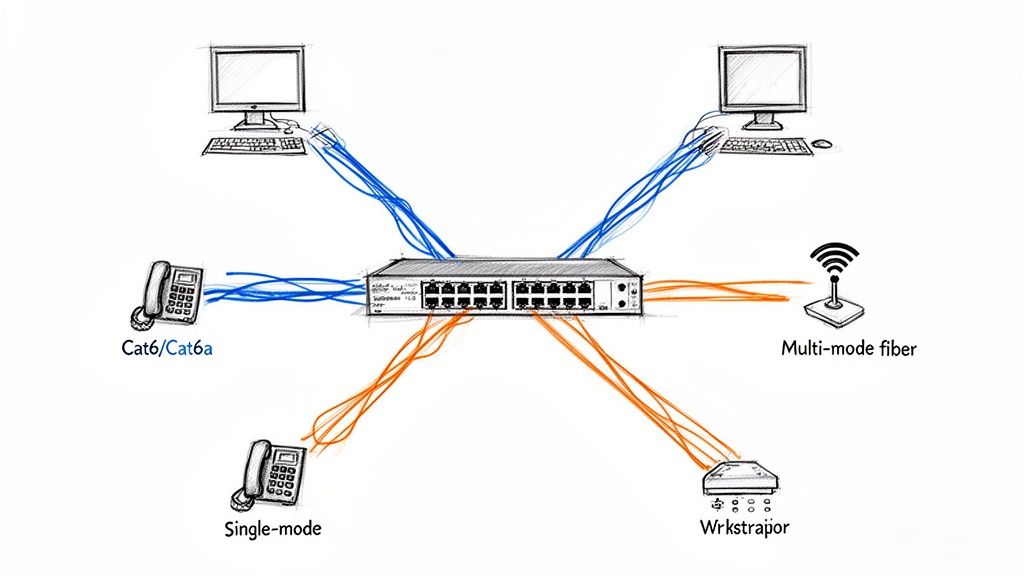
This simple, elegant design is incredibly robust. If one "spoke" breaks, it only affects that single device; the rest of the network continues to operate without interruption. This makes finding and fixing problems much faster and less disruptive.
Let's move past the technical specifications. The real conversation about structured cabling is about the strategic value it brings to your business. When you invest in a professional, organised system, you're not just buying cables and ports; you're making a foundational decision that pays dividends in efficiency, reliability, and future growth.
Think of it as a direct investment in your company's operational resilience.
Slash Downtime and Free Up Your IT Team
The most immediate benefit is felt by your IT team. In a messy, unstructured setup, a single faulty connection can trigger a full-blown investigation, with technicians spending hours crawling through ceilings trying to trace one tangled wire. It's a massive waste of skilled time and a huge source of frustration.
A structured system, with its logical layout and clear labelling, completely changes the game.
Troubleshooting is reduced from hours to minutes. This frees up your valuable technical experts to focus on strategic projects that move the business forward, instead of constantly firefighting connectivity issues. That efficiency gain directly impacts your bottom line by minimising expensive downtime and keeping everyone productive.
Build a Foundation for Seamless Growth
Your business is always evolving. You hire new people, reconfigure departments, and adopt new technologies. A structured cabling system is designed from the ground up to handle this constant change.
Imagine you need to add a new team of ten people. With an organised infrastructure, the network points are already in place, tested, and ready to go. The entire process of moves, adds, and changes (MACs) becomes a simple, predictable task, not a disruptive and costly rewiring project. This means your physical infrastructure will never be the bottleneck holding back your growth.
A well-planned cabling system doesn't just solve today's problems—it anticipates tomorrow's. It gives you the capacity to easily integrate new technologies like Power over Ethernet (PoE) lighting, advanced CCTV, and IoT sensors without needing to rip everything out and start again.
This future-readiness is about more than just adding desks. It’s about building a platform that can support the next generation of business tools, ensuring your initial investment continues to deliver value for a decade or more.
Boost Your Network Reliability and Performance
In today's digital-first world, a slow or unreliable network is a serious business liability. Dropped video calls, crawling cloud applications, and patchy Wi-Fi don't just frustrate your staff; they can damage your reputation with customers. Structured cabling addresses this problem at its source.
By adhering to strict industry standards, using high-quality components, and ensuring professional installation, a structured system delivers consistent, high-speed connectivity. It eliminates the signal loss, interference, and random dropouts that plague messy, ad-hoc wiring. The result is a stable, predictable network that can easily handle the demands of:
- High-density Wi-Fi: Supporting hundreds of wireless devices without grinding to a halt.
- Cloud-based applications: Giving you fast, reliable access to critical platforms like Microsoft Azure.
- Unified Communications: Delivering crystal-clear VoIP calls and smooth video conferences.
This level of reliability is non-negotiable as UK businesses become increasingly dependent on digital tools. The demand for structured cabling is growing, driven by this shift to data-heavy services. One Europe-wide study values the structured cabling market at around USD 3.6 billion, with projections hitting roughly USD 5.5 billion by 2030.
For businesses adopting modern security frameworks like Zero Trust, the physical layer becomes even more critical. A properly designed system using Category 6A or fibre optic cable can support multi-gigabit speeds and high-power PoE devices for years to come, saving you from disruptive "rip-and-replace" projects down the line. To get the full picture, you can discover more insights about the European structured cabling market.
Ultimately, a professionally installed structured cabling system is a strategic asset. It's the invisible backbone that supports your operational efficiency, enables sustainable growth, and delivers the rock-solid performance your business needs to thrive.
Planning and Installation Best Practices
A high-performance structured cabling system doesn't happen by accident. It is the direct result of meticulous planning and professional installation. While the quality of your cables and components is vital, how they are deployed is what truly separates a reliable network from a future liability. This is where experience-driven best practices turn a good design into a rock-solid, long-term asset.
The process begins long before the first cable is pulled. A thorough needs assessment is the critical first step. This isn't just about your current requirements for data, voice, and power; it's about looking to the future. How many employees do you anticipate having in five years? What new technologies, like advanced Wi-Fi or IoT sensors, are on your roadmap?
Answering these questions allows you to strategically future-proof your investment. For instance, installing spare cables to key areas during the initial fit-out costs marginally more but can save thousands of pounds later. It helps you avoid the disruptive and expensive process of opening up walls and ceilings just to add one or two new connections down the line.
Core Principles of a Professional Installation
Executing the plan requires discipline and strict adherence to industry standards. Common pitfalls at this stage can cripple the performance of the entire system, turning a significant investment into a source of constant frustration. Here are some non-negotiable best practices:
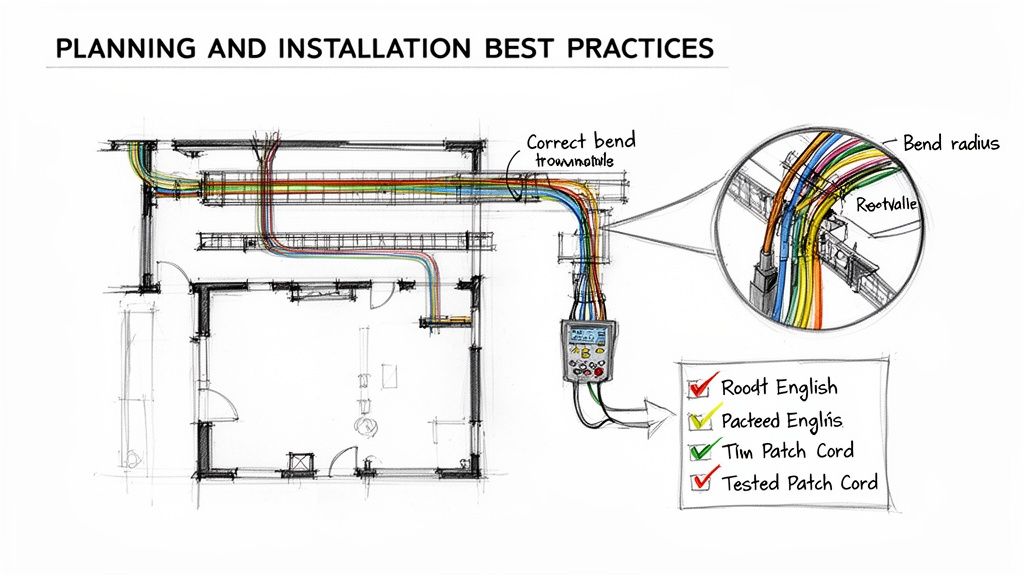
- Proper Cable Routing: Data cables are sensitive to electromagnetic interference (EMI) from sources like power lines, fluorescent lights, and large motors. Professionals maintain a safe distance between data and electrical cables and use shielded cabling in high-interference zones to protect signal integrity.
- Meticulous Labelling: Every single cable, port, and patch panel must be clearly and logically labelled at both ends. This seemingly small detail is an absolute lifesaver for your IT team, slashing troubleshooting time from hours of painful guesswork to mere minutes of targeted work.
- Adherence to Bend Radius: Every cable has a specified minimum bend radius. Violating this by pulling cables too tightly around corners can damage the internal conductors, leading to signal degradation and intermittent faults that are notoriously difficult to diagnose.
A professional installation is defined by its attention to detail. It’s the difference between a system that merely functions and one that performs reliably under pressure for over a decade, adapting to new demands without requiring a complete overhaul.
Certified Testing Guarantees Performance
Once the last cable is in place, the job is not finished. The final, non-negotiable step is comprehensive testing and certification. Using specialised equipment, every single link in the new system is tested against strict performance standards (like those from the TIA/EIA). This process verifies that each connection meets the required specifications for bandwidth and reliability.
This certification provides a documented guarantee that your network will perform exactly as expected. It confirms there are no physical faults from the installation process and gives you a vital baseline for future network health checks. It’s the ultimate quality assurance that your infrastructure is ready to support your business operations.
A clear understanding of your requirements, including the demands of high-density wireless networks, is essential. Expert guidance on enterprise Wi-Fi solutions can help ensure your physical cabling infrastructure is perfectly aligned with your wireless performance goals. Without this final testing step, you are essentially flying blind, hoping that everything was installed correctly.
Laying the Groundwork for Tomorrow's Business
So, what is the key takeaway? Structured cabling is far more than just a collection of wires. It’s the very bedrock upon which your entire digital operation is built.
We've explored how its organised, standards-based approach brings reliability and makes future growth straightforward. By understanding its core components and business value, you can move beyond seeing your network as a tangled mess and recognise it as a powerful asset that enables cloud adoption, digital innovation, and operational resilience.
The final message is clear: investing in a professionally designed and installed cabling infrastructure is one of the smartest, most impactful decisions you can make for the long-term health and agility of your business.
This foundational layer is what determines whether your network can handle tomorrow's demands for higher speeds, more devices, and seamless connectivity. It's an investment in predictable performance and operational stability.
Getting this right isn't a DIY job. Success almost always involves partnering with experienced IT consultants who can translate your business goals into a solid, future-ready network foundation. Their strategic guidance ensures your physical infrastructure is perfectly aligned with where you're headed, preventing frustrating bottlenecks and making sure your technology is a competitive advantage, not a constraint. That is the key to building a resilient, high-performance IT environment.
Your Structured Cabling Questions, Answered
Even when the benefits are clear, it’s only natural to have practical questions before starting a structured cabling project. Here are some of the most common queries from organisations planning to upgrade their network infrastructure.
How Long Does a Structured Cabling System Last?
A professionally installed structured cabling system should be viewed as a long-term asset for your building. When high-quality components are used, the physical infrastructure is built to last for 15-20 years or more, easily outliving multiple generations of network hardware.
While you might refresh active equipment like network switches every 5-7 years, the cables within the walls and ceilings remain a constant. For instance, installing Category 6a (Cat6a) cable today provides a solid foundation for future multi-gigabit speeds that are not yet standard. It’s a practical way to protect your investment for years to come.
Can I Install Structured Cabling Myself?
Technically, anyone can run a cable from point A to point B, but this is strongly discouraged for any business-critical environment. Professional installers bring specialised tools for terminating and testing every connection. More importantly, they possess a deep understanding of TIA/EIA standards, local building codes, and can provide certified performance reports backed by warranties.
A DIY installation often leads to hidden performance issues, potential safety hazards, and can quickly become a costly, frustrating troubleshooting nightmare. A certified installer ensures your system works exactly as it should from day one.
How Much Does Structured Cabling Cost?
There's no single price tag for a structured cabling installation; the cost varies significantly based on a few key factors.
Here’s what drives the cost:
- Cable Type: Your choice between Cat6, Cat6a, or fibre optic cabling is a major factor in material costs.
- Number of Drops: The total number of individual network outlets (drops) you need is a primary cost driver, often priced on a per-drop basis.
- Building Complexity: The layout of your space—such as wall construction and ceiling access—directly impacts the amount of labour required.
- Labour Rates: The cost of skilled technicians in your geographical area will also influence the final price.
Although it’s an upfront investment, its long lifespan and rock-solid reliability deliver an excellent return by eliminating the constant hidden costs of managing and fixing a messy, unplanned network.
A well-designed physical network is the essential foundation for any modern business. At ZachSys IT Solutions, we provide the strategic guidance and structured IT support that organisations rely on to build scalable, secure, and future-ready systems.
Book a free consultation today to discuss building the right foundation for your business. Learn more at https://zachsys.com.