
Subtotal $0.00



When you hear about the SD WAN benefits, the conversation usually centres on big wins like significant cost savings, noticeably better application performance, and a much tighter security posture. But beyond the buzzwords, SD-WAN is a foundational technology that addresses a core challenge: it transforms rigid, outdated networks into agile, intelligent, and secure systems built for how businesses actually operate today—in the cloud.
Why Traditional Networks Are Hitting a Wall
For decades, the standard for connecting offices was Multi-Protocol Label Switching (MPLS). It was the gold standard for reliability, creating a private, high-speed motorway for data to travel between a branch office and a central data centre. This model was perfectly suited for an era when all of your critical applications and data resided in one secure, on-premise location.
But that's not the reality of modern IT. Today, your operations are distributed. Your critical applications aren't just in your headquarters; they're hosted in the cloud with providers like Azure and AWS. Your teams collaborate using SaaS platforms like Microsoft 365, and your staff are working from anywhere and everywhere.
This fundamental shift has turned the old strengths of MPLS into serious operational weaknesses.

The Breaking Point for Legacy Infrastructure
Consider the data journey in a traditional setup: all traffic from remote staff and branch offices must take an inefficient detour back to a central office just to access a cloud application. This routing problem, known in the field as "hairpinning," creates tangible business challenges:
- Performance Bottlenecks: This unnecessary detour introduces significant latency. The real-world result is slow-loading applications and a frustrating experience for both employees and customers.
- Escalating Costs: MPLS circuits are notoriously expensive and inflexible. As your bandwidth demands explode with cloud apps and video conferencing, the costs can quickly become unsustainable.
- Security Gaps: Attempting to secure a distributed workforce and cloud applications from a single central point is no longer effective. It creates a complex and brittle security perimeter that is difficult to manage and defend.
In essence, traditional WANs were engineered for a centralised world that no longer exists. They are inflexible, costly, and ill-suited for the dynamic, cloud-first traffic patterns of a modern organisation. This reality is forcing IT leaders to rethink their network architecture from the ground up.
This is the precise challenge SD-WAN was designed to solve. It's not a simple incremental upgrade; it represents a new architectural approach. SD-WAN functions as an intelligent, software-driven overlay that can manage multiple connection types—from business broadband and fibre to 5G. This strategy transforms rigid, outdated networks into agile, secure, and cost-effective systems prepared for future demands.
Understanding these foundational issues is the first step in building a resilient and modern network, a process often guided by experts in structured networking. Now, let's explore the tangible SD WAN benefits this architectural shift delivers.
Boosting Application Performance and User Experience
Slow, unresponsive applications are more than just an annoyance; they directly impact productivity and staff morale. One of the most immediate benefits organisations experience after adopting SD-WAN is how much faster and more reliable their critical business tools become. It directly addresses the network latency that often plagues legacy setups.
This performance improvement is driven by a core feature called dynamic path selection. Imagine your business has several internet connections: a primary fibre line, a backup broadband connection, and perhaps a 5G wireless link for resiliency. A traditional network would typically use only the main line, leaving the others idle until a complete failure occurs.
SD-WAN, in contrast, actively monitors all of these paths. It continuously measures key health metrics like latency, jitter, and packet loss on every available connection in real-time. This awareness enables it to make intelligent, sub-second decisions about the optimal route for your data at any given moment.
Making Smart Choices with Application-Aware Routing
This is where the technology's intelligence truly shines. SD-WAN doesn't just see a stream of undifferentiated data; it understands what that data is. This capability is known as application-aware routing.
You can implement business-driven policies that instruct the system on which applications are most critical. It can differentiate between a high-priority video conference that is sensitive to delay and a low-priority data synchronisation running in the background.
Let's consider a practical, real-world scenario:
- A Critical Teams Call: Your finance team is conducting a crucial video call. SD-WAN immediately identifies this traffic as real-time voice and video, which is highly sensitive to latency. It automatically steers that call onto the highest-quality, lowest-latency connection available, ensuring the conversation remains crystal clear.
- A Non-Urgent Backup: Simultaneously, a large data backup to a cloud server kicks off. SD-WAN recognises this as bulk data that is not time-sensitive. It can direct this traffic over a secondary broadband connection, ensuring the backup completes without disrupting the more critical Teams call.
This intelligent traffic management ensures your most important business functions are never compromised by less critical background tasks. The network dynamically adapts to ensure every application receives the performance it needs.
By intelligently prioritising traffic, SD-WAN enables organisations to move from a reactive, "one-size-fits-all" network model to a proactive, business-driven approach. It ensures the network serves the applications, not the other way around.
Delivering a Better Experience for Cloud and Remote Users
This performance enhancement is vital in today's cloud-centric environment. If your business relies on platforms like Azure Virtual Desktop for remote workers or SaaS tools like Microsoft 365, that connection must be direct and efficient.
SD-WAN resolves the "hairpinning" problem by enabling branch offices to connect securely and directly to the internet. This means traffic destined for a trusted cloud provider like Azure or AWS no longer takes a long, slow detour through a central data centre. It goes directly where it needs to be, dramatically reducing latency and improving application responsiveness.
The end result is a consistently superior user experience, which translates directly into tangible business value:
- Higher Employee Productivity: Your team spends less time waiting for applications to load and more time on value-adding work.
- Improved Customer Satisfaction: When your internal systems are fast and reliable, you can provide better, quicker service to your customers.
- Enhanced Collaboration: Smooth, jitter-free voice and video calls make communication between distributed teams seamless and effective.
Ultimately, by ensuring every application performs optimally for every user, regardless of their location, SD-WAN transforms the network from a potential bottleneck into a powerful business enabler. Achieving this requires careful planning and strategic guidance to align network policies with specific business objectives.
Driving Significant Cost Savings and Efficiency
While improved performance delivers an immediate and visible win, the long-term financial case for SD-WAN is often what solidifies the business decision. Modernising your network isn't just a technical upgrade; it's a strategic financial move that can deliver a powerful return on investment by addressing the high costs and operational inefficiencies of legacy networks.
Slashing High-Cost Connectivity Bills
The most direct and significant saving comes from reducing dependency on expensive and rigid MPLS circuits. For years, businesses paid a premium for the guaranteed reliability of these private connections. SD-WAN fundamentally changes this economic model. It allows you to blend more affordable transport options—like business broadband, fibre, and even 5G—without compromising on performance or security.
This "transport independence" means your network is intelligent enough to use the most cost-effective path for any given task. This capability immediately unlocks substantial savings on your connectivity expenditure.
The table below contrasts the financial and management differences between the old and new networking paradigms.
Traditional WAN vs SD-WAN Cost and Management Comparison
This table compares the key financial and operational differences between a legacy MPLS-based WAN and a modern SD-WAN architecture, highlighting areas of significant cost savings and efficiency gains.
| Aspect | Traditional WAN (MPLS) | Modern SD-WAN |
|---|---|---|
| Circuit Costs | High monthly fees for private, dedicated MPLS circuits. | Lower costs by using a mix of affordable broadband, fibre, and 5G. |
| Bandwidth Utilisation | Inefficient. Expensive backup links often sit idle until a failure. | Active-active use of all connections, maximising value from all paid-for circuits. |
| Management | Manual, device-by-device configuration. Requires on-site engineers for changes. | Centralised, "single pane of glass" management for all locations. |
| Deployment Time | Slow and complex. New sites can take weeks or months to bring online. | Rapid, often zero-touch provisioning for new branches, cutting deployment time. |
| IT Overhead | High operational costs due to manual monitoring, troubleshooting, and updates. | Drastically reduced overhead through automation and centralised control. |
| Scalability | Rigid and expensive to scale. Adding bandwidth or sites is a major project. | Flexible and cost-effective. Easily scales to meet changing business needs. |
As illustrated, the impact extends beyond your monthly circuit invoice; it fundamentally changes the operational effort required to manage your network.
Reducing the Operational Burden
Beyond direct circuit costs, SD-WAN dramatically reduces the day-to-day workload on your IT team. With a traditional network, managing multiple branch offices is a painstakingly manual process. Every router update, policy change, or security patch requires an engineer to log into each device individually—a process that is slow, costly, and prone to human error.
SD-WAN replaces this fragmented approach with a single, centralised management console. From one dashboard, your team can deploy policies, monitor network health, and resolve issues across the entire organisation. This frees your skilled IT professionals from repetitive tasks, allowing them to focus on strategic initiatives that drive the business forward.
The diagram below illustrates how SD-WAN intelligently prioritises applications, ensuring cost-effective bandwidth is used efficiently to maintain optimal performance.
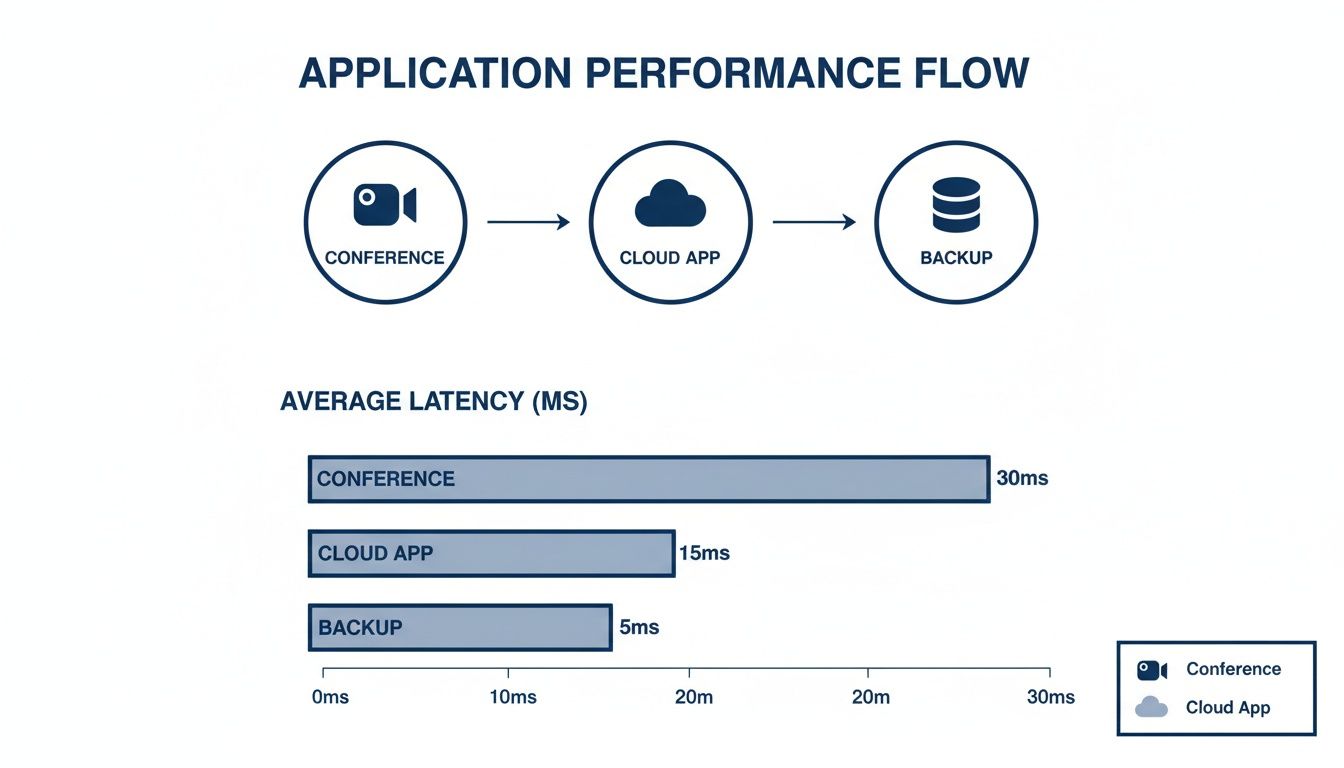
This intelligent routing means you can often reduce total bandwidth spend while providing users with a superior experience on the applications that matter most.
Maximising Value from Your Bandwidth
Another key efficiency gain comes from more intelligent bandwidth utilisation. Instead of paying for expensive backup lines that sit dormant, SD-WAN actively uses all available connections. It can load-balance traffic across multiple links or dedicate specific paths to certain applications, ensuring you derive maximum value from the circuits you pay for.
This means your network can handle the growing demands of cloud applications and video conferencing without constant, costly bandwidth upgrades. The result is a more resilient, efficient network that costs less to operate.
For many small and mid-sized businesses, this is a game-changer. Organisations are finding that SD-WAN can reduce their WAN costs by up to 50% while simultaneously improving application performance. It's an ideal fit for businesses upgrading legacy systems or deploying tools like Microsoft 365. In fact, recent data shows 40% of SMEs now invest in SD-WAN specifically to reduce operational costs and enhance connectivity, a trend rapidly growing in retail and professional services. You can explore more data on this trend in European markets to see the broader picture.
By combining lower circuit costs with a reduced operational workload and optimised bandwidth, SD-WAN presents a clear and compelling financial argument. It transitions network expenditure from a rigid capital expense to a more flexible and efficient operational model.
This is not theoretical; it's a tangible impact on the bottom line. Businesses that successfully make the transition find they can reallocate a significant portion of their budget from simply "keeping the lights on" to funding genuine innovation.
Of course, realising these results depends on proper planning and execution. The initial design and migration must be strategically sound to ensure security policies are robust and traffic is prioritised correctly. This is where structured IT support becomes invaluable, providing the expertise to build a secure, scalable foundation that maximises ROI from the start.
Building a Modern and Integrated Security Foundation
In an era of distributed teams and cloud applications, the traditional approach of bolting security onto the network as an afterthought is no longer viable. A modern network requires security to be woven into its very fabric. This is where one of the most powerful SD‑WAN benefits emerges—it creates an intelligent, secure foundation that protects your data from the branch office all the way to the cloud.
Legacy networks typically relied on a hardened perimeter at the central data centre. But with staff now accessing cloud applications directly from anywhere, that perimeter has effectively dissolved. SD‑WAN addresses this challenge by embedding security functions directly into the network itself, ensuring consistent protection regardless of where your users or data are located.

This deep integration allows you to enforce the same robust security policies across every location, from your headquarters to a small retail branch or a remote employee's home office. It's a unified approach that closes the dangerous security gaps left by a patchwork of disparate tools.
Core Security Features Baked In
Modern SD‑WAN platforms are far more than just efficient traffic routers; they are powerful security engines. They are equipped with a suite of essential security features that work in concert to create layered defences for your entire network.
These core capabilities typically include:
- End-to-End Encryption: All data traversing the SD‑WAN fabric is automatically encrypted, shielding sensitive information from interception as it travels over public internet links.
- Next-Generation Firewall (NGFW): Integrated NGFW capabilities enable deep packet inspection and application-aware policy enforcement, giving you granular control over traffic.
- Intrusion Prevention Systems (IPS): These systems actively scan network traffic for suspicious activity and known threats, automatically blocking malicious traffic before it can cause damage.
By consolidating these functions onto a single platform, you not only strengthen your security posture but also dramatically simplify its management. This is a significant advantage for organisations pursuing certifications like Cyber Essentials, where demonstrating consistent security controls is paramount.
A Springboard for Modern Security Frameworks
Perhaps the greatest security advantage of SD‑WAN is how it paves the way for modern, forward-thinking security architectures. It provides the essential network foundation needed to effectively implement frameworks like Zero Trust and Secure Access Service Edge (SASE).
SD‑WAN’s ability to see and control application traffic with such granularity makes it the perfect launchpad for a Zero Trust security model. This is where no user or device is trusted by default, and access is granted on a strict, least-privilege basis.
This natural alignment is what's driving the market. For instance, BT's recent launch of a Fortinet-powered secure SD‑WAN service, complete with integrated SSE capabilities, highlights a major trend in the UK. It demonstrates an industry-wide shift towards solutions that create a seamless path to a full SASE architecture—a model that works hand-in-glove with structured frameworks like Cyber Essentials.
This convergence of networking and security is precisely what our guide on Global Secure Access (SSE) explores in greater detail. SD‑WAN's integrated approach enables you to implement concepts like micro-segmentation, which isolates different parts of your network to contain a threat and prevent lateral movement if a breach occurs.
Ultimately, SD‑WAN shifts security from a static, location-based defence to a dynamic, identity-driven one. It ensures your security policies follow your users and your data, wherever they go. However, designing and implementing such a secure architecture demands real expertise to ensure policies are correctly configured and aligned with business risk. This is where structured IT support is key to building a truly resilient and future-ready defensive posture.
Simplifying Network Management and Visibility
Complexity is the enemy of both efficiency and security. In a traditional WAN, managing dozens of sites felt like spinning plates. IT teams had to manually configure, monitor, and troubleshoot each device separately—a process that was as inefficient as it was frustrating. One of the most significant operational wins with SD-WAN is how it dismantles this complexity, bringing your entire network under a single, unified command centre.
This is achieved through a centralised management console, often referred to as a ‘single pane of glass’. Instead of juggling multiple tools and command-line interfaces, your IT team gains a clear, intuitive dashboard. From this one screen, they can see the real-time health of every connection, deploy new security policies across the entire organisation, and identify potential issues long before users are impacted.

This centralised control model is a true game-changer for day-to-day operations. It transforms network administration from a reactive, fire-fighting chore into a proactive, strategic function.
Accelerating Growth with Zero-Touch Provisioning
For any growing business, opening a new office or retail location used to be a major IT project. The process was often painful: ship hardware, dispatch a skilled engineer for a lengthy on-site setup, and wait weeks for new circuits to be provisioned. SD-WAN completely transforms this slow process with a feature known as zero-touch provisioning (ZTP).
With ZTP, a pre-configured appliance can be shipped directly to the new site. An on-site employee simply needs to plug it in and connect it to the internet. The device then automatically contacts the central controller, downloads its configuration, and securely joins the corporate network.
What once took weeks of coordinated effort can now be accomplished in minutes. This agility is a massive competitive advantage for businesses that need to scale quickly and predictably without being held back by IT bottlenecks.
The ‘single pane of glass’ view isn't just about making life easier for IT. It provides deep, actionable insights into how the network is actually being used, turning raw data into strategic intelligence.
Gaining Deep Visibility into Network Traffic
Beyond simplified management, SD-WAN provides a level of visibility that was previously impossible. Because the system is application-aware, it doesn’t just show you that a link is busy; it shows you why it's busy. You can instantly see how much bandwidth is being consumed by Microsoft 365, video conferencing, or cloud backups.
This detailed insight enables much smarter decision-making. If a particular application is consistently underperforming, for example, you can see exactly where the bottlenecks are and adjust your traffic policies to resolve the issue. This granular visibility is essential for:
- Proactive Problem-Solving: Identify and resolve potential issues like packet loss or high latency on a specific path before users even notice a problem.
- Informed Capacity Planning: Make data-driven decisions about when and where to upgrade bandwidth based on real-world usage patterns, not guesswork.
- Better Strategic Alignment: Ensure your network is properly optimised to support your most critical business applications and strategic goals.
This clarity directly resolves a long-standing frustration for IT leaders who have been hampered by the opaque nature of legacy network tools. Realising these benefits, however, depends on a careful initial setup to ensure policies and reporting are aligned with business priorities. This is often where structured IT guidance proves invaluable, helping organisations build a scalable and observable network foundation right from the start.
Choosing Your Path to SD-WAN Implementation
Realising the powerful SD-WAN benefits we've discussed is a strategic project, not just a hardware replacement. Once you decide it's time to modernise, the next critical question is how to implement it. Broadly, you have two primary options: manage it in-house with your own IT team or partner with a managed service provider (MSP).
The right choice depends entirely on your organisation’s internal resources, expertise, and strategic priorities. Making the wrong decision can lead to a stalled project, unexpected costs, and a failure to achieve the promised return on investment.
The In-House DIY Approach
Taking the in-house route gives your team maximum control over the network. If you have a deep bench of experienced network and security engineers who are experts in routing protocols, firewall policies, and carrier management, this can be a viable option. It allows you to build a completely bespoke solution tailored to your precise operational requirements.
However, the do-it-yourself path comes with significant responsibilities:
- Deep Technical Expertise: Your team must be highly skilled in designing, deploying, and securing the chosen SD-WAN platform. This is not a technology that can be learned on the fly.
- Ongoing Management: They will be responsible for 24/7 monitoring, patching, and troubleshooting the entire network. When an issue arises at 3 a.m., it's their phone that rings.
- Vendor and Carrier Relations: You will need to manage all relationships and contracts with multiple internet service providers yourself, which can be a significant administrative burden.
This path requires a substantial upfront investment in both training and time, and it places a heavy, continuous operational load on your internal staff.
The Managed SD-WAN Service Path
For many organisations, especially those with lean IT teams, partnering with an MSP is the more strategic choice. A managed service takes the complexity of deployment and day-to-day management off your plate, freeing your team to focus on core business initiatives.
A strong provider brings deep, real-world experience from hundreds of deployments. This expertise is invaluable for avoiding common pitfalls in network design and security configuration. They handle carrier management, proactive monitoring, and security updates, ensuring you realise the full benefits of SD-WAN from day one.
A managed approach converts a large capital expenditure project into a predictable operational expense. More importantly, it provides access to a level of specialised expertise that is often difficult and expensive to maintain in-house.
This model ensures a smoother, more successful transition, much like the structured planning required for any complex technology project. If you want to understand more about how a well-defined strategy is crucial for success, you can explore the principles of a successful cloud migration in our guide, which shares many of the same core concepts.
Ultimately, the decision comes down to a trade-off between control and expertise. A DIY approach offers total control but demands significant internal resources. A managed service, on the other hand, provides expert guidance and operational relief, ensuring a much faster path to realising the full value of your investment.
Common Questions About SD-WAN Benefits
Even when the advantages of SD-WAN are clear, practical questions often arise as businesses evaluate the transition. Addressing these common queries helps clarify how the technology functions in the real world and dispels any lingering misconceptions.
Here are a few of the most frequent questions we encounter from organisations exploring SD-WAN.
Does SD-WAN Completely Replace MPLS?
Not necessarily, and that is one of its greatest strengths. A key benefit of SD-WAN is its flexibility to create a hybrid network. Many businesses choose to retain their existing MPLS circuits for mission-critical, latency-sensitive applications while offloading the majority of their other traffic onto more affordable broadband connections.
Think of SD-WAN as the intelligent traffic controller for your network. It automatically directs data over the optimal available path based on your defined business policies. This allows you to retain the rock-solid reliability of MPLS where it truly matters, while gaining the significant cost savings of the public internet elsewhere. Determining this optimal hybrid balance is where expert IT guidance can make all the difference, ensuring you get the best of both worlds.
How Does SD-WAN Improve Cloud Performance?
Traditional networks often "hairpin" cloud-bound traffic, forcing it on a long detour back through a central data centre before it can reach its destination. This process introduces significant latency, which slows down applications and frustrates users. SD-WAN eliminates this bottleneck by enabling secure, direct internet access from the branch office.
The system is intelligent enough to identify traffic destined for trusted cloud platforms like Azure or Microsoft 365 and route it directly and securely over the internet. This direct path dramatically reduces latency, delivering a much faster and more responsive experience for everyone using your cloud applications.
Is SD-WAN Secure Enough for Regulated Businesses?
Absolutely, provided it is implemented correctly. A core component of any modern SD-WAN solution is robust, integrated security. This includes features like next-generation firewalls, intrusion prevention systems, and end-to-end encryption across the entire network.
More importantly, SD-WAN provides the ideal foundation for advanced security models like Secure Access Service Edge (SASE) and Zero Trust. It enables critical security practices like micro-segmentation, which prevents threats from moving laterally across your network in the event of a breach. For any business in a regulated industry, ensuring your SD-WAN deployment aligns with established frameworks like Cyber Essentials is a crucial step toward building a compliant and genuinely defensible security posture.
Navigating the complexities of network modernisation and security requires a clear strategy and deep technical expertise. The team at ZachSys IT Solutions provides the structured support and guidance necessary to design and implement a secure, high-performance SD-WAN architecture that delivers tangible business value from day one. https://zachsys.com