
Subtotal $0.00


In today's complex IT landscape, simply having security tools is not enough. How can you be certain your defences are working, your cloud environment is configured correctly, and you're protected against emerging threats? The answer lies in proactive validation. Cyber security assessments are no longer a technical tick-box exercise; they are a fundamental business process for identifying, quantifying, and mitigating risk. This guide breaks down 10 essential types of assessments, explaining what they are, why they matter for modern businesses, and how they provide the clarity needed to make informed security decisions.
1. Vulnerability Assessment
A vulnerability assessment is a systematic review of security weaknesses across your IT estate. It uses automated tools to identify, quantify, and prioritise vulnerabilities in networks, servers, and applications. Think of it as a foundational health check, scanning for known issues like unpatched software, weak configurations, or exposed services that could serve as an entry point for an attacker.
This assessment is crucial for maintaining a strong security posture and is often a prerequisite for compliance standards like Cyber Essentials. For example, a healthcare provider might use routine vulnerability scanning to meet data protection requirements, while a financial firm uses it to secure payment systems. It provides a clear, risk-prioritised roadmap, allowing IT teams to focus remediation efforts where they matter most.
Key Considerations for Vulnerability Assessments
- Scheduling: Run scans during planned maintenance windows to avoid disrupting business operations.
- Prioritisation: Develop a risk-based remediation plan that focuses on fixing critical and high-severity vulnerabilities first, rather than treating all findings equally.
- Consistency: Establish a security baseline and track your progress over time to demonstrate continuous improvement and manage risk effectively.
2. Penetration Testing
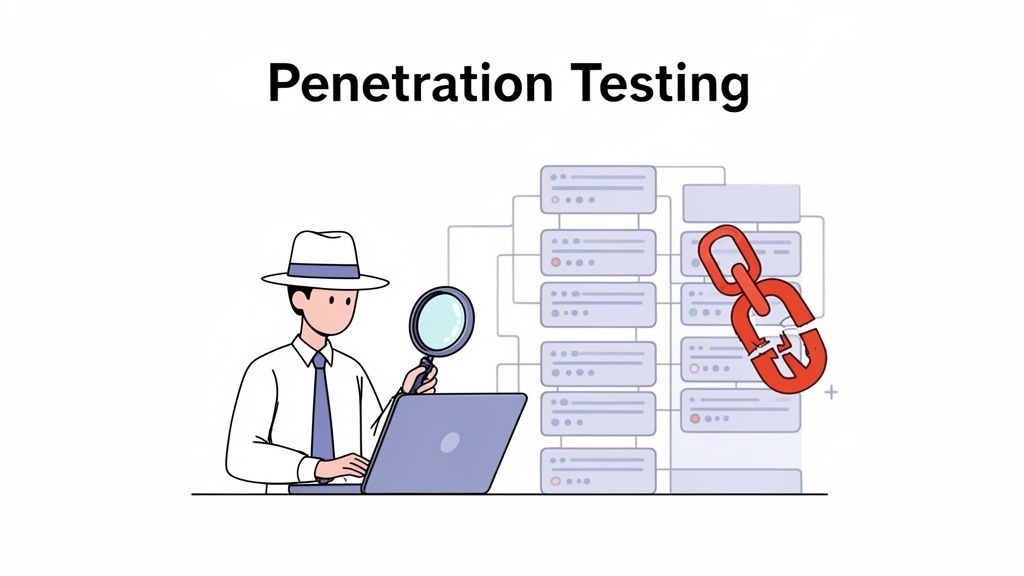
While a vulnerability assessment identifies potential weaknesses, a penetration test (or "pen test") actively tries to exploit them. It is an authorised, simulated cyberattack designed to evaluate the real-world effectiveness of your security controls. Pen testers mimic the actions of a genuine attacker to determine the actual business impact of a breach, answering the critical question: "What could an adversary actually do?"
This hands-on validation is invaluable. Regulated industries often require annual penetration tests to meet compliance standards like PCI-DSS. A technology firm might use it to test for authentication bypass flaws in its Microsoft 365 setup, demonstrating how an attacker could gain unauthorised access and what data would be exposed. This type of cyber security assessment provides undeniable proof of where security gaps exist and what their consequences are.
Key Considerations for Penetration Testing
- Scope Definition: Clearly define the rules of engagement and the systems in scope before testing begins to avoid operational disruption.
- Comprehensive Testing: Include both external (internet-facing) and internal testing perspectives to simulate different threat scenarios, including insider threats.
- Communication: Establish clear communication protocols and emergency stop procedures in case the testing unexpectedly impacts critical systems.
3. Security Configuration Review
A security configuration review is a detailed audit of your systems, applications, and network devices against established security benchmarks. Unlike vulnerability scanning, which looks for known flaws, this assessment checks that your technology is hardened and configured securely from the ground up to minimise the attack surface. It validates settings against best practices like CIS Benchmarks, NIST guidelines, or Microsoft security baselines.
This type of cyber security assessment is critical for organisations deploying cloud infrastructure, such as Microsoft 365 or Azure, where misconfigurations are a leading cause of data breaches. For instance, a review might find that a cloud storage bucket is publicly accessible or that a Microsoft 365 tenant lacks multi-factor authentication enforcement. It ensures that security features are enabled, policies are enforced, and access controls follow the principle of least privilege.
Key Considerations for Security Configuration Reviews
- Establish Baselines: Create organisation-specific hardening guidelines based on industry standards to ensure consistent and secure deployments.
- Automate and Monitor: Use Cloud Security Posture Management (CSPM) tools to automate assessments and continuously monitor for configuration drift.
- Integrate into DevOps: Incorporate configuration checks into your CI/CD pipelines to validate infrastructure-as-code before it is deployed.
4. Cyber Essentials Assessment
The Cyber Essentials assessment is a UK government-backed certification scheme that validates an organisation's security against the most common cyber threats. It focuses on five fundamental technical controls: secure configuration, user access control, malware protection, patch management, and boundary firewalls. This type of cyber security assessment provides a clear, verifiable baseline for cyber hygiene, demonstrating a tangible commitment to security.
This certification is essential for businesses supplying to UK government bodies and is increasingly a requirement in private sector supply chains. For example, a small technology firm can win public sector contracts by achieving certification, while a managed service provider uses it to reassure clients of its security practices. The scheme offers a practical framework for protecting against the majority of common, unsophisticated cyber attacks.
Key Considerations for Cyber Essentials Assessments
- Start with the Basics: Begin with the self-assessed Cyber Essentials Basic certification to identify and address foundational gaps before pursuing the more rigorous, audited Plus level.
- Documentation: Maintain clear evidence of how each of the five controls is implemented, as this is crucial for the assessment process.
- Plan Remediation: Align any necessary remediation work with your certification timeline to ensure a smooth and successful audit. Learn more about the advanced Cyber Essentials Plus assessment to understand the next steps.
5. Cloud Security Assessment
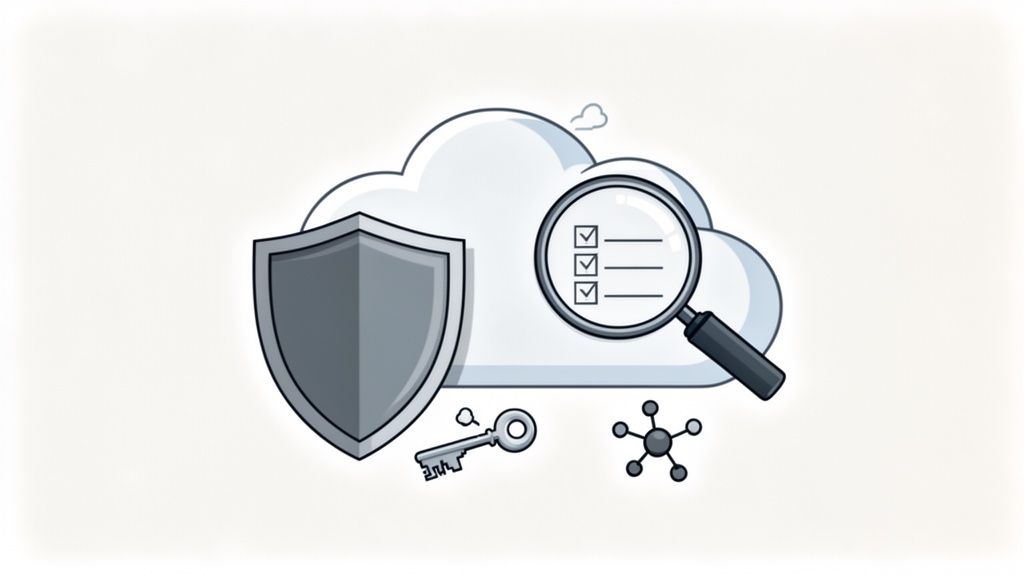
A cloud security assessment is a specialised evaluation of your security posture within cloud environments like Azure, AWS, or GCP. It goes beyond traditional network checks to examine identity and access management (IAM), data protection, network configurations, logging, and adherence to the shared responsibility model. This type of cyber security assessment is critical for any organisation migrating to or operating within the cloud.
These assessments are vital for maintaining control and visibility as infrastructure scales. For instance, a financial services firm would use an Azure assessment to ensure its data processing workloads are compliant, while a retailer could validate PCI-DSS compliance in their AWS environment. The outcome is a clear understanding of your cloud-specific risks and a roadmap for implementing robust controls to secure your data and applications.
Key Considerations for Cloud Security Assessments
- Leverage Native Tools: Use provider tools like Microsoft Defender for Cloud or AWS Security Hub alongside third-party assessments for comprehensive coverage.
- Prioritise Identity: Focus on Identity and Access Management (IAM), as it is the most critical control plane in any cloud environment.
- Embrace Automation: Employ Cloud Security Posture Management (CSPM) tools to automate checks and continuously monitor for misconfigurations.
6. Compliance and Regulatory Assessment
A compliance and regulatory assessment evaluates your security practices against specific legal or industry frameworks like GDPR, ISO 27001, or PCI-DSS. This type of audit identifies gaps between your current security posture and the required standards, providing a clear roadmap for remediation. These cyber security assessments are essential for businesses in regulated sectors or those handling sensitive customer data.
This assessment is crucial for avoiding significant fines and reputational damage. For example, any business that processes card payments must meet PCI-DSS requirements, while a healthcare provider uses this assessment to validate its adherence to data protection laws. It systematically documents evidence of controls, making it easier to demonstrate due diligence to auditors, partners, and customers.
Key Considerations for Compliance and Regulatory Assessments
- Framework Mapping: Identify all applicable regulations and map their overlapping controls to avoid duplicating effort and streamline compliance activities.
- Continuous Monitoring: Implement tools and processes to monitor compliance continuously rather than treating it as a one-off annual audit.
- Documentation is Key: Maintain thorough and organised documentation of all security controls and processes to provide clear evidence for auditors when required.
7. Zero Trust Architecture Assessment
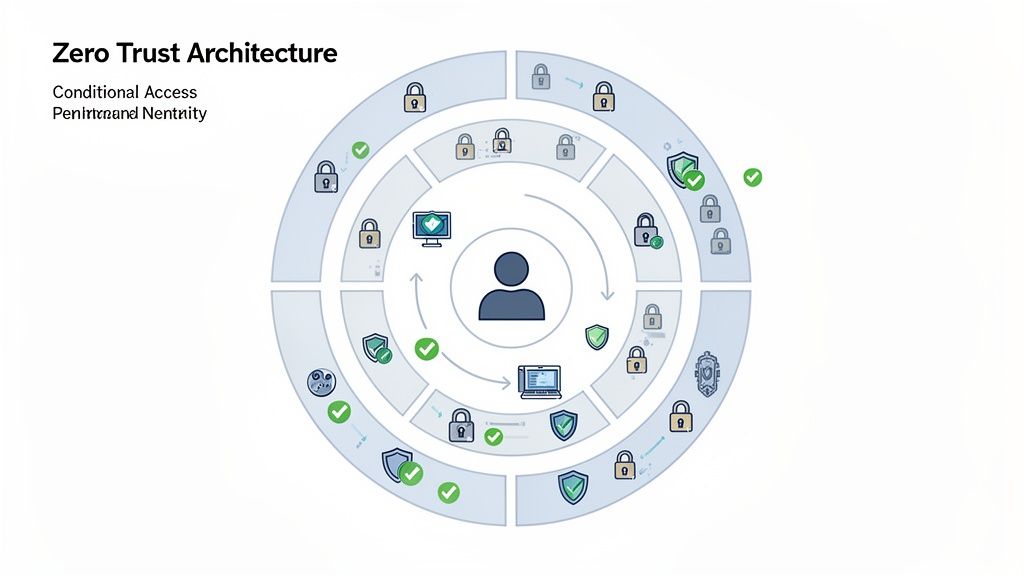
A Zero Trust Architecture assessment evaluates your organisation's alignment with the "never trust, always verify" security model. Instead of relying on a traditional network perimeter, this modern approach authenticates and authorises every access request, regardless of where it originates. The assessment reviews identity verification, device health, network segmentation, and data protection controls to validate your progress on the Zero Trust journey.
This type of cyber security assessment is critical for organisations with distributed workforces or hybrid cloud environments. For example, a legal firm might use it to secure remote access to sensitive case files, ensuring only verified users on compliant devices can connect. It provides a strategic roadmap for moving away from outdated, perimeter-based security toward a more resilient, identity-centric model. You can learn more about what Zero Trust security is and why it matters.
Key Considerations for Zero Trust Architecture Assessments
- Phased Implementation: Start your journey by focusing on identity and access management before expanding to devices, networks, and applications.
- Leverage Existing Tools: Use capabilities within platforms like Microsoft Entra ID (formerly Azure AD), such as Conditional Access, to enforce foundational Zero Trust policies.
- Prioritise Visibility: Implement tools that provide continuous monitoring and behavioural analytics to detect and respond to anomalies in real-time.
8. Data Protection and Privacy Assessment
A data protection and privacy assessment is a comprehensive evaluation of how your organisation collects, processes, stores, and protects sensitive information. This assessment goes beyond technical controls to examine data governance policies, classification, encryption, and access controls, ensuring that personal and confidential data is managed securely throughout its entire lifecycle. It is a critical component of modern cyber security assessments, validating compliance with regulations like GDPR.
This assessment is vital for any organisation handling sensitive information, from a healthcare provider protecting patient records to a marketing firm managing customer data. It helps implement principles like data minimisation and purpose limitation, ensuring you only collect and retain what is necessary. The outcome is a clear roadmap to strengthen data handling practices, build customer trust, and meet legal obligations.
Key Considerations for Data Protection and Privacy Assessments
- Data Discovery: Begin with a thorough data discovery and classification exercise to understand what sensitive data you hold and where it resides.
- Access Control: Implement role-based access control (RBAC) based on the principle of least privilege to ensure employees can only access data essential for their roles.
- Integrate Technology: Leverage tools like Microsoft Purview and Data Loss Prevention (DLP) to automate data governance and prevent unauthorised data movement. For more information, explore our guide on data governance best practices.
9. Incident Response and Disaster Recovery Assessment
An Incident Response (IR) and Disaster Recovery (DR) Assessment evaluates your organisation's ability to withstand and recover from a cyber attack or operational disruption. It examines the maturity of your incident response plans, communication procedures, and technical recovery capabilities through methods like tabletop exercises. This type of cyber security assessment validates whether you can effectively detect, contain, and remediate threats while maintaining business continuity.
This proactive review is vital for minimising financial and reputational damage. For instance, a financial services firm might conduct tabletop exercises to test its response to a ransomware attack, while a manufacturer validates its ability to recover critical factory systems. The goal is to ensure you can meet your Recovery Time Objectives (RTO) and Recovery Point Objectives (RPO) under pressure, turning a potential disaster into a managed event.
Key Considerations for Incident Response and Disaster Recovery Assessments
- Test Your Plans: A plan that hasn't been tested is just a document. Conduct regular tabletop exercises and simulations to validate your procedures and identify gaps.
- Define Roles Clearly: Ensure your IR plan has clearly defined roles, responsibilities, and communication channels to avoid confusion during a crisis.
- Validate Backups: Test your backup and recovery processes at least annually to ensure they are reliable, and maintain resilient backup infrastructure (e.g., immutable or offsite).
10. Third-Party and Supply Chain Risk Assessment
A third-party and supply chain risk assessment evaluates the security posture of your vendors, contractors, and partners. It systematically validates that external entities with access to your systems or data adhere to appropriate security standards, preventing them from becoming a weak link in your defences. This type of cyber security assessment examines their security controls, contractual obligations, and incident response capabilities.
This assessment is vital for any organisation that relies on external services, from cloud providers to software suppliers. For instance, a financial services firm would assess its payment processor to ensure PCI-DSS compliance, while a manufacturer might scrutinise the security of its IoT device vendors. It provides essential assurance that your partners do not introduce unacceptable risks into your operational environment.
Key Considerations for Third-Party Risk Assessments
- Standardise Onboarding: Develop a standardised security questionnaire and set of requirements for all new vendors.
- Prioritise by Risk: Classify vendors based on their access to critical data and systems to focus your assessment efforts where the risk is highest.
- Embed Security in Contracts: Ensure contracts include clear security requirements, incident notification timelines, and the right to audit.
10-Point Comparison of Cybersecurity Assessments
| Assessment | Implementation complexity | Resource requirements | Expected outcomes | Ideal use cases | Key advantages |
|---|---|---|---|---|---|
| Vulnerability Assessment | Low–Medium | Automated scanners + analyst time | Inventory of vulnerabilities with risk prioritization | Routine security hygiene, compliance baseline | Cost-effective, quantifiable remediation priorities |
| Penetration Testing | High | Skilled testers, time, controlled test environment | Demonstrable exploit paths and PoC evidence | Pre-production validation, high-risk systems, compliance | Shows real-world impact and control gaps |
| Security Configuration Review | Medium | Platform expertise, configuration tools | Hardened settings mapped to industry baselines | M365/Azure hardening, baseline compliance | Quick, actionable hardening guidance |
| Cyber Essentials Assessment | Low–Medium | Documentation, basic technical fixes; external auditor for Plus | Certification (Basic/Plus) and validated core controls | Government contracts, SMB baseline security | Government-recognized, straightforward certification |
| Cloud Security Assessment | Medium–High | Cloud specialists, CSPM tooling, continuous monitoring | Cloud-specific misconfigurations and remediation roadmap | Cloud migration, multi-cloud operations | Addresses shared responsibility and cloud risks |
| Compliance and Regulatory Assessment | High | Legal/compliance experts, cross-functional evidence collection | Gap analysis and roadmap to meet specific regulations | Regulated industries, audit preparation | Reduces legal risk and supports audits |
| Zero Trust Architecture Assessment | High | Identity/monitoring tools, phased project resources | Roadmap and validation of zero trust controls | Remote/hybrid work, security architecture modernization | Reduces breach impact via segmentation and continuous auth |
| Data Protection and Privacy Assessment | High | Data discovery/classification tools, legal and IT coordination | Data inventory, classification, DLP and encryption guidance | GDPR/CCPA compliance, sensitive data handling | Prevents data breaches and supports privacy compliance |
| Incident Response & Disaster Recovery Assessment | Medium–High | IR tools, backup systems, staff training, tabletop exercises | Tested IR/DR plans, RTO/RPO definitions and playbooks | Business continuity, ransomware readiness | Minimizes downtime and speeds recovery |
| Third-Party & Supply Chain Risk Assessment | Medium | Vendor questionnaires, audit reviews, continuous monitoring | Vendor risk ratings and contractual security requirements | Outsourced services, critical vendor onboarding | Reduces supplier-introduced risk and informs vendor selection |
From Assessment to Action: Building a Resilient Security Programme
Understanding the different types of cyber security assessments is the essential first step. However, their true business value emerges when findings are transformed into a continuous cycle of security improvement. Each report should be viewed not as a final grade, but as a strategic roadmap providing an evidence-based snapshot of your security posture. It highlights what's working well and, more importantly, pinpoints the vulnerabilities that require immediate attention.
This journey from reactive analysis to proactive defence is the cornerstone of modern cyber resilience. Whether you are pursuing Cyber Essentials certification, securing a complex Azure environment, or mapping controls to GDPR, the objective is constant: to make informed, risk-based decisions that measurably strengthen your organisation. It’s about moving beyond a simple pass-fail mentality and embracing a culture of persistent enhancement.
Ultimately, mastering this process means turning data into decisive action. The insights gained from regular, targeted cyber security assessments empower leaders to prioritise resources effectively, close critical security gaps, and build a security programme that adapts to an ever-changing threat landscape. This proactive stance not only protects critical assets but also establishes a solid foundation for sustainable business growth and innovation.