
Subtotal $0.00


In the past, IT services were seen as a reactive function: fix the broken printer, reset the forgotten password. This view is now dangerously outdated. Today, strategic IT services are the engine room of a modern business, directly driving operational efficiency, securing critical data, and creating a tangible competitive advantage.
Why Modern Businesses Need Strategic IT Services

Forward-thinking organisations have shifted their perspective, treating technology not as a cost centre but as a strategic asset. IT is no longer a background utility; it is a fundamental capability for navigating a complex digital landscape. This mindset shift is not a trend—it's a requirement for resilience and growth.
A strong IT partnership helps businesses address their most pressing challenges, from defending against sophisticated cyber threats to leveraging flexible cloud technologies for scalable operations. The data validates this shift: the UK's IT services market is projected to reach USD 112.5 billion by 2025, with a significant portion driven by cloud adoption. This highlights how deeply UK businesses now depend on expert IT guidance. You can explore these UK market trends on mordorintelligence.com.
Ultimately, strategic IT is not about maintenance; it's about building for the future. It creates a secure, scalable, and resilient foundation that enables your business to achieve its long-term objectives.
A proactive IT strategy isn't about preventing every single problem. It's about building a system so resilient that problems have minimal impact on your business operations. It’s the difference between firefighting and future-proofing.
The Four Pillars of Modern IT Services for Businesses
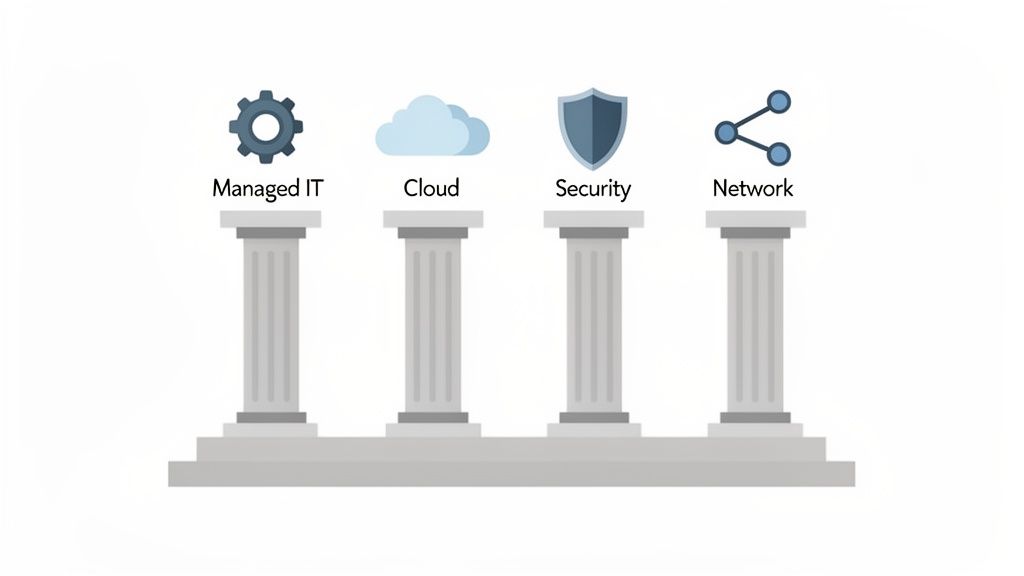
To make informed technology decisions, it is crucial to understand the distinct functions of core IT services. Business IT services generally stand on four interconnected pillars, each addressing a critical operational area.
Understanding these pillars helps you identify where your organisation needs the most support and investment. They are the essential systems of a modern business: a solid operational structure, reliable utilities, robust security, and the pathways that connect everything.
Managed IT Services: The Proactive Guardian
Managed IT is the proactive stewardship of your entire technology stack. Instead of waiting for a server to crash or a system to fail, this service focuses on continuous monitoring, maintenance, and optimisation to prevent issues from occurring in the first place.
This pillar handles the essential daily functions—system updates, performance monitoring, and helpdesk support—transforming IT from a reactive, unpredictable cost into a stable, value-driven asset. The core objective is to ensure your systems are consistently available, secure, and performing optimally.
Cloud Solutions: Flexible and Scalable Infrastructure
Cloud solutions provide agile, on-demand infrastructure. This pillar empowers you to scale computing resources up or down without the significant capital expenditure of purchasing and maintaining physical servers. It delivers true business agility.
Whether migrating your entire operation to the cloud or adopting specific SaaS applications, you gain the ability to support remote workforces, launch new initiatives quickly, and align costs directly with usage. The compelling benefits of cloud migration are often the primary driver for business modernisation efforts.
A strong IT foundation is built on more than just technology; it's built on a clear understanding of how each component—from cybersecurity to cloud infrastructure—directly supports your business objectives.
To help clarify how these core services translate into tangible business outcomes, here’s a quick breakdown.
Key IT Service Categories and Their Business Impact
| Service Category | Primary Function | Key Business Benefit |
|---|---|---|
| Managed IT Services | Proactive monitoring, maintenance, and support of IT systems. | Increased uptime, predictable costs, and improved team productivity. |
| Cloud Solutions | Providing scalable, on-demand computing resources and applications. | Greater flexibility, reduced capital expenditure, and enhanced collaboration. |
| Cybersecurity | Protecting data, networks, and devices from digital threats. | Reduced risk of data breaches, protected reputation, and regulatory compliance. |
| Network Infrastructure | Designing, building, and managing the company’s digital connectivity. | Seamless communication, reliable access to resources, and secure data flow. |
Each category serves a distinct purpose, but their integration creates a comprehensive strategy that keeps your business running securely and efficiently.
Cybersecurity and Network Infrastructure
Finally, the two pillars that secure and connect the entire structure are cybersecurity and network infrastructure.
-
Cybersecurity: This is your digital defence system, focused on protecting your data, users, and reputation from a constantly evolving threat landscape. It extends far beyond basic antivirus software to include advanced firewalls, threat detection, employee training, and compliance management. The goal is to build genuine cyber resilience.
-
Network Infrastructure: This is the digital nervous system of your business. It encompasses everything from Wi-Fi and structured cabling to the complex systems that ensure seamless, secure communication between all devices, whether they are in the office or distributed globally.
The Business Case for an Expert IT Partnership
Outsourcing IT is more than a solution for technical problems; it's a strategic decision with measurable business outcomes. The most immediate benefit is the transformation of your technology budget from unpredictable capital expenditure (CapEx) for emergency repairs into a stable, manageable operating expense (OpEx).
This approach provides access to a deep pool of specialists whose expertise would be prohibitively expensive and difficult to recruit in-house. A dedicated partner doesn't just react to issues; they proactively strengthen security, manage critical updates, and ensure operational resilience. This forward-thinking methodology significantly reduces the risk of costly downtime.
Turning IT into a Revenue Enabler
A strategic IT partnership can directly contribute to revenue growth. For example, when bidding for valuable government or public sector contracts, holding a certification like Cyber Essentials is often a mandatory requirement. The right IT partner can guide you through the certification process, transforming a support function into an essential tool for winning new business.
By aligning technology with your actual business goals, an expert IT partner doesn't just cut costs—they create brand-new opportunities. The conversation shifts from "how much does IT cost?" to "how much value can our IT generate?"
The ultimate aim is to gain a sustainable competitive edge. Partnering with a specialist provider ensures your technology is not only secure and reliable but also agile enough to support future growth. For a detailed exploration, review the full spectrum of managed IT services benefits and how they drive long-term business success.
How to Choose the Right IT Partner
Selecting an IT provider is a critical business decision, comparable to choosing a financial advisor or legal counsel. The right partner becomes a seamless extension of your team, whereas the wrong one introduces risk and inefficiency. It is essential to look beyond the initial price and evaluate their technical capabilities, operational processes, and commitment to your success. A provider’s true value lies not in the technology they sell, but in the strategic guidance they deliver.
Begin by requesting evidence of their technical expertise and real-world experience. Do not hesitate to ask for client testimonials or case studies relevant to your industry. A proven track record is not a bonus; it is a fundamental requirement.
Vetting Your Potential Partner
A structured evaluation process is the most effective way to protect your investment and ensure a successful partnership. Focus your diligence on these key areas:
- Technical Certifications: Look for accreditations from major technology vendors like Microsoft or Amazon Web Services. These serve as a clear indicator that their team's knowledge is current and adheres to industry best practices.
- Service Level Agreements (SLAs): Examine the contract details carefully. A robust Service Level Agreement (SLA) will clearly define response times, resolution guarantees, and key performance indicators. Vague terms are a significant red flag.
- Security Credentials: Inquire about their internal security measures and certifications, such as Cyber Essentials. Their commitment to security must be as rigorous as your own. For more on modern security frameworks, our guide explains what is Zero Trust security.
The goal is to find a partner who is genuinely invested in your long-term outcomes, not one simply selling a pre-packaged solution. Their success should be directly tied to yours.
When evaluating providers for specific platforms, such as AWS, unique considerations apply, making it important to understand how to approach choosing a Managed Service Provider for different environments. Ultimately, you are seeking a provider who offers transparent, reliable, and expert it services for businesses like yours.
What to Expect From a Professional Onboarding Process
Engaging a new IT provider should be a structured, transparent process designed to build confidence and minimise disruption from day one. A professional partnership follows a clear methodology.
The engagement begins with a discovery and consultation phase. During this stage, the provider invests time to understand your specific challenges, existing infrastructure, and strategic goals. This functions as a deep-dive diagnostic of your organisation's technological health.
Next comes the solution design, which is tailored to your unique requirements, not a generic package. A detailed plan is developed, outlining the appropriate technology, processes, and implementation timelines. This includes establishing a clear Service Level Agreement (SLA), which formally documents performance and support commitments.
Once the plan is approved, the migration and execution phase begins. This is a carefully managed process to ensure a smooth transition with minimal impact on daily operations. The process always involves these key checks.
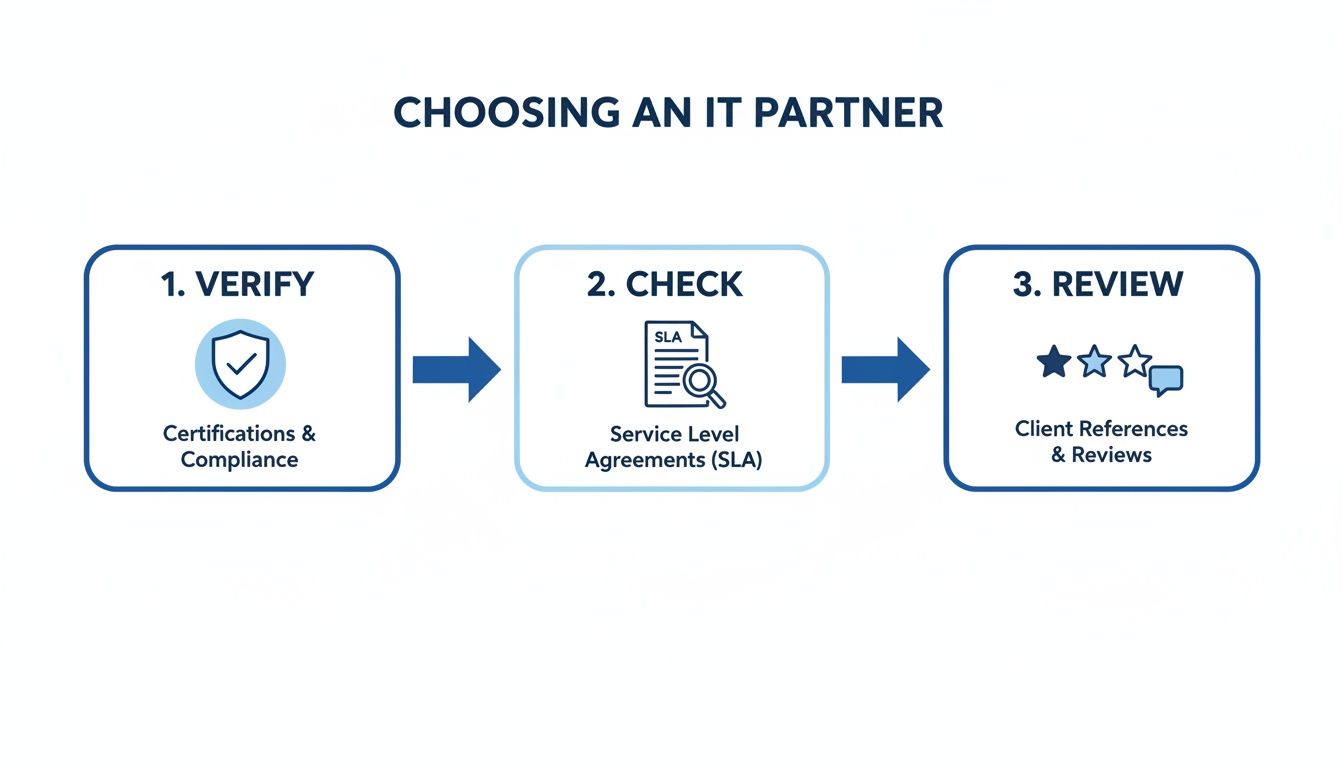
This methodical approach ensures that critical details like certifications and service guarantees are confirmed before the system goes live. The final, ongoing stage is continuous support and optimisation, ensuring your technology not only functions effectively today but also evolves with your business needs.
Your Questions About IT Services, Answered
If you are exploring professional IT services, you likely have questions. It is a significant decision, and clarity is key. Here are concise answers to some of the most common inquiries we encounter.
What’s the Real Difference Between Managed IT and Break-Fix Support?
Think of break-fix support as an emergency service you call after a problem has occurred. It is purely reactive. When a system fails, operations stop, and you call for help, facing unpredictable downtime and costs.
Managed IT services, in contrast, are a preventative framework. The service is proactive, involving constant system monitoring to identify and resolve issues before they impact your business. It includes managing all essential security updates and performance optimisations in the background. It is a strategic partnership designed to maintain operational continuity, not just to fix things when they break.
How Do IT Services Actually Improve Our Cybersecurity?
A professional IT partner implements a multi-layered defence strategy designed for modern threats, going far beyond simple antivirus installation. This involves configuring advanced firewalls, deploying continuous threat detection tools, and enforcing robust security policies across your organisation.
Crucially, expert guidance helps you achieve and maintain key compliance standards like Cyber Essentials, which is often a prerequisite for winning UK public sector and enterprise contracts. By implementing modern frameworks like Zero Trust—where no user or device is trusted by default—we systematically reduce your attack surface and minimise the risk of a breach.
Are Professional IT Services Really Affordable for a Small Business?
Yes. In fact, small and medium-sized businesses (SMBs) often derive the greatest value from professional it services for businesses.
Partnering with an IT provider grants immediate access to enterprise-grade technology and a deep bench of specialist expertise at a fraction of the cost of hiring a full-time, in-house IT team with comparable skills. It is a cost-effective, scalable model that allows your technology capabilities to grow with your business, enabling you to compete securely and efficiently without a large upfront investment.