
Subtotal $0.00


Managed IT security services provide businesses with outsourced cybersecurity expertise, offering a practical way to gain 24/7 monitoring, threat detection, and incident response without the significant overhead of an in-house security team. This approach allows organisations to leverage specialised tools and experienced professionals to defend against complex digital threats.
What Are Managed IT Security Services?
Imagine trying to secure a large commercial building by yourself. You would need to monitor every door, window, and camera feed around the clock—an overwhelming and unsustainable task. Yet, this is how many businesses approach their digital security, leaving critical data and systems exposed.
Managed IT security services offer a more strategic alternative. It’s like engaging a specialised security firm for your digital environment. Instead of shouldering the entire burden, you gain immediate access to a dedicated team of:
- Certified security experts
- Specialists using advanced threat detection technologies
- A team providing constant, vigilant monitoring
This strategic partnership enables businesses to defend against sophisticated cyber threats without the massive expense and complexity of building an internal Security Operations Centre (SOC). A good starting point is this complete guide to Managed IT Security Services.
This is no longer a luxury for large corporations; it's a foundational strategy for modern businesses that require robust protection. As our deeper insights on cyber security managed services explain, expert guidance makes enterprise-grade security accessible and sustainable, regardless of your organisation's size.
The Core Components of Modern Cyber Defence
An effective security service isn't a single piece of software; it's a system of interconnected layers, each designed to protect your business from a different angle. Understanding how these components work together clarifies how managed IT security services build a unified and resilient defence.
At the heart of this operation is the Security Operations Centre (SOC). Think of it as a digital command centre, staffed 24/7 by analysts whose sole focus is monitoring your network, servers, and devices. They analyse security alerts, hunt for hidden threats, and coordinate the response to any incident, ensuring nothing slips through the cracks.
The image below illustrates how this blend of skilled personnel, intelligent technology, and continuous monitoring forms the bedrock of a managed security service.
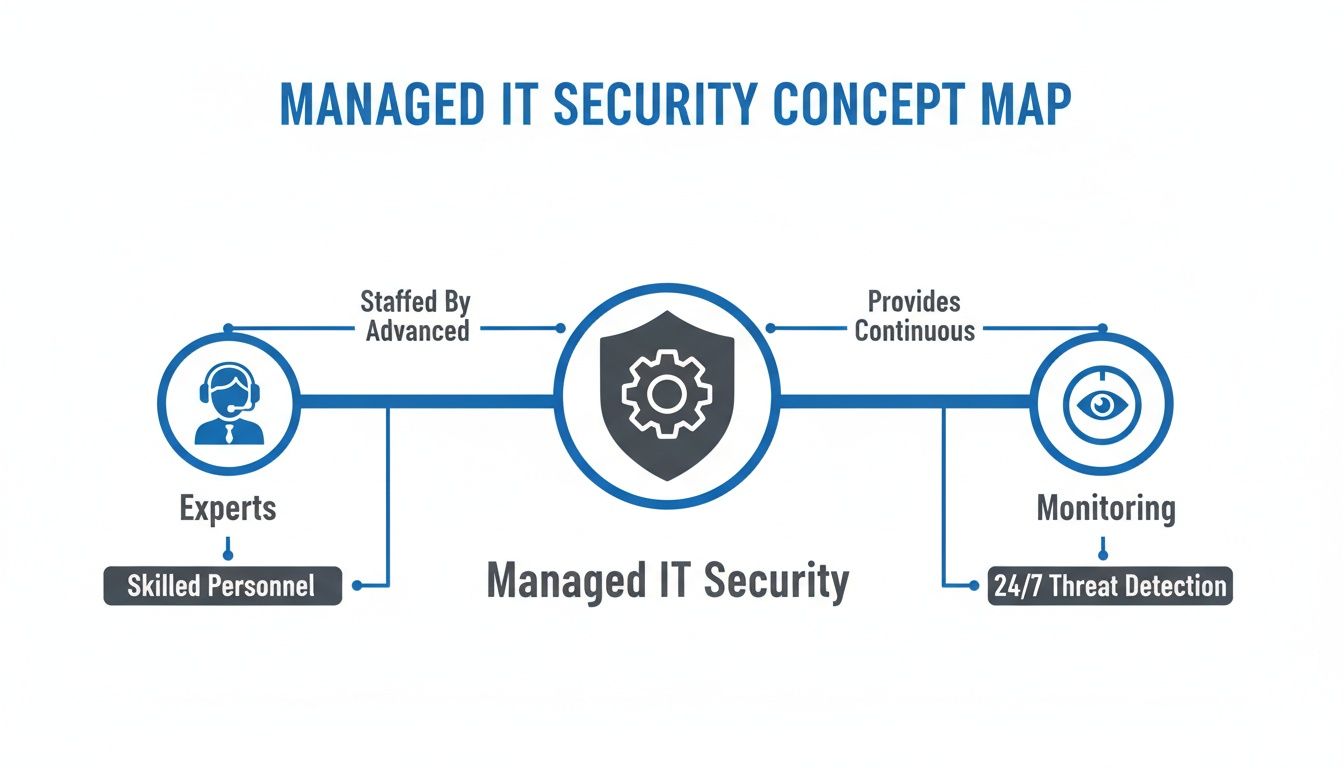
As you can see, a powerful defence seamlessly integrates human expertise with advanced tools, all operating around the clock to keep your business secure.
Key Managed Security Service Components Explained
To properly defend your digital assets, several key functions must work in harmony. The table below outlines the essential pillars of modern security and the specific business challenges they solve.
| Service Component | Primary Function | Business Benefit |
|---|---|---|
| Security Operations Centre (SOC) | Provides 24/7 monitoring, threat hunting, and incident response coordination. | Ensures constant vigilance and rapid reaction to security events, day or night. |
| Endpoint Detection & Response (EDR) | Acts as a security guard for individual devices like laptops, phones, and servers. | Isolates compromised devices instantly, stopping threats from spreading across the network. |
| Network Security | Defends the digital perimeter using firewalls and intrusion detection systems. | Filters out malicious traffic and prevents unauthorised access to your core business data. |
| Identity & Access Management (IAM) | Ensures the right people have the right access to the right resources—and nothing more. | Reduces the risk of internal threats and data breaches by enforcing strict access rules. |
| Cloud Security | Extends protection to assets in cloud platforms like Microsoft Azure and AWS. | Secures cloud configurations to prevent data leaks and unauthorised access in a shared environment. |
Each of these components plays a vital role. Let's explore them in more detail:
-
Endpoint Detection and Response (EDR) is the security guard for every device, from laptops to servers. It monitors for suspicious behaviour and can immediately quarantine a compromised machine to contain a threat. With remote work now standard, it’s no surprise the endpoint security market is forecast for the fastest growth through 2030.
-
Network Security protects your digital perimeter with firewalls and intrusion detection systems. It is responsible for filtering malicious traffic and ensuring only authorised communications enter or leave your network.
-
Identity and Access Management (IAM) is about control. It enforces the principle that users should only have access to the specific resources required for their role. This is often built on a Zero Trust security model, which operates on the philosophy of "never trust, always verify." You can learn more in our guide on what is Zero Trust security.
-
Cloud Security applies these protections to data and applications hosted in platforms like Microsoft Azure and AWS. It involves correctly configuring these services to prevent data breaches and unauthorised access, a critical discipline in shared cloud environments.
Why UK Businesses are Turning to Managed Security
The shift toward managed IT security services in the UK is a strategic response to real-world business pressures. A significant driver is the increasingly stringent regulatory landscape. New legislation, such as the Cyber Security and Resilience Bill, is raising security standards, transforming robust cyber defence from a best practice into a legal imperative.
For many businesses, achieving certifications like Cyber Essentials Plus is now a prerequisite for winning valuable government and enterprise contracts. Suddenly, security is no longer just an IT issue—it's a commercial enabler that unlocks growth and provides a competitive advantage.
Beyond compliance, the persistent cybersecurity skills gap presents a major challenge. Finding, hiring, and retaining expert security talent is difficult and expensive, leaving many organisations vulnerable. This is where managed security services provide a crucial lifeline.
Managed security changes the conversation from a reactive cost into a proactive investment in resilience, reputation, and long-term competitiveness. It provides access to specialist skills that would otherwise be out of reach.
This combination of compliance demands and a shallow talent pool is fuelling significant market growth. Managed security in the UK is projected to grow at a compound annual growth rate (CAGR) of 9.38% through 2031, largely driven by these mandatory compliance requirements. You can explore more data on the UK IT services market to see the full picture. This trend clearly signals that expert support is now seen as fundamental to navigating today’s complex threat landscape.
How to Choose the Right Security Partner
Selecting the right managed IT security partner is one of the most important decisions a business can make. This isn't merely about procuring technology; it's about entrusting the security of your data, reputation, and operations to a third party. Therefore, it is essential to look beyond the sales pitch.
The UK market is crowded. As of March 2025, there were 12,867 active managed service providers in the United Kingdom, so identifying a partner with proven, genuine expertise is critical. You can explore detailed research on the UK MSP market to better understand this competitive landscape.
Key Areas for Evaluation
When comparing providers, focus on tangible proof of their capabilities and whether their approach aligns with your business culture. A true partner delivers structured, hands-on support, not just a set of software licenses.
To get to the heart of what matters, ask these critical questions:
- SOC and Incident Response: How does their Security Operations Centre (SOC) function? Ask for real-world examples of how they have handled security incidents for businesses similar to yours.
- Technical Expertise: Do they hold relevant certifications for core platforms like Microsoft Azure or AWS? More importantly, can they demonstrate an understanding of the specific security frameworks relevant to your industry?
- Compliance and Certifications: Can they actively support your compliance objectives? For example, if you aim for government contracts, you need to understand what is Cyber Essentials certification and how a partner can guide you through the process.
- Communication and Reporting: What is their communication protocol during a crisis? You need clarity on how they will keep you informed. Are their reports actionable and easy to understand, or just a data dump?
A potential partner's answers to these questions will reveal their level of experience and commitment to your success.
Onboarding and Sidestepping Common Pitfalls
Integrating a managed IT security service is the beginning of a deep collaboration, not a simple handover. The process starts with a detailed assessment to understand your business workflows, technology stack, and unique risk profile. This ensures the security solution is tailored to your specific needs from day one.
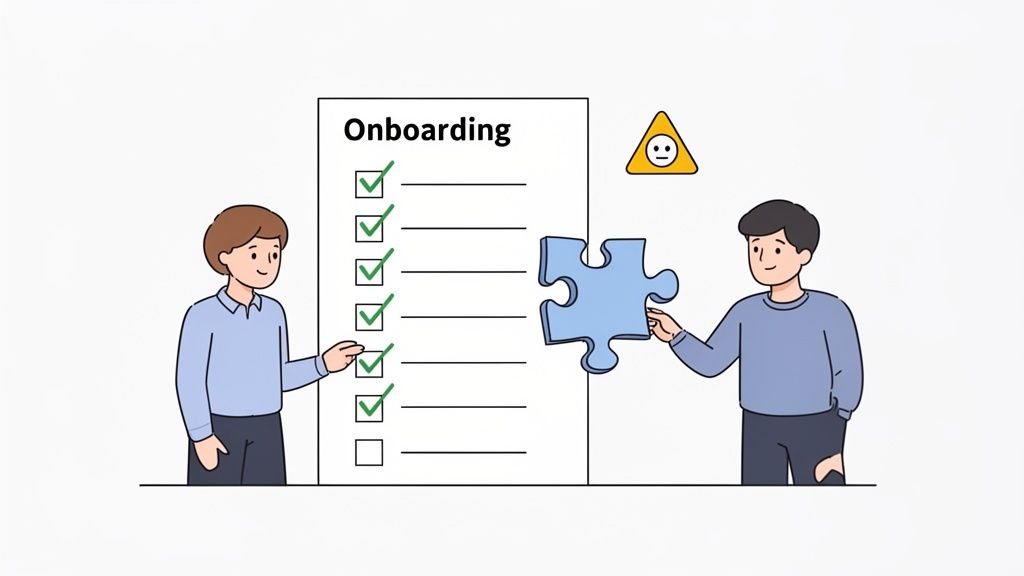
However, even the most advanced technology can be undermined by common implementation mistakes. Establishing clear roles, responsibilities, and expectations is critical to avoid friction and maximise the value of your investment.
Common Implementation Mistakes
Many organisations fall into the trap of treating security as a 'set it and forget it' solution. To ensure a smooth transition and long-term effectiveness, watch out for these classic pitfalls:
- Vague Service Level Agreements (SLAs): Do not accept ambiguous promises. Your SLA must define clear, measurable targets for key metrics like response times and issue resolution. Any ambiguity can lead to significant problems during a real incident.
- Neglecting Employee Awareness: Technology is only one part of the equation. Your employees are your first line of defence, which makes ongoing security awareness training non-negotiable.
- Poor Communication Channels: A crystal-clear communication protocol is essential. This includes established channels for routine updates and, most importantly, for emergencies.
This is precisely where structured IT support makes a significant difference. An experienced partner helps navigate these complexities, ensuring a seamless onboarding process and building a truly resilient security posture.
Building a More Secure and Resilient Business
Ultimately, engaging managed IT security services is a strategic business decision, not just a defensive tactic. In a complex threat landscape, partnering with experts frees your internal teams to focus on core business objectives with the confidence that their digital foundation is secure.
A true security partner does more than manage alerts; they help you build a more resilient, scalable, and competitive organisation prepared for future challenges. This resilience extends beyond threat prevention to include robust data lifecycle management, such as implementing practices like secure hard drive shredding to protect information from creation to disposal.
By transforming your security posture from a cost centre into a strategic asset, you gain the stability and assurance needed to innovate and grow. For businesses ready to take that step, expert consultation is the most effective pathway forward.
Frequently Asked Questions
As business leaders begin to understand the fundamentals of managed IT security, a few practical questions consistently arise. Here are straightforward answers to these common queries.
How Much Do Managed IT Security Services Cost?
There is no one-size-fits-all price. The cost depends on the size of your business, the complexity of your IT environment, and the specific services required. For instance, comprehensive 24/7 SOC monitoring represents a different level of investment than basic endpoint protection for laptops.
Most providers use a subscription model, typically priced per user or per device monthly. While a significant investment, this is almost always more cost-effective than hiring, training, and equipping an in-house cybersecurity team.
Are Managed Security Services Suitable For Small Businesses?
Absolutely. In fact, small and medium-sized businesses (SMBs) are often ideal candidates. Cybercriminals frequently target smaller companies, knowing they often lack the resources for robust defence.
A managed security provider levels the playing field, giving an SMB access to the advanced tools and expertise once exclusive to large corporations. This partnership closes a critical security gap for smaller organisations.
Outsourcing security provides a small company with the same calibre of threat detection and expert response that large enterprises depend on. It plugs a critical vulnerability.
What's The Difference Between IT Support And a Security Service?
This is a crucial distinction. A standard IT support team focuses on operational efficiency—fixing laptops, managing software updates, and resolving user issues to maintain productivity and uptime.
In contrast, managed IT security services are laser-focused on proactively identifying, preventing, and responding to cyber threats. While there can be some overlap, a security service employs specialised tools and experts to continuously hunt for malicious activity, manage vulnerabilities, and ensure your business can withstand an attack.
Thinking through these questions is the first step toward building a much stronger defence. Strategic guidance can help you properly assess your risks and map out a clear plan for a more secure future. Book a free 30-minute consultation to get started.