
Subtotal $0.00


Understanding managed IT services pricing can feel complex, but it boils down to two core factors: the provider's pricing model and the specific services your business requires. For most UK businesses, this translates into a predictable monthly fee, typically calculated on a per-user or per-device basis. This approach is popular because it brings clarity and predictability to IT budgeting.
This guide breaks down the common pricing structures, the key factors that influence your final quote, and how to evaluate proposals to ensure you’re investing in value, not just an outsourced helpdesk.
Decoding Common Managed IT Services Pricing Models
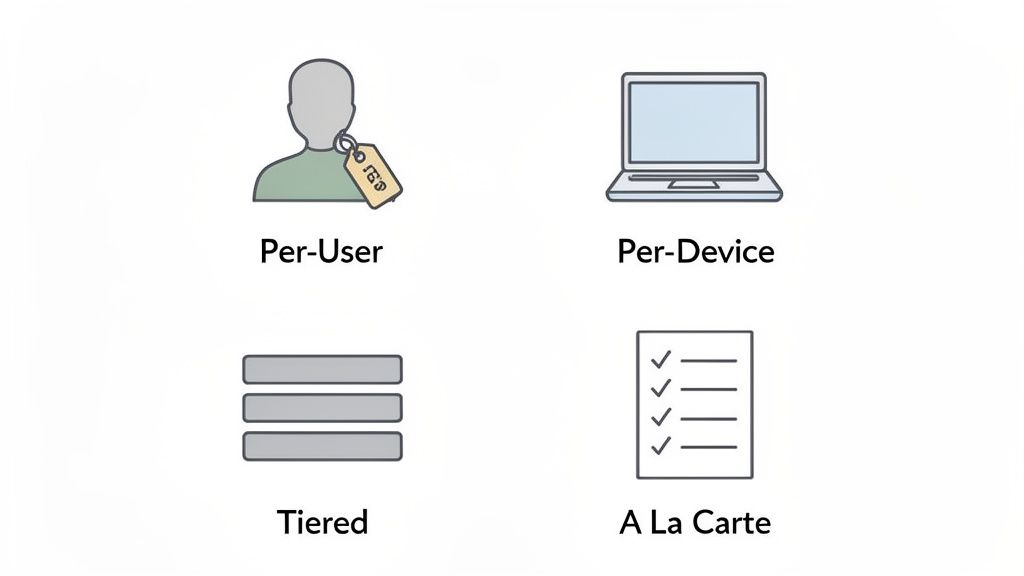
Grasping the basic pricing models is the first step toward making an informed decision. Most Managed Service Providers (MSPs) use one of four primary structures. Each has distinct advantages and disadvantages depending on your business operations, scale, and long-term goals.
The objective is to find a model that aligns with how your organisation functions. For instance, if your team embraces flexible work and bring-your-own-device (BYOD) policies, the predictable cost of a Per-User model offers significant value. Conversely, a manufacturing firm where multiple staff share workstations would likely find a Per-Device model more cost-effective.
Core Pricing Structures
These models form the foundation of almost every MSP proposal. While the names are indicative, their application can vary between providers. For deeper insight into how specialised services are priced, reviewing different managed security service pricing models can provide a useful parallel.
To help you quickly assess the options, the following table summarises the core models.
Quick Comparison of MSP Pricing Models
This table outlines the most common pricing models, helping you identify which might best suit your business needs at a glance.
| Pricing Model | Ideal Business Scenario | Cost Predictability |
|---|---|---|
| Per-User | Companies with remote teams or multiple devices per employee. | High – A clear, fixed cost for each employee. |
| Per-Device | Businesses with shared workstations (e.g., retail, manufacturing). | High – A fixed cost for every device being managed. |
| Tiered | Organisations wanting defined service levels (e.g., Bronze, Silver). | Moderate – Predictable within your chosen tier. |
| A La Carte | Businesses with a solid in-house IT team needing specific support. | Low – Varies completely based on the services you pick. |
Choosing the right model means aligning the cost structure with your operational reality. Carefully consider how your team works and which approach offers the best value without locking you into services you don't need.
A Practical Comparison of Pricing Structures
Selecting the right managed IT services pricing model isn't about finding a single "best" option; it's about identifying the best fit for your business operations. Each structure has practical implications for your budget, scalability, and the level of support you receive.
Let's move beyond theory to see how these models perform in real-world scenarios.
Per-User vs Per-Device Models
If your team is growing, especially with a remote or hybrid workforce, the Per-User model is often the most logical choice. It anchors your costs to a predictable figure per employee, regardless of whether they use a laptop, tablet, and smartphone. This simplifies budgeting as you onboard new staff.
In contrast, consider a manufacturing plant or a retail business with shared computer terminals. For these organisations, the Per-Device model delivers better value. Costs are tied to a fixed number of machines, which is more economical when several employees use the same computer across different shifts. It provides tight control over IT spending in environments where device count is stable.
The decision often comes down to one question: what is your primary cost driver? Is it your headcount or your hardware inventory? The answer is key to aligning IT spend with your business operations.
Tiered vs A La Carte Models
The Tiered model is well-suited for businesses that require clearly defined service levels. An e-commerce business, for example, might select a "Gold" tier that guarantees a 15-minute response for a critical server outage—a business necessity, not a luxury. This structure provides clarity and the assurance of a consistent, pre-agreed level of support.
The A La Carte model, on the other hand, offers surgical precision. It’s ideal for a company that already has a capable in-house IT team but needs specialist expertise in one or two areas, like advanced cybersecurity monitoring. To understand this better, you can explore how cybersecurity managed services are structured. This flexibility ensures you don't pay for redundant services.
The UK's managed services market is substantial, with 12,867 providers generating £51 billion annually, ensuring a wide range of specialised options. You can read the full government research on the UK managed service provider market.
Key Factors That Influence Your Final Quote
The pricing model you select is just the starting point. Several other variables contribute to the final quote for managed IT services. Understanding these factors is crucial for a productive discussion with any potential IT partner.
Ultimately, your final cost is directly tied to the scale and complexity of your IT environment.
Core Cost Drivers
A few core elements consistently have the greatest impact on your monthly fee:
- Number of Users and Devices: This is the foundation of any quote. More people and more endpoints—laptops, servers, mobiles—mean a larger digital footprint to secure, monitor, and support.
- Infrastructure Complexity: A straightforward, single-office setup is inherently less expensive to manage than a multi-site organisation with complex networking, multiple servers, or specialised on-premise hardware.
- Security and Compliance Needs: Meeting specific standards like Cyber Essentials or GDPR requires additional layers of management, continuous monitoring, and detailed reporting, which increases the cost.
This infographic illustrates how the core pricing models are structured before these specific factors are applied.
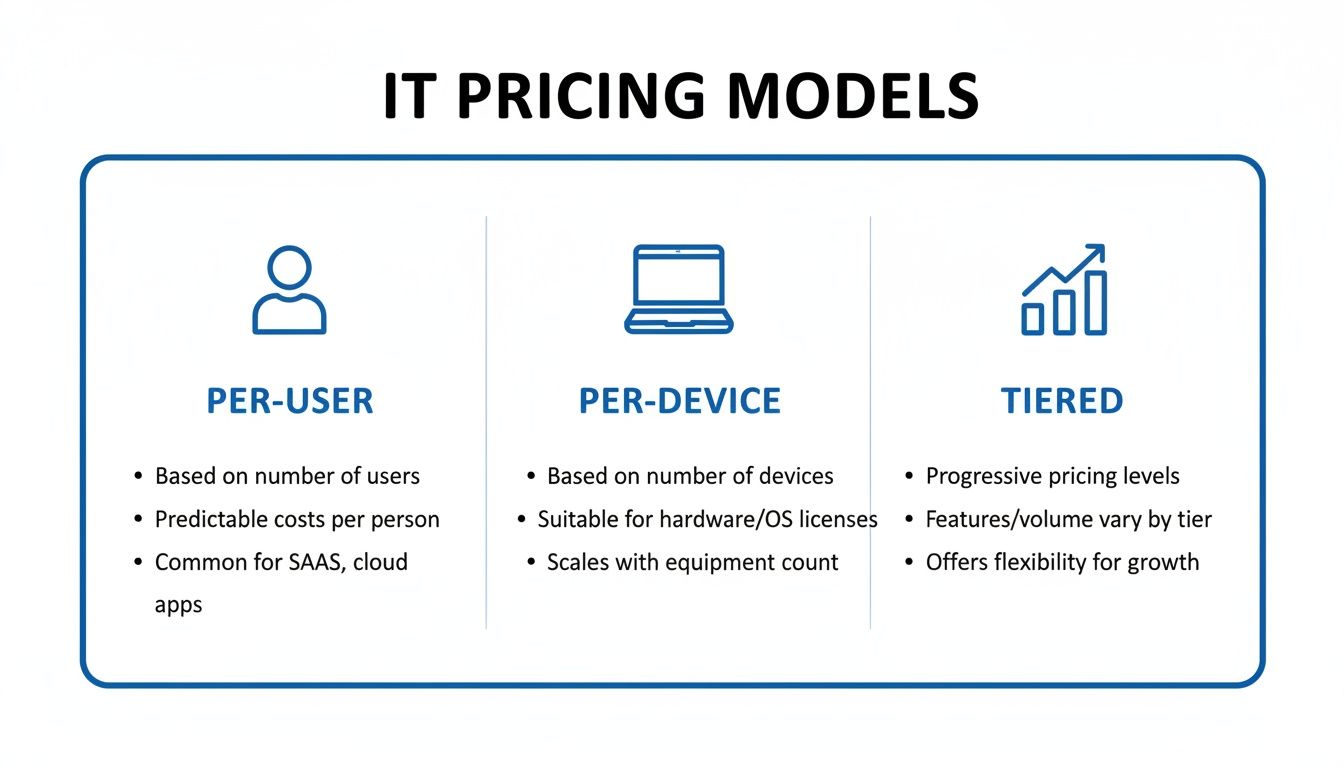
Think of each model as a base price, which is then tailored to your exact operational requirements.
Beyond your technical inventory, the Service Level Agreement (SLA) is a significant cost driver. An SLA that guarantees a 15-minute response for critical incidents requires far more dedicated resources than a standard four-hour guarantee, and your quote will reflect that.
Finding the right balance between cost and service levels is vital. It can be helpful to get a sense of general hourly IT consulting rates for a baseline comparison. For more specialised support packages, you can also explore different IT services for businesses to see how specific solutions are typically bundled.
How to Evaluate and Compare Provider Quotes
When reviewing quotes for managed IT services, it's easy to focus solely on the monthly fee. However, the lowest quote is rarely the best value. The real differentiators are often found in the fine print, revealing significant gaps in service quality, security posture, and strategic alignment with your business goals.
A robust comparison starts by scrutinising the scope of services. Does the proposal include proactive monitoring and preventative maintenance, or is it merely a reactive, break-fix agreement? Proactive support may have a higher initial cost but prevents the significant expense and disruption of downtime. You should also verify if critical security tools like Endpoint Detection and Response (EDR) are included—this is non-negotiable for modern cyber defence.
Key Questions for Every Provider
To conduct a true apples-to-apples comparison, ask every potential provider the same direct questions. Their answers will reveal their operational maturity and the true meaning behind their pricing.
- Onboarding: Is the initial setup, documentation, and transition process included, or is this an additional charge?
- Out-of-Scope Work: What is your hourly rate for projects or tasks that fall outside the main agreement?
- On-Site Support: Are on-site visits covered in the monthly fee, or are they billed separately?
- Response vs. Resolution: Does your SLA guarantee a response time (an acknowledgement) or a resolution time for critical issues? The difference is significant.
The most insightful comparison focuses on business outcomes. A provider whose quote is built around minimising risk, ensuring business continuity, and supporting your growth offers a strategic partnership, not just an outsourced helpdesk.
This structured approach is the only way to select a partner that delivers genuine, sustainable value for your business.
Finding The Right Balance Between Cost And Value
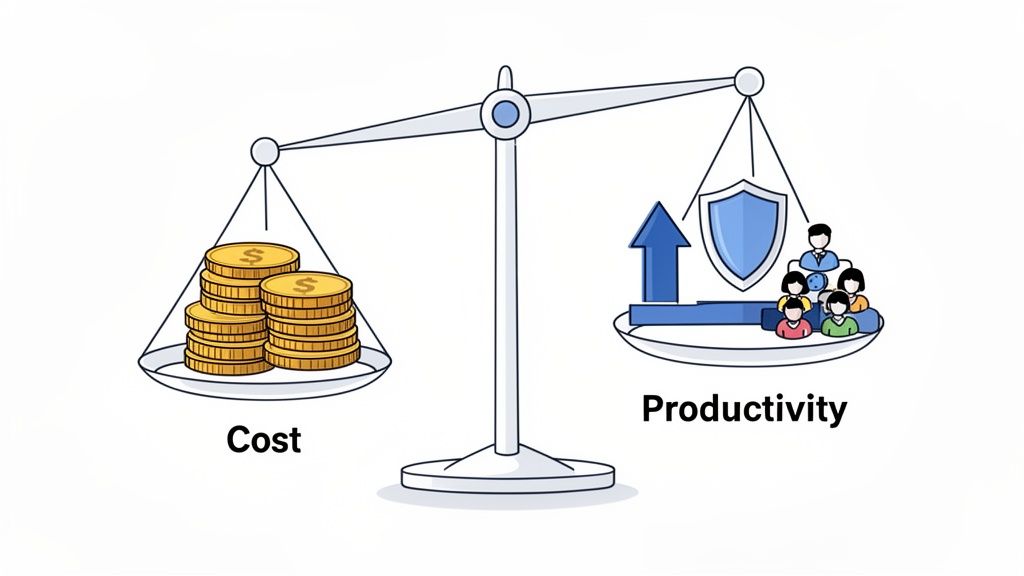
In IT support, the cheapest quote can quickly become the most expensive mistake. It is vital to shift the conversation from cost alone to the overall business value you receive. A strategic IT partnership is about more than fixing technical issues; it delivers a tangible return on investment.
Proactive IT management leads to less downtime, stronger cybersecurity, and a more productive workforce. These are not just abstract benefits—they have a real, measurable financial impact. Consider the hidden costs of inadequate IT support: the reputational damage from a data breach or the operational paralysis when a critical system fails. Those costs can be devastating.
This is precisely why many organisations are increasing their investment in specific security areas. Forecasts show managed security services in the UK are projected to grow at a 9.38% compound annual rate through 2031. This is a clear indicator that businesses are prioritising modern security frameworks. You can see more insights about the UK's IT services market growth on mordorintelligence.com.
Viewing IT as a strategic investment rather than a necessary expense is fundamental. It underpins your organisation's resilience, scalability, and long-term competitive advantage.
Ultimately, understanding this true value helps you see the long-term benefits of managed IT services and make a decision that supports growth, not just short-term cost-cutting.
Your Pricing Questions Answered
When exploring managed IT services, several practical pricing questions consistently arise. Getting clear answers to these is essential before committing to a partnership.
Here are the most common queries we hear from UK businesses, designed to clarify any remaining uncertainties.
What’s a Typical Price Range for Managed IT Services in the UK?
While it varies, most small to medium-sized businesses can expect a per-user cost between £40 to over £100 per month. This range is influenced by the scope of services required, the complexity of your current IT setup, and specific security or compliance demands. The monthly fee is only one component; the real value is detailed in the Service Level Agreement (SLA).
Are There Hidden Costs I Should Watch For?
Yes, hidden costs can exist. Some providers may apply additional charges for the initial setup project, frequent on-site visits, or support outside standard business hours.
A reputable provider will offer complete transparency, itemising exactly what is included and what is extra in their proposal. Always ask for this clarity upfront to avoid future budget surprises.
How Does a Service Level Agreement (SLA) Affect the Price?
The SLA is a primary driver of the final cost. An SLA that guarantees rapid response and resolution times for critical incidents requires the provider to dedicate more resources, which naturally increases the price. For example, a 15-minute response guarantee for a total system failure will always be priced higher than a standard 4-hour guarantee.
Navigating IT pricing should be a transparent process built around your business needs and strategic goals. Many organisations rely on structured IT support to build scalable, secure, and future-ready systems. To gain a clear understanding of how a predictable, value-driven IT strategy can benefit your organisation, a direct conversation is the best next step.
Book a free 30-minute consultation at https://zachsys.com.