
Subtotal $0.00


Understanding what are managed IT services is the first step in transforming your technology from a reactive cost centre into a proactive, strategic asset. Many businesses, particularly small to mid-sized enterprises (SMEs), struggle to manage the complexities of modern IT—from cloud migrations and cybersecurity threats to infrastructure scalability and compliance.
This guide moves beyond simple definitions to offer practical, decision-oriented insights. It is designed to demystify managed IT, providing clear frameworks to help you evaluate, select, and implement a partnership that drives real business value. The right partner doesn’t just fix problems; they build a secure, scalable, and future-ready foundation for growth.
1. Managed IT Services Glossary: Essential Terms and Definitions
To make an informed decision, you first need to speak the language. This glossary demystifies common technical jargon, providing clear definitions for terms you will encounter when evaluating providers. It is essential for aligning technical and non-technical stakeholders, ensuring everyone from the CEO to the IT manager understands the scope and implications of a service agreement. Without this shared vocabulary, comparing proposals or interpreting Service-Level Agreements (SLAs) becomes a significant challenge, often leading to misaligned expectations and costly oversights.
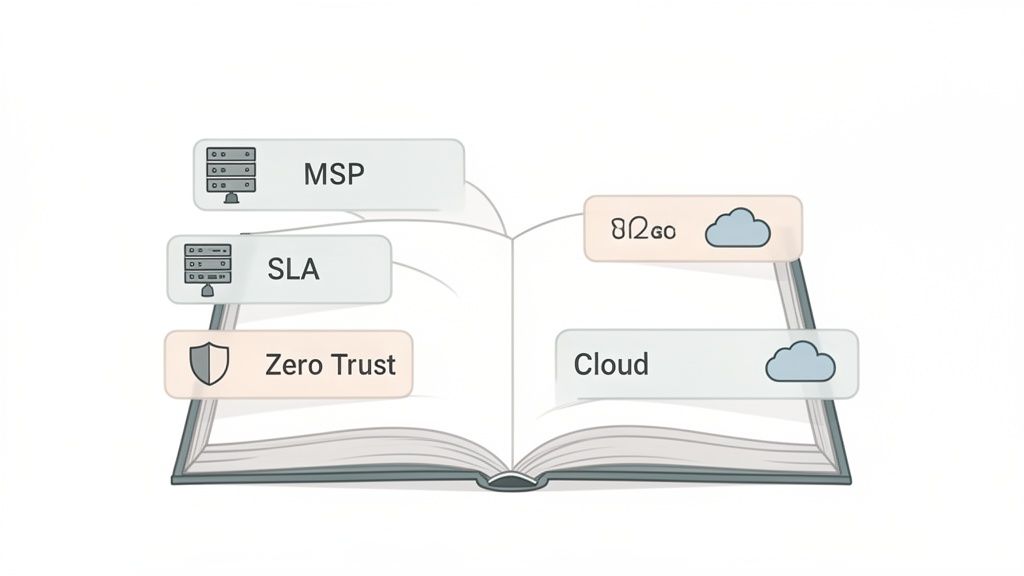
This glossary is particularly useful for clarifying critical business concepts like Recovery Time Objective (RTO) and Recovery Point Objective (RPO) in disaster recovery planning, or for accurately calculating the Total Cost of Ownership (TCO) of a proposed cloud migration. It equips your team to ask more precise questions and better assess a provider’s expertise.
Why It Matters for Your Business:
- Informed Discussions: Use it as a reference during vendor consultations to clarify any unfamiliar terms in real-time.
- Proposal Clarity: Refer to the glossary when reviewing service proposals to ensure you fully understand what is being offered and what is excluded.
- Stakeholder Alignment: Share key definitions with your leadership team to build a common understanding of IT's role in business strategy.
2. Complete Managed IT Services Beginner's Guide
This foundational guide explains in detail what are managed IT services, how they operate, and why so many modern businesses rely on them. It explores the critical shift from reactive break-fix IT support to proactive, strategic management, covering different service delivery models and how a Managed Service Provider (MSP) integrates with your organisation. The content is tailored for businesses looking to modernise legacy systems, enhance security, or move away from an overstretched in-house IT department. For a foundational understanding of one core component, this clear guide on What Is Managed Network Services is an excellent starting point.
The guide is particularly useful for real-world scenarios, like a manufacturing firm moving from on-premises servers to a hybrid cloud environment or a professional services firm implementing Microsoft 365 with managed security. By outlining the core principles, it equips you to understand the strategic value and benefits of managed services that extend far beyond simple IT support.
Why It Matters for Your Business:
- Build Foundational Knowledge: Grasp the core concepts before engaging with potential providers to ensure productive conversations.
- Align Internal Teams: Share the guide with stakeholders to create a common understanding of the MSP model and its business implications.
- Prepare for Consultations: Reference key sections during initial meetings to ask informed, relevant questions about strategy and outcomes.
3. Managed IT Services Provider and SLA Comparison Guide
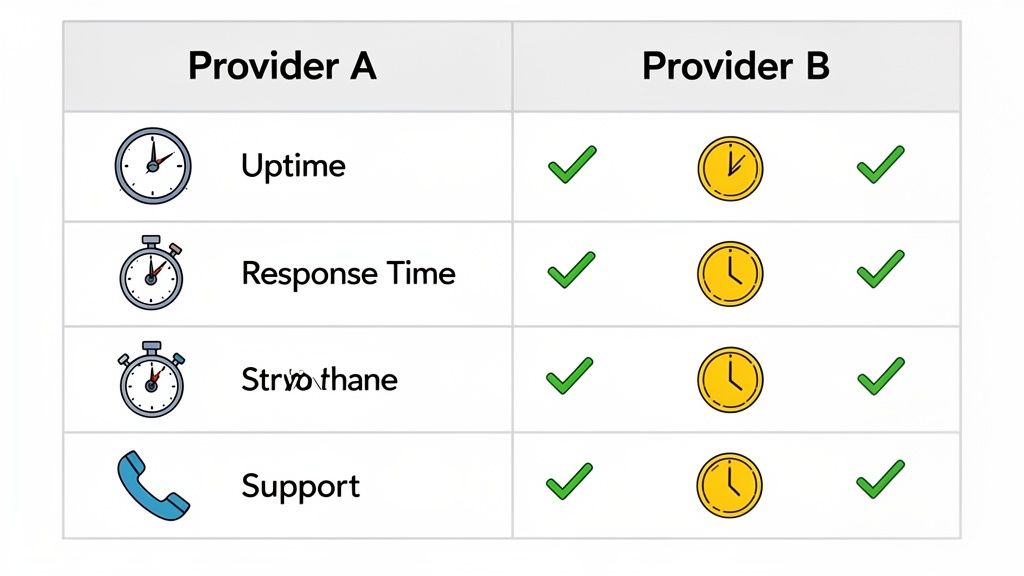
Selecting the right provider is a critical business decision, and a structured comparison framework is essential for making an objective choice. This guide combines provider evaluation criteria with a detailed analysis of Service Level Agreements (SLAs), creating a comprehensive tool to weigh technical capabilities against guaranteed service delivery. It helps you systematically score potential partners on criteria like industry experience, certifications, support models, and security posture, ensuring the chosen provider aligns with your operational and compliance needs. This methodical approach helps avoid decisions based on cost alone, focusing instead on long-term value and risk mitigation.
This process is vital when comparing what managed IT services can offer for specific needs, such as a financial services firm evaluating Zero Trust implementation expertise or an e-commerce business requiring a 99.99% uptime SLA for its platform. Using a weighted scoring system, you can prioritise factors that matter most to your business, from response times for critical incidents to expertise in cloud cost optimisation.
Why It Matters for Your Business:
- Objective Decision-Making: Define weighted criteria before outreach to score providers consistently and avoid subjective bias.
- SLA Clarity: Use the guide to negotiate meaningful SLAs that define uptime, response times, and service credits relevant to your business operations.
- Future-Proofs Investment: Assess a provider's strategic roadmap to ensure they can support your business as it scales and evolves.
4. Managed IT Services Pricing Guide and Cost Modeling
Decoding how providers structure their fees is critical to understanding what managed IT services will truly cost your organisation. This resource clarifies common pricing models—such as per-user, per-device, and tiered packages—and provides a framework for calculating the total cost of ownership (TCO) and return on investment (ROI). It helps you identify potential hidden costs, evaluate pricing transparency, and accurately budget for services, preventing unexpected expenses down the line.
A practical pricing guide is vital when comparing quotes, as it allows you to assess value beyond the monthly fee. For instance, a 50-person firm might see a £8,000 monthly fee for comprehensive services as a significant saving compared to the £120,000 annual cost of an equivalent in-house IT team with benefits and training. For a practical example of how a provider might structure their offerings, explore illumichat's pricing structure. This knowledge empowers you to make a financially sound decision.
Why It Matters for Your Business:
- Accurate Budgeting: Use cost modeling to forecast IT expenditure and avoid financial surprises.
- Vendor Comparison: Analyse itemised quotes to compare services and value between different providers on a like-for-like basis.
- ROI Justification: Calculate TCO savings to demonstrate the financial benefits of managed services to stakeholders and secure budget approval.
5. Managed IT Services for Cloud Migration: Comprehensive Whitepaper
This technical whitepaper outlines how managed IT services are fundamental to executing and optimising complex cloud migrations. It provides a strategic roadmap covering initial discovery and assessment, different migration methodologies (like rehost or refactor), and the critical security hardening required during the transition to platforms such as Azure or AWS. The document is invaluable for understanding not just the technical steps, but also the financial aspects, including cost optimisation strategies (FinOps) and post-migration performance management.
This resource is essential for any organisation considering a move from on-premises infrastructure. For example, it details how a financial firm can migrate to Azure SQL with a Zero Trust security framework, or how a healthcare provider can shift legacy systems to the cloud while ensuring HIPAA compliance. By exploring these use cases, you can better understand the full scope of what are managed IT services in a cloud context and discover the tangible benefits of cloud migration.
Why It Matters for Your Business:
- Phased Planning: Use the sections aligned with your current migration phase to guide decision-making and project scheduling.
- Risk Assessment: Reference the risk and compliance sections to identify potential organisational pain points before they impact the project.
- Financial Foresight: Apply the cost optimisation strategies during your financial planning to build a realistic and efficient cloud budget.
6. Managed IT Services Security Implementation Checklist
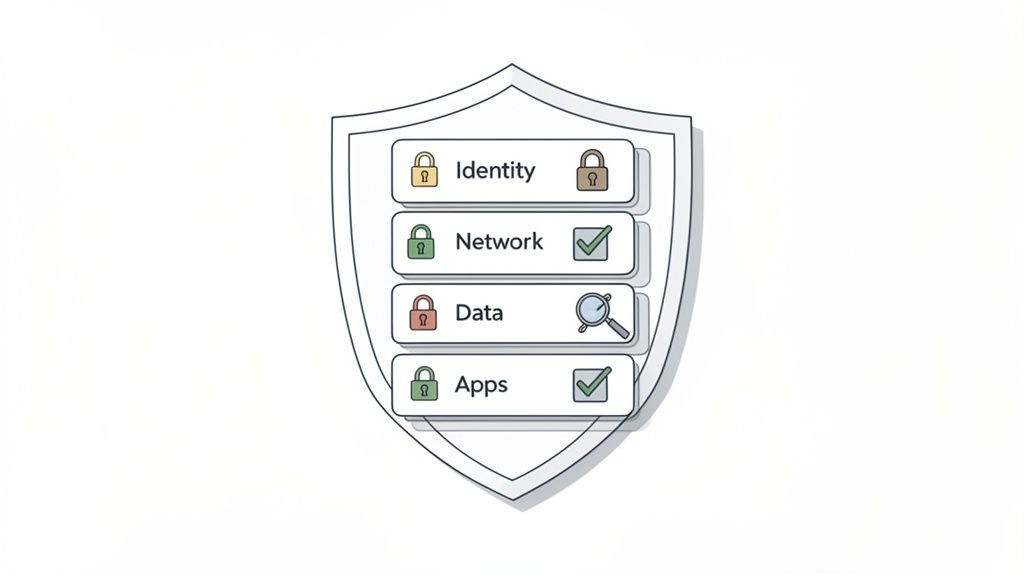
A security implementation checklist is a structured, actionable tool that translates high-level security policies into concrete tasks. It guides businesses and their managed service providers through the essential steps for hardening systems, covering everything from identity and access management (IAM) to ongoing threat monitoring and incident response. This resource is vital for systematically addressing vulnerabilities and ensuring compliance with frameworks like Zero Trust and Cyber Essentials, turning abstract security goals into measurable outcomes. Without a clear plan, critical security controls are often overlooked, leaving dangerous gaps in your organisation's defence.
This checklist is particularly effective for regulated industries, such as a financial services firm implementing Zero Trust principles to meet SOC 2 compliance, or a healthcare provider using it to align with Cyber Essentials Plus requirements. It provides a clear roadmap for implementation, making it easier to track progress and assign accountability. For a deeper dive into structuring your security strategy, you can explore our detailed guide on managed IT security services.
Why It Matters for Your Business:
- Systematic Implementation: Use the checklist to ensure all security bases are covered during initial setup or a security overhaul.
- Compliance & Auditing: Track completion with dates and evidence, creating an audit trail for certifications and regulatory requirements.
- Clear Accountability: Assign ownership of each item to internal team members or your MSP to prevent confusion and ensure follow-through.
7. Managed IT Services FAQ: Common Questions and Expert Answers
Navigating the landscape of managed IT services often raises critical questions for business leaders. This FAQ serves as a vital resource, addressing common concerns about service scope, security responsibilities, and cost predictability before you even engage with a provider. It provides clarity on practical matters, ensuring that initial consultations are productive and focused on your organisation’s specific strategic needs. Without this foundational knowledge, key details about implementation, data ownership, or exit strategies can be easily overlooked.
This resource is particularly effective for aligning expectations on complex topics, such as how an MSP will handle data security during a cloud migration or ensure compatibility with your existing software stack. It demystifies the process, explaining concepts like data portability and knowledge transfer, which are crucial for avoiding vendor lock-in. Answering these questions upfront helps build a transparent and trustworthy partnership from day one.
Why It Matters for Your Business:
- Prepare for Consultations: Review the FAQ to formulate targeted questions for your initial meetings with potential providers.
- Align Stakeholders: Share relevant sections with your team to create a shared understanding of what to expect from a managed partnership.
- Negotiate with Clarity: Refer to specific answers during contract discussions to ensure key terms are clearly defined and aligned with your business goals.
Managed IT Services — 7-Resource Comparison
| Resource | Core focus | Key features | Target audience | Value / Cost & complexity |
|---|---|---|---|---|
| Managed IT Services Glossary: Essential Terms and Definitions | Terminology & concepts for cloud, security, infra | Alphabetical definitions, examples, cross-references, regular updates | Non-technical decision-makers, new IT staff, business leaders | Low cost (informational), low complexity, improves vendor communication |
| Complete Managed IT Services Beginner's Guide | Intro to managed services, models & benefits | MSP vs break-fix, onboarding steps, use cases, cost-benefit framework | Business owners, IT decision-makers new to MSPs, legacy IT leads | Low-medium complexity, strategic overview, good for preparation and buy-in |
| Managed IT Services Provider and SLA Comparison Guide | Vendor evaluation and SLA negotiation framework | Weighted scoring, certification checklist, SLA templates, escalation models | Procurement teams, CIOs, IT directors, regulated industries | High value for selection, medium-high complexity, supports negotiation and compliance |
| Managed IT Services Pricing Guide and Cost Modeling | Pricing structures, TCO and ROI modeling | Per-user/device models, TCO calculator, hidden costs, scenario examples | CFOs, finance teams, procurement, mid-market companies | Direct budgeting impact, medium complexity, essential for cost predictability |
| Managed IT Services for Cloud Migration: Comprehensive Whitepaper | End-to-end cloud migration strategy (Azure/AWS/hybrid) | Discovery, migration strategies, security hardening, FinOps, case studies | CIOs, infra teams, regulated orgs, large enterprises | High technical depth, high complexity, reduces migration risk and surprises |
| Managed IT Services Security Implementation Checklist | Practical security & compliance implementation steps | Zero Trust checklist, Cyber Essentials mapping, IAM, RACI, incident playbooks | CISOs, security/compliance teams, IT directors | Immediate compliance value, medium complexity, requires ongoing updates and maintenance |
| Managed IT Services FAQ: Common Questions and Expert Answers | Answers to common procurement, security and SLA questions | 50+ Qs by category, plain-language answers, integration and exit guidance | Business owners, IT evaluators, finance and compliance stakeholders | Low complexity, quick reassurance, shortens sales cycle but needs periodic updates |
From Information to Action: Partnering for Long-Term Success
You are now equipped with a practical understanding that answers the fundamental question: what are managed IT services? We’ve moved beyond definitions to explore the tangible benefits, service models, and critical business considerations like pricing, security, and compliance. From streamlining helpdesk support to orchestrating a full-scale cloud migration, the strategic value of a managed services partnership is clear. It’s about transforming your IT from a reactive cost centre into a proactive engine for growth and resilience.
The key takeaway is that managed IT is not simply about outsourcing tasks; it’s about gaining a strategic partner dedicated to your long-term success. The resources outlined—from pricing guides to security checklists—provide the foundational knowledge needed to begin this journey with confidence. Mastering these concepts empowers you to make informed decisions, whether you're a small business modernising legacy systems or a regulated organisation hardening your security posture. The ultimate goal is to build a secure, scalable, and future-ready IT environment that aligns perfectly with your commercial objectives. Realising this vision often requires translating this information into a bespoke, actionable roadmap, a process greatly enhanced by expert guidance.
Ready to translate knowledge into a tailored IT strategy? The specialists at zachsys IT Solutions provide the structured guidance and deep implementation experience needed to navigate the complexities of managed IT services. We help organisations like yours build secure, scalable, and resilient systems for sustainable success.