
Subtotal $0.00


Digital transformation services are not about bolting on new technology; they represent a strategic partnership focused on reshaping how your business operates from the inside out. Think of it as a suite of expert-led initiatives designed to weave modern digital solutions into every part of your organisation, from daily operations and security to how you engage with customers.
What Are Digital Transformation Services Really?
Let's cut through the buzzwords. At its heart, digital transformation is about modernising your organisation to stay competitive, efficient, and resilient.
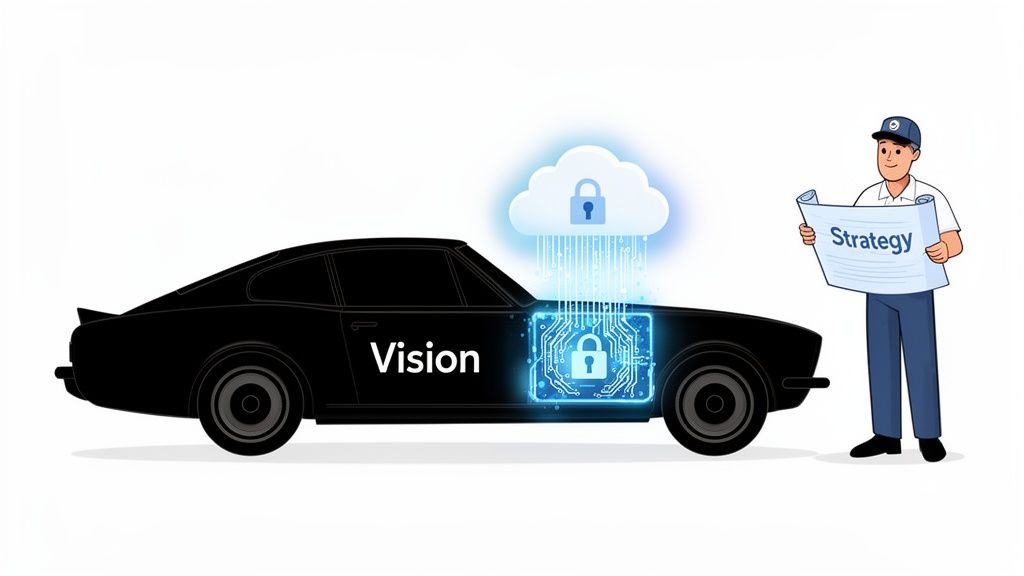
Imagine restoring a classic car. You preserve the iconic design—that's your core business vision—but you upgrade the engine, suspension, and electronics with modern components for better performance, reliability, and safety. Digital transformation services act as the expert mechanics who perform that same kind of upgrade for your business.
This is more than just installing the latest software. It's a fundamental shift in strategy and operations, integrating digital technology into every business area. The goal is to build an organisation that is more agile, efficient, and prepared to handle future challenges.
The Core Pillars of Transformation
Lasting transformation is built on a solid foundation. Real, sustainable change rests on a few key pillars that work together to create a future-ready business:
- Cloud Adoption and Managed Services: This means moving away from rigid on-premise hardware to flexible cloud platforms that scale with your needs and provide predictable cost models.
- Data Intelligence and AI: Your business generates vast amounts of data. This pillar focuses on turning that raw information into a strategic asset that drives smarter, faster decisions.
- Proactive Security: Old-school perimeter defence is no longer sufficient. This involves implementing modern security frameworks like Zero Trust to protect your data and systems in an increasingly complex threat environment.
This is not a theoretical exercise; it's a critical business imperative. In the United Kingdom alone, the digital transformation market reached an estimated USD 42.9 billion in 2024. Projections show it skyrocketing to USD 270.9 billion by 2033, fuelled by government initiatives and the widespread understanding that digital capability is now essential for survival and growth. You can explore the full UK market analysis on imarcgroup.com.
A successful digital transformation is not a one-off project but a continuous process. It requires a clear vision, a structured plan, and the right expertise to connect technology choices with long-term business outcomes.
Ultimately, engaging with digital transformation services means finding a partner who can translate your business goals into a tangible technology roadmap. They provide the strategic thinking and hands-on technical execution needed to build systems that are scalable, secure, and adaptable, ensuring your business is positioned to thrive.
The Building Blocks of a Modern Business
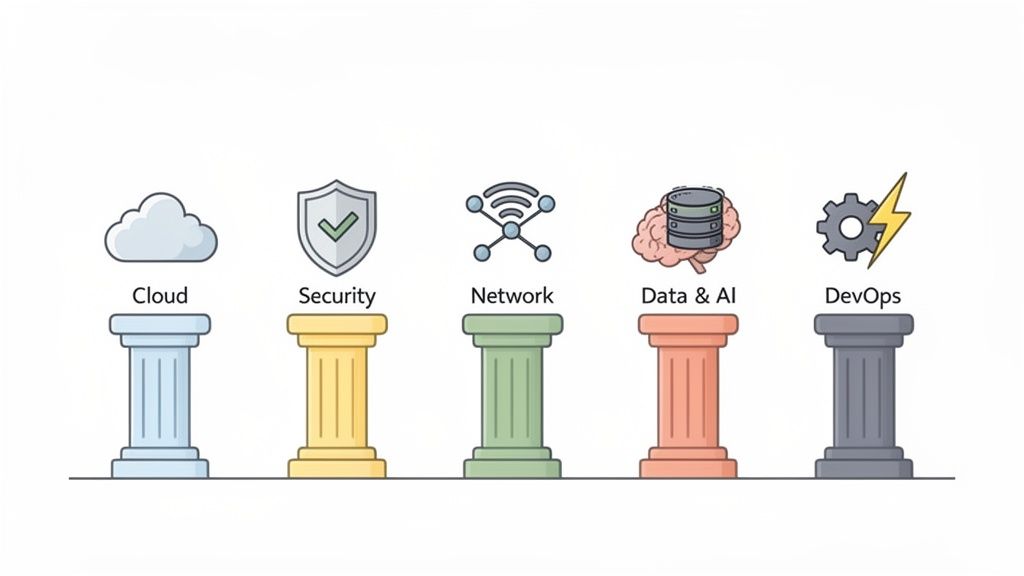
True digital transformation isn't about adding a few new software tools. It’s about building a new foundation for your business—one that is resilient, agile, and ready for the future. This foundation is supported by several interconnected pillars. Getting them right is what separates a short-term tech refresh from a genuine, long-lasting competitive advantage.
Think of it like constructing a modern building. You need a solid foundation (cloud infrastructure), state-of-the-art security systems (Zero Trust), reliable utilities (networking), an intelligent management system (data & AI), and an efficient process for future upgrades (DevOps). Cutting corners on any one of these compromises the entire structure.
Let’s break down each of these critical components.
Cloud and Managed Services
The most fundamental shift is moving beyond rigid, on-premise hardware. Traditional servers are expensive to purchase, complex to maintain, and slow to scale. Cloud platforms like Microsoft Azure fundamentally change the game, converting IT infrastructure from a large capital expense into a flexible, operational one.
This move provides scalability and cost control previously out of reach. If you need more computing power for a seasonal peak, you can provision it in minutes, not months. When demand subsides, you scale back and only pay for what you used. This is the essential first step that enables all other modernisation efforts. To better understand this, explore the strategic benefits of cloud migration in our detailed guide.
Managed services are the other half of this equation. Instead of burdening your internal team with routine maintenance, monitoring, and patching, a managed service provider (MSP) handles it all. This frees your best people to focus on strategic initiatives that drive business growth, rather than just keeping the lights on.
Advanced Security with Zero Trust
In a world of remote work and cloud applications, the old ‘castle-and-moat’ security model is obsolete. Your data and people are no longer contained within a single network. This is where a Zero Trust security framework becomes essential.
The core principle of Zero Trust is simple yet powerful: never trust, always verify. It operates on the assumption that threats can exist anywhere—inside or outside your network. Consequently, it demands strict identity verification for every user and device trying to access company resources, regardless of their location.
This isn't a single product but a layered strategy that includes:
- Identity and Access Management (IAM): Ensuring only the right people access the right data, always enforced with multi-factor authentication.
- Endpoint Protection: Securing every device connecting to your network, from laptops and mobiles to servers.
- Continuous Monitoring: Actively hunting for and responding to suspicious activity across your entire IT environment, 24/7.
Adopting a Zero Trust posture hardens your defences against modern cyber threats, from ransomware to sophisticated phishing attacks.
Modern Networking
Your network is the central nervous system of your business, connecting your people, applications, and data. With distributed teams, reliable and secure connectivity is non-negotiable. Modern networking solutions like enterprise-grade Wi-Fi and Software-Defined Wide Area Networking (SD-WAN) are designed for this reality.
SD-WAN intelligently routes traffic over the most efficient path available, dramatically improving application performance and reducing reliance on expensive private lines. The result is a consistent, secure, and high-performance experience for every employee, whether at headquarters, a branch office, or working from home.
Data and AI Integration
Data is one of your most valuable assets, but it's useless if it remains untapped. The goal is to turn it into actionable insight. This is where modern data platforms and AI come in, transforming raw information into a strategic advantage that fuels smarter, faster decisions.
Tools like Microsoft Purview help govern and manage your data, ensuring it’s accurate, compliant, and secure. By layering on services like Azure OpenAI, you can unlock its full potential—from automating routine tasks to identifying new market trends before your competitors. For a deep dive into its application in finance, see this Strategic AI Transformation Guide for Banking.
DevOps and Automation
To remain competitive, you must deliver new ideas and features to market quickly. DevOps is a set of practices that unites software development (Dev) and IT operations (Ops) with a single goal: to dramatically shorten the development lifecycle.
By automating the processes of building, testing, and deploying software, DevOps enables your teams to release updates and features faster and with fewer errors. This fosters a culture of continuous improvement and innovation, ensuring your business can adapt rapidly to changing customer needs.
Why UK SMEs Are Embracing Transformation
For years, digital transformation was often seen as a domain reserved for large corporations with vast budgets. That has changed. Today, small and mid-sized enterprises (SMEs) across the UK are not just participating; they are often leading the charge, driven by a powerful combination of necessity and opportunity.
Unlike their larger counterparts, SMEs lack the luxury of standing still. They operate in a competitive environment where agility is a core survival skill. The constant pressure to pivot, manage tight budgets, and compete effectively is pushing them to adopt modern technology in a practical, results-oriented way.
This isn't about chasing trends. It’s about solving real business problems with solutions that deliver value without breaking the bank.
The Great Equaliser in a Competitive Market
Historically, a major barrier for SMEs was access to enterprise-grade technology. The cost of building and maintaining on-premise servers, hiring specialist security teams, or developing custom software was prohibitive. Cloud platforms and managed IT services have levelled the playing field.
Tools like Microsoft 365 and Azure act as a great equaliser, giving SMEs access to the same powerful collaboration, security, and data analysis capabilities once exclusive to multinational corporations. Crucially, they do so without the crippling upfront investment, shifting IT costs from a large capital expense to a predictable operational one.
Digital transformation for an SME is fundamentally about democratising capability. It’s about leveraging managed services and cloud platforms to gain enterprise-grade resilience, security, and efficiency on an SME-friendly budget.
This accessibility allows smaller businesses to compete on more equitable terms. It frees them to focus their resources on what truly matters—innovation and customer service—rather than being bogged down by the complexities of managing IT infrastructure.
Responding to Modern Business Pressures
It's not just about keeping up with competitors. A confluence of modern business pressures is accelerating the adoption of digital transformation services. These are not abstract concepts but the daily realities of running a business in the UK today.
- Cybersecurity Threats: SMEs are prime targets for cyberattacks but rarely have the budget for a dedicated security team. Modern, managed security services provide essential protection against threats like ransomware and data breaches.
- Remote and Hybrid Work: The shift to flexible working requires staff to have secure, reliable access to company data and applications from any location. Cloud-based tools are the only practical way to enable this.
- Customer Expectations: Consumers now expect seamless, digital-first experiences. To retain customers, SMEs must deliver with efficient online services and responsive communication.
The momentum is clear. Research forecasts that the UK's SME sector will see a compound annual growth rate of 29.2% in digital transformation adoption through 2030. This is not a gradual shift but a surge driven by the urgent need to integrate digital platforms for both survival and growth, with SMEs leading the way in cloud computing adoption. You can read the full UK market research on researchandmarkets.com.
For UK SMEs considering or already on this journey, exploring tailored solutions for SMEs can provide necessary clarity and resources. Ultimately, these services deliver the agility and resilience required to turn today's challenges into tangible competitive advantages.
Your Practical Digital Transformation Roadmap
Moving from abstract ideas to tangible results requires a clear, structured plan. A successful digital transformation is not a single, giant leap but a series of deliberate, well-managed steps. This blueprint provides direction, minimises disruption, and ensures every action aligns with core business objectives, preventing costly missteps and wasted effort.
A phased approach breaks the complex journey into manageable stages, allowing for continuous feedback and adjustment. Each phase builds upon the last to create a solid foundation for sustainable growth.
Stage 1: Discovery And Assessment
The journey begins with a deep dive into your current state. Before you can build the future, you must thoroughly understand the present. This initial phase involves a comprehensive audit of your existing systems, workflows, and business processes to identify pain points, bottlenecks, and untapped opportunities.
This is not just a technical audit but a strategic analysis. The goal is to answer fundamental questions: Where are we losing time? What processes are hindering growth? Which systems are creating security risks? By mapping your current operational reality against your long-term business goals, you build a clear and compelling case for change.
Stage 2: Strategic Planning
With a clear understanding of your starting point, the next stage is to define your destination. This involves setting clear, measurable objectives, selecting the right technologies, and creating a realistic timeline and budget. A well-defined strategy acts as your North Star, guiding every subsequent decision.
This is where an experienced partner proves their value. They help translate broad business ambitions—like "improve customer satisfaction" or "increase efficiency"—into specific, technology-enabled outcomes. This ensures the plan is not only ambitious but also achievable, secure, and financially sound.
A common failure point is treating transformation as a pure technology project. The most successful roadmaps are those where technology choices are direct answers to specific business challenges, not just solutions looking for a problem.
For UK SMEs, the primary drivers for this planning often fall into three key areas. This flowchart illustrates how businesses use digital services to compete, optimise, and secure their operations.
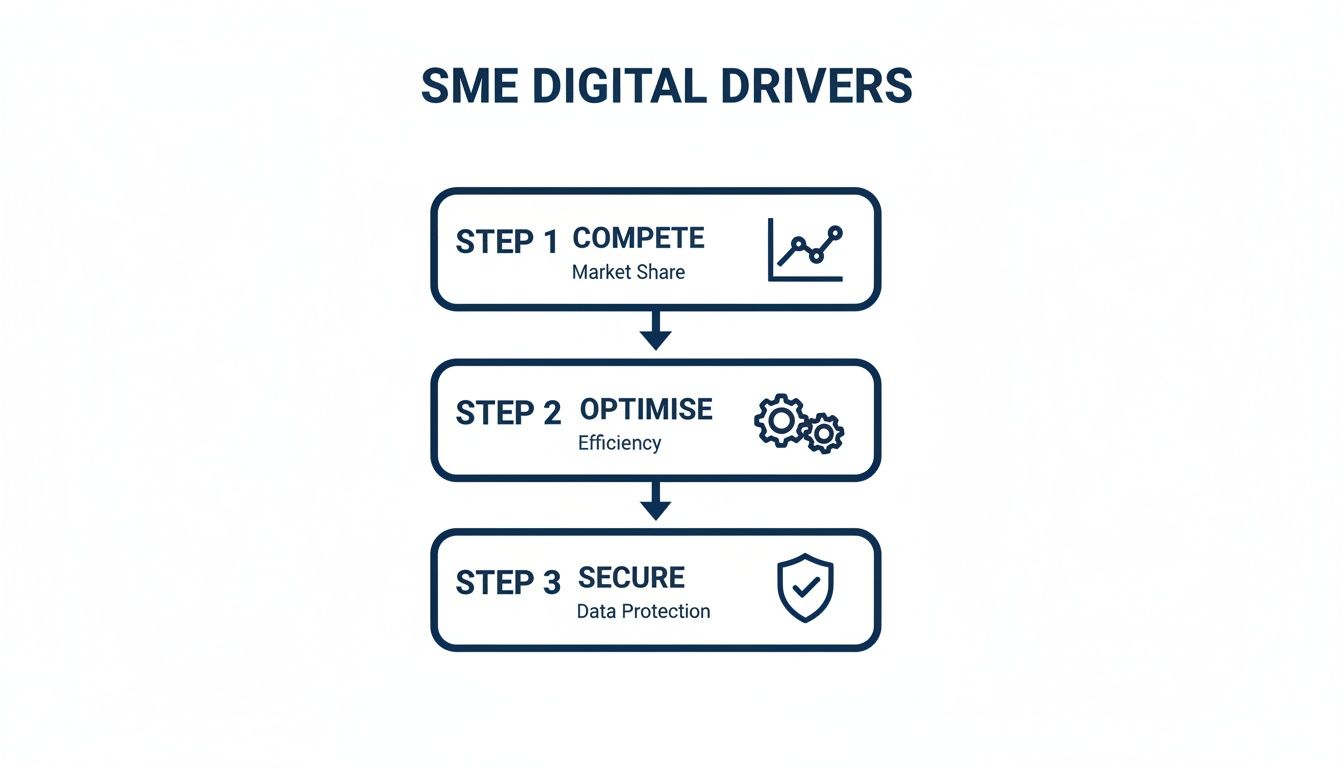
The visualisation highlights that transformation is a multi-faceted strategy focused on gaining a competitive edge, streamlining internal processes, and building a strong security posture.
Stage 3: Foundational Rollout
With a solid plan in place, it's time to build the foundation. Instead of trying to change everything at once, this stage prioritises core infrastructure upgrades that will support all future initiatives. This typically includes critical projects like cloud migration and security hardening.
By establishing a secure, scalable cloud environment and implementing modern frameworks like Zero Trust from the outset, you create a resilient platform for growth. This foundational work de-risks subsequent phases and ensures new applications and services are built on solid ground.
Stage 4: Phased Implementation
Now, you can begin deploying new solutions in manageable, phased rollouts. This iterative approach minimises disruption to daily operations by introducing changes department by department or process by process. It also creates invaluable feedback loops.
Deploying in smaller stages allows you to gather user feedback, identify issues early, and make continuous improvements. This agile methodology ensures the final solutions are well-adopted and aligned with user needs, boosting the overall return on investment. The insights gathered are also critical for refining your broader strategy; strong data governance best practices are key to making sense of this feedback.
Stage 5: Ongoing Optimisation And Support
Finally, it is crucial to understand that digital transformation is not a one-off project with a finish line. It is a continuous process of improvement and adaptation. The business environment, customer expectations, and technology itself are constantly evolving.
This final, ongoing stage involves expert management to control costs, maintain a robust security posture, and adapt to new challenges and opportunities. A dedicated partner provides the structured IT support necessary to ensure your systems remain scalable, secure, and future-ready, turning your initial investment into a lasting competitive advantage.
Choosing the Right Transformation Partner
Embarking on a digital transformation journey is one of the most significant strategic moves a company can make. The success of that journey often depends less on the technology itself and more on the partner you choose to guide you.
Selecting the right provider is not just about procuring a service; it's about finding a team that understands your business goals and is committed to your long-term success. A great partner translates your objectives into a practical, secure, and scalable technology roadmap. The wrong one can lead to expensive mistakes, security vulnerabilities, and a return on investment that never materialises.
Proven Expertise and Official Certifications
First, look for verifiable proof of expertise. While anyone can claim to be an expert, official certifications and partner statuses are tangible indicators of capability. They demonstrate that a provider has met high standards for technical knowledge, service delivery, and customer success.
For example, credentials like a Microsoft Solutions Partner designation are significant. This is not just a badge; it means Microsoft has validated their skills in critical areas like infrastructure, data & AI, or modern work. It shows a deep, ongoing investment in training and a proven history of successful project delivery.
End-to-End Capabilities
Digital transformation is a continuous cycle of strategy, implementation, and ongoing management. A partner with end-to-end capabilities can support you at every stage, from initial discovery to final rollout and beyond.
This integrated approach is crucial because it prevents important details from falling through the cracks. It means the team that designs your cloud architecture is the same one that will manage and secure it, creating a seamless process with clear accountability. You need a partner who can provide robust Microsoft Azure managed services to ensure your environment runs smoothly long after the initial setup.
A Security-First Approach
In today's environment, security cannot be an afterthought—it must be the foundation of your entire strategy. A top-tier partner operates with a security-first mindset, embedding modern principles like Zero Trust into every solution they design from the ground up.
A partner’s commitment to security should be evident in their methodology. Ask how they approach identity verification, data protection, and threat monitoring. Their answers will reveal whether security is part of their DNA or just another line item on a proposal.
Their approach must go beyond traditional firewalls, focusing on proactive threat detection and response to protect your most valuable assets. This is especially vital as the UK digital transformation market is projected to reach £47.33 billion in 2025, with cybersecurity being a primary driver for businesses moving away from legacy IT. You can read more about the UK's market growth on archivemarketresearch.com.
Transparent Processes and Relevant Experience
Finally, look for a partner with a clear, well-defined process and a portfolio of successful projects with businesses similar to yours. They should be able to walk you through their engagement model, from the initial conversation to ongoing support, so you know exactly what to expect at every step.
Do not hesitate to ask for case studies or references from clients in your industry or of a similar size. This relevant experience is invaluable because it demonstrates they understand the unique challenges and opportunities you face. A true partner is invested in your success, offering the strategic guidance that helps organisations build secure, future-ready systems.
To help you vet potential partners, we've created a practical checklist. Use it to compare providers and ensure you're asking the right questions.
Vendor Selection Checklist
| Evaluation Criteria | What to Look For | Red Flags to Avoid |
|---|---|---|
| Industry Expertise | Case studies and client testimonials from your specific industry. They should speak your language. | Generic, one-size-fits-all solutions. A lack of familiarity with your sector's compliance or operational needs. |
| Technical Certifications | Official partner statuses (e.g., Microsoft Solutions Partner) and individual engineer certifications. | Vague claims of "expertise" without any verifiable credentials or proof. |
| Security Methodology | A clear commitment to a security-first approach, like Zero Trust. Security should be embedded, not bolted on. | Treating security as an optional add-on or a separate service package. |
| Cultural Fit & Communication | A collaborative and transparent communication style. Do they feel like an extension of your team? | Poor responsiveness, unclear communication, or a rigid "our way or the highway" attitude. |
| End-to-End Service Model | The ability to handle strategy, implementation, security, and long-term managed services under one roof. | Outsourcing core functions to other vendors, which can lead to accountability gaps and finger-pointing. |
| Roadmap & Scalability | A forward-looking approach that plans for your future growth, not just your immediate needs. | A focus only on the initial project with no discussion of long-term support, optimisation, or scalability. |
Choosing the right partner is the most important decision you will make. A great one will feel less like a vendor and more like an integral part of your team, dedicated to helping you navigate the complexities of technology and achieve real business outcomes.
Building Your Future-Ready Business
Digital transformation is not a project with a finish line; it is a continuous journey toward making your business more resilient, efficient, and ready for growth. The goal is to move beyond one-off fixes and embed a culture of constant adaptation, where technology serves as the engine for competitive advantage. The true aim is to build an organisation that is not just efficient today but agile enough to thrive tomorrow.
This journey delivers tangible, business-defining results. By modernising core systems, you can unlock significant gains in operational efficiency, automating routine tasks to free your team for high-value work. You also build a robust security posture, shifting from a reactive defence to a proactive Zero Trust framework that guards your data, reputation, and customer trust against ever-present threats.
The Path to Sustainable Success
Achieving these results depends on a clear, structured approach. A well-defined roadmap, like the one outlined above, provides the clarity needed to navigate this complex process. It ensures every investment is deliberate and aligned with your long-term vision. This strategic planning is what prevents costly mistakes and transforms abstract goals into measurable outcomes.
However, a roadmap is only as good as the experts guiding you. The complexities of cloud migration, cybersecurity, and data integration demand specialist knowledge that most businesses lack in-house. An experienced partner plays a critical role, providing the structured IT support and strategic guidance needed to turn your vision into a secure, scalable, and future-proof reality.
Digital transformation is fundamentally about readiness. It’s the ongoing commitment to evolving your people, processes, and platforms to meet future challenges and seize new opportunities before your competitors do.
Your Next Strategic Conversation
The first step is always the most critical: gaining an honest assessment of your digital maturity. Understanding where you are now is essential to mapping out what is possible for your business. A strategic conversation can help you move from a place of uncertainty to a clear, actionable plan.
An initial consultation should be a collaborative workshop, not a sales pitch. It is an opportunity to explore your goals, assess your current environment, and identify the steps that will deliver the greatest impact. This value-first dialogue is the logical starting point for building a more resilient, efficient, and competitive business.
Frequently Asked Questions
When it comes to digital transformation, business leaders often have similar questions. Here are straightforward answers to help you move forward with clarity and confidence.
How Long Does a Digital Transformation Project Take?
There is no single answer, as the timeline depends entirely on the scope and complexity of the initiative. A focused project, such as migrating a single application to the cloud, might take a few weeks. In contrast, a comprehensive transformation affecting multiple systems, processes, and teams could take 12 to 24 months or longer.
The timeline is influenced by:
- The complexity of your existing IT environment.
- The scope and ambition of your goals.
- The readiness of your organisation to adopt new ways of working.
Experience shows that a phased approach delivers the best results. Delivering value in small, incremental steps is far more effective and less risky than a "big bang" launch.
What Is the Most Common Reason These Initiatives Fail?
Failure is rarely due to the technology itself. The most common reason digital transformations falter is a lack of clear vision and executive buy-in. If leadership does not consistently champion the change and communicate its importance, the initiative will lose momentum.
Other significant hurdles include:
- Employee resistance to adopting new tools and processes.
- An unclear strategy that fails to connect technology investments to business outcomes.
- Treating transformation as just another IT project rather than a fundamental business evolution.
Successful transformation is as much a cultural shift as it is a technological one. It requires aligning your people, processes, and platforms around a single, shared objective.
Can We Transform in Stages to Manage Cost?
Absolutely—in fact, this is the recommended approach. Attempting to overhaul everything at once is high-risk, disruptive, and can quickly exhaust your budget and your team's morale.
By breaking the journey into manageable phases—such as starting with foundational security, then moving to cloud migration, and later focusing on data analytics—you can:
- Manage costs effectively with predictable, milestone-based investments.
- Demonstrate early wins to build momentum and maintain stakeholder support.
- Minimise disruption to daily operations.
- Learn and adapt as you go, refining your strategy based on real-world feedback.
This iterative method ensures each step delivers tangible value, de-risking the overall investment and setting you up for sustainable success. Working with an experienced partner helps map this journey, ensuring each phase builds logically on the last.
Navigating modern IT requires a clear strategy and expert execution. At zachsys IT Solutions, we provide the structured support and guidance organisations need to build secure, scalable, and future-ready systems. Book a free, no-obligation consultation today to discuss your business goals.