
Subtotal $0.00


Data protection consulting is a strategic service designed to help businesses navigate complex data privacy laws and defend against persistent cyber threats. It's not just an IT task, but a crucial partnership that aligns how you handle data with legal requirements like GDPR. The goal is to safeguard your organisation from significant fines and, more importantly, build lasting trust with your customers.
What Is Data Protection Consulting Really About?
Imagine trying to navigate complex litigation without a solicitor. That’s a close analogy for managing data in today’s regulatory environment without expert guidance. A data protection consultant acts as that specialist, guiding your business through the intricate web of privacy regulations and security risks.
This is not about simply ticking compliance boxes. It is a strategic partnership designed to protect your most valuable asset—your data—in an environment where threats are a constant reality. This elevates data protection from a technical IT function to a core business discipline.
A consultant serves as the architect of your data security framework. They develop a detailed blueprint covering everything from technical controls like encryption and access management to the operational policies your team needs to follow daily to minimise human error.
More Than Just A Compliance Checkbox
Effective data protection is not a one-off project; it’s an ongoing discipline that must be woven into your company's culture. Consultants help embed this mindset, transforming compliance from a reactive burden into a proactive business advantage. Their ultimate purpose is to help build an organisation that is both resilient and trustworthy.
At its core, the engagement aims to answer critical questions that challenge many business leaders:
- Do we have a complete and accurate picture of where all our sensitive customer data is stored and processed?
- Are we genuinely compliant with GDPR and other regulations applicable to our operations?
- If we experience a data breach, do we have a clear, tested plan to respond effectively and minimise damage?
- Is our team sufficiently trained to recognise and prevent security incidents before they escalate?
By addressing these points head-on, a consultant helps you manage operational risk, protect your brand reputation, and build deeper trust with your customers.
A strong data protection strategy is fundamental to modern business. It's the bedrock upon which customer trust is built and the shield that protects a company's reputation and financial stability in the face of evolving digital threats.
Data protection consulting provides a structured framework to achieve these outcomes. Let's break down the key areas and what they deliver for your business.
Core Components of Data protection Consulting
This table summarises the primary functions and business benefits delivered through expert data protection consulting services.
| Consulting Area | Business Outcome |
|---|---|
| Risk Assessments & Gap Analysis | Identifies specific vulnerabilities in your current systems and processes, enabling proactive remediation. |
| GDPR & Regulatory Compliance | Ensures you meet legal obligations, helping to avoid significant fines and reputational damage. |
| Policy & Process Development | Creates clear, practical guidelines for your team, reducing human error and fostering a security-conscious culture. |
| Technical Control Implementation | Deploys tools like encryption and access controls to secure data across your systems, including platforms like Microsoft Purview. |
| Incident Response Planning | Develops a clear, actionable plan to minimise damage and recover quickly from a data breach. |
| Ongoing Monitoring & DPO Services | Provides continuous oversight to adapt to new threats and maintain compliance over the long term. |
Ultimately, these services work in concert to create a holistic security posture that supports, rather than hinders, your business objectives.
A Growing Sector For A Critical Need
The surging demand for this expertise is mirrored in the rapid growth of the UK’s broader cyber security sector. This industry, which is deeply connected to data protection, generated £13.2 billion in revenue in its most recent reporting year—a 12% annual increase. You can find out more about the UK's cyber security sector growth on GOV.UK.
This growth makes one thing clear: investing in expert guidance is no longer a discretionary spend. It is a vital step for any organisation that wants to operate securely and successfully in the modern economy. A data protection consultant brings the specialised knowledge needed to build a security posture that is not only compliant but also resilient enough to withstand modern threats.
Their work is a unique blend of legal know-how, technical skill, and business acumen. This balanced approach ensures that security measures are practical, effective, and aligned with your commercial objectives, ultimately protecting your business for the long haul.
The Core Services of a Data Protection Consultant
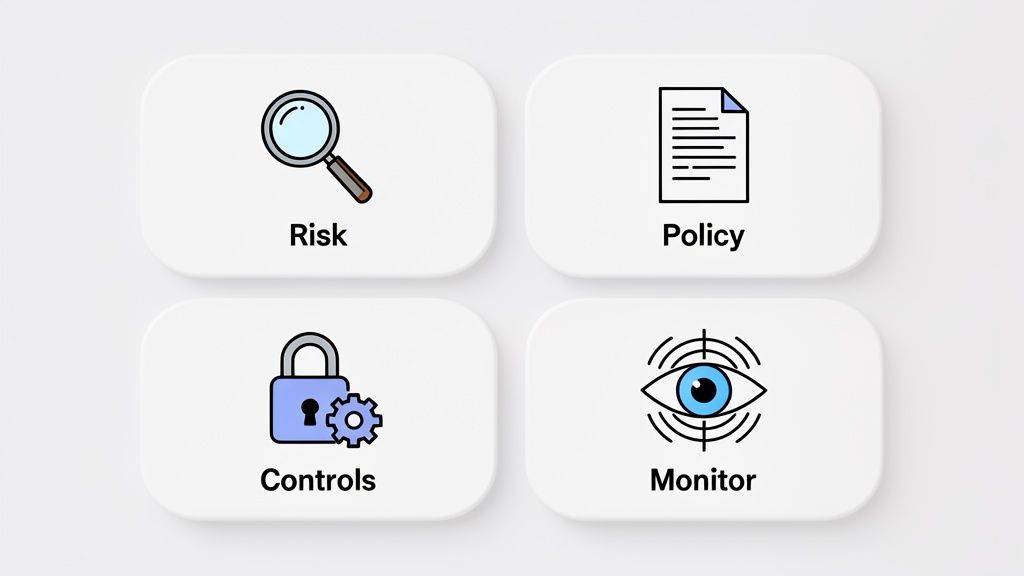
Engaging a data protection consultant is the difference between guesswork and establishing a structured, defensible security posture. Their work is a practical mix of high-level strategy, technical execution, and operational guidance, all grounded in your specific business reality.
So, what does this look like in practice? Let's unpack the tangible services you should expect. The process almost always begins with a deep-dive diagnostic—before you can protect your data, you have to understand where it is, how it moves, and what risks it faces.
Risk Assessments and Gap Analysis
Think of a risk assessment as a comprehensive health check for your organisation's information assets. A consultant will meticulously map your entire data landscape, identifying everything from customer databases and employee files to valuable intellectual property. The objective is to find the weak spots before a threat actor does.
This involves analysing your current policies, technical configurations, and operational procedures to benchmark them against regulations like GDPR and established security frameworks. The result is a clear gap analysis. This report doesn't just list problems; it highlights precisely where your defences fall short and provides a prioritised roadmap for remediation.
Policy and Process Development
Once the risks are understood, the next step is to develop the rulebook for your team. Effective policies are not generic templates. They must be practical, easy-to-follow documents that genuinely guide people in their daily work, and creating them is a central part of a consultant's role.
A consultant will work with your teams to build and refine key policies, including:
- Data Handling Policies: Clear rules on how sensitive information should be collected, stored, and shared securely.
- Acceptable Use Policies: Outlining what is expected of staff when using company systems and data.
- Incident Response Plans: A step-by-step playbook detailing what to do the moment a breach is suspected.
These documents are fundamental to building a culture of security where everyone, from the top down, understands their role in protecting the company’s data.
A well-crafted policy is more than a compliance document; it's a strategic tool that embeds security into the fabric of your organisation, reducing human error and empowering your team to make safe, informed decisions every day.
Consultants also bring clarity to roles and accountability. For instance, defining the Data Protection Officer responsibilities correctly is crucial for effective governance, and their guidance ensures there are no ambiguities.
Technical Control Implementation
With a solid strategy and clear policies in place, the focus shifts to technology. A consultant helps you select and implement the right technical controls to fortify your defences. This is not about acquiring the latest security tool; it's about deploying solutions that solve your specific problems effectively.
Common technical projects include implementing:
- Encryption for data, whether it is stored on a server (at rest) or moving across the network (in transit).
- Access Control Systems that enforce the "principle of least privilege," ensuring people can only access the data they absolutely need to perform their jobs.
- Data Loss Prevention (DLP) tools that act as a gatekeeper, monitoring and preventing sensitive information from leaving your network without authorisation.
By aligning the right technology with your policies, you create a layered defence that is much more difficult to penetrate.
Continuous Monitoring and Advisory Services
Data protection is never a "one and done" project. Threats evolve, regulations change, and your business adapts. Consequently, ongoing oversight is vital to ensure your security posture does not degrade over time.
This is where a consultant can provide continuous monitoring or act as a long-term advisor. This might involve conducting periodic audits, performing vulnerability scans, or even serving as your outsourced Data Protection Officer (DPO). This kind of sustained partnership helps your business remain agile and resilient in the face of new challenges. For a deeper look at the principles behind this, explore these data governance best practices that are key to long-term success.
Making the Most of Microsoft’s Built-in Data Protection Tools
Many businesses are surprised to learn they already possess a wealth of data protection features within their existing Microsoft 365 and Azure subscriptions. The primary challenge is often not a lack of technology, but the expertise to configure and manage these tools to meet strict regulatory demands. This is precisely where a data protection consultant proves their value, bridging the gap between owning the tools and using them effectively.
An expert can help you transform your Microsoft environment from a collection of office applications into a powerful, integrated command centre for data protection. This ensures your technology investment directly supports your security and compliance goals, rather than leaving critical features unused while risks go unaddressed.
Microsoft Purview: Your Data Command Centre
At the centre of Microsoft's data protection ecosystem is Microsoft Purview. It serves as a unified hub for data governance, risk, and compliance management. It is designed to help you answer fundamental questions like, "Where is our sensitive data?" and "Who has access to it?"
You cannot protect what you cannot see, and that is the first problem Purview solves. It provides the tools to discover, classify, and manage data across your entire organisation—from on-premises servers to cloud services like SharePoint and Teams.
Here's a look at the Microsoft Purview compliance portal, which gives you a single, unified view of your organisation's data governance and risk management status.
This dashboard consolidates critical functions into one interface. At a glance, you can gain insights into data classification, information protection, and compliance, making it an ideal starting point for any data protection initiative.
A consultant’s role is to translate these features into practical, real-world solutions. For instance, they can configure Purview's sensitivity labels to automatically classify and encrypt any document containing personally identifiable information (PII) the moment it is created. We explain more about how to maximise your data governance with Microsoft Purview in our detailed guide. This proactive approach shifts your organisation from reacting to security incidents to preventing them by design.
Building a Zero Trust Security Model
Beyond data discovery, Microsoft’s tools are essential for implementing a Zero Trust security model. This modern security philosophy operates on a simple but powerful principle: never trust, always verify. It assumes that a breach is inevitable or has already occurred, thereby eliminating the outdated concept of a "trusted" internal network.
Implementing Zero Trust is not about buying a single product; it is a strategic approach that integrates several key Microsoft technologies:
- Azure Active Directory (Azure AD) acts as the gatekeeper, ensuring every user and device is authenticated before gaining access.
- Conditional Access Policies serve as the rulebook, allowing you to enforce granular controls based on user identity, location, device health, and application sensitivity.
- Microsoft Defender provides continuous monitoring, detecting and responding to suspicious activity across endpoints, identities, and cloud applications.
A data protection consultant helps weave these technologies into a cohesive security fabric. They ensure your Zero Trust architecture is not only technically sound but also practical for your team, striking the right balance between robust security and operational efficiency.
A Zero Trust architecture fundamentally changes the security conversation from "How do we keep threats out?" to "How do we ensure every access request is legitimate, regardless of its origin?" This shift is critical for protecting data in a world of remote work and cloud-based systems.
The demand for this expertise is growing rapidly. In the UK, the IT security consulting industry has experienced significant expansion. Revenue has climbed at a compound annual growth rate (CAGR) of 5.2% over the last five years, reaching an estimated £12.8 billion. This growth is a direct reflection of the increasing complexity of securing data. You can explore the full IT security consulting industry report for more details. It underscores the immense value that specialist knowledge brings to unlocking the full security potential of your Microsoft investment.
How to Choose the Right Data Protection Consultant
Selecting a data protection consultant is a significant decision. You are entrusting an individual or firm with access to your most sensitive operational details. The right partner can serve as a strategic guide, while the wrong one can lead to wasted investment and persistent risks.
You need to look beyond generic sales pitches and focus on three core areas: technical expertise, relevant industry experience, and their engagement model. A consultant who excels in all three will deliver real, lasting value, not just a one-off report. Think of it as investing in a long-term security partnership, not just purchasing a service.
Assess Their Technical and Business Acumen
First, a consultant must be technically proficient. Look for certifications that demonstrate expertise with the technologies your business relies on. If you operate within the Microsoft 365 and Azure ecosystem, credentials like the Microsoft Certified Security Operations Analyst or Identity and Access Administrator are strong indicators of hands-on skill. This shows they can translate abstract security principles into concrete configurations within your environment.
However, technical skill is only half the equation. You need a partner who understands business context. A great consultant doesn’t just recite GDPR articles; they ask about your revenue streams, commercial goals, and how data underpins your core processes. This business-first approach ensures their advice is practical, proportionate, and aligned with your operational realities.
The best data protection consultants are bilingual—they speak the language of technical security and the language of business strategy. Their real value is in bridging that gap, making sure security enables your growth, rather than getting in the way.
Verify Relevant Industry Experience
Data protection is not a one-size-fits-all discipline. The challenges a financial services firm faces are vastly different from those in healthcare or retail. Therefore, industry-specific experience is non-negotiable. An expert who understands your sector’s unique regulations, common threats, and operational challenges will provide far more targeted and valuable advice.
The UK consulting market highlights the importance of this specialisation. The technology consulting segment is projected to grow at a 6.23% CAGR through the decade. Financial services currently hold the largest market share at 24.63%, driven by stringent regulations. However, healthcare is expanding rapidly with a predicted 9.44% CAGR, largely due to NHS digital transformation initiatives that place a heavy emphasis on cybersecurity. You can discover more about these UK consulting market trends to see how sector expertise is driving demand.
When speaking with potential partners, ask for case studies or references from businesses similar to yours. It is the most effective way to verify they have a proven track record of solving the types of problems you are facing.
Understand Their Engagement Model
Finally, understand how they work. Avoid rigid, off-the-shelf packages that do not account for your unique circumstances. A true partner begins by listening, seeking to understand your specific pain points and objectives before proposing a solution.
Look for an engagement model that is flexible, transparent, and collaborative. The process should feel like a partnership from the initial conversation. A positive sign is an offer for a brief, no-obligation discussion to understand your needs. From there, they should outline a clear plan with distinct phases, deliverables, and metrics for success. This structured yet adaptable approach ensures the project remains focused on your goals and builds a foundation for sustainable, long-term security.
What A Typical Consulting Engagement Looks Like
Engaging a data protection consultant is a far more structured and collaborative process than many assume. It is not about handing over control; it is a partnership designed to build your organisation's resilience from the inside out.
Think of it as a guided journey. It moves methodically from understanding your unique challenges to implementing lasting solutions, with your consultant acting as a trusted navigator every step of the way.
Stage 1: The Initial Discovery And Scoping
The process begins with a conversation. The first step is typically a no-obligation discovery call where the consultant's primary objective is to listen. They need to understand your specific business, your commercial goals, and the data protection challenges that are causing concern.
This phase is about building a shared understanding. You will discuss your current setup, your primary worries—whether GDPR compliance, securing a remote workforce, or passing a client audit—and what a successful outcome looks like for you. It is here that a good consultant gauges the scope and ensures they are the right fit for your needs.
Stage 2: Developing A Tailored Strategic Plan
Once they understand your environment, the consultant develops a strategic plan. This is a bespoke roadmap built from your initial discussions, not a generic template. It outlines a clear, phased approach to addressing your specific vulnerabilities and achieving your compliance targets.
Typically, this plan will include:
- A Statement of Work: Defining precisely what will be delivered and by when.
- Prioritised Actions: Identifying the most significant risks first and the immediate steps to mitigate them.
- Resource Allocation: Recommending the right mix of policy updates, technology implementation, and team training.
- Success Metrics: Agreeing on how progress and success will be measured.
This document becomes the blueprint for the entire engagement, ensuring all stakeholders are aligned and working toward the same goals.
A well-defined strategic plan transforms data protection from a vague, intimidating challenge into a series of manageable, actionable steps. It provides the clarity and direction needed to move forward with confidence and purpose.
Stage 3: Implementation And Ongoing Support
With a solid plan approved, the practical work begins. This is a hands-on, collaborative phase where the consultant works alongside your team to implement the required changes. This could involve rewriting data handling policies, conducting staff training sessions, or configuring security tools within your Microsoft 365 environment.
Delivery is often iterative, allowing for flexibility and continuous feedback. This ensures the solutions are not only technically sound but are also practical for your team to adopt in their daily workflows.
Choosing the right partner for this journey is critical. The infographic below highlights three core steps to get it right.
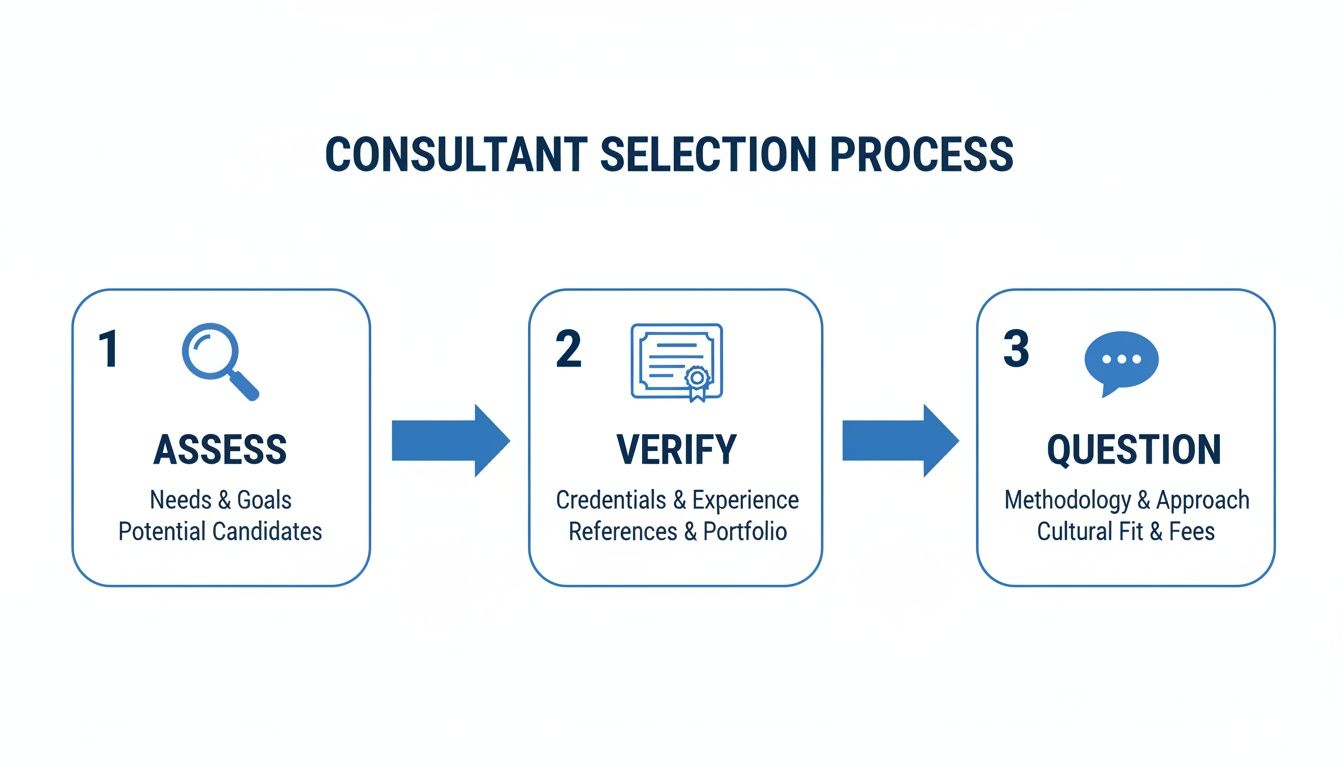
This structured approach—assessing expertise, verifying experience, and asking the right questions—is fundamental to finding a partner who can see the engagement through successfully, from discovery to delivery.
Once the initial project goals are met, the relationship often evolves. Many businesses retain their consultant for ongoing advisory services, ensuring they remain protected as new threats and regulations emerge.
To provide a clearer picture, here’s a breakdown of the entire lifecycle.
A Typical Consulting Engagement Lifecycle
| Phase | Key Activities | Primary Outcome |
|---|---|---|
| 1. Initial Consultation | Free 30-minute call to discuss pain points, business context, and high-level goals. | Mutual understanding of the core problem and confirmation of a good potential fit. |
| 2. Scoping & Proposal | Deep-dive analysis of needs, leading to a detailed Statement of Work (SOW). | A clear, costed plan with defined objectives, deliverables, timelines, and success metrics. |
| 3. Foundational Work | Gap analysis, risk assessments, and prioritisation of critical vulnerabilities. | A prioritised action list focusing on the highest-impact areas first. |
| 4. Iterative Delivery | Hands-on implementation of policies, processes, and technical controls in manageable sprints. | Tangible improvements in security and compliance posture with minimal business disruption. |
| 5. Training & Handover | Knowledge transfer to internal teams, staff training sessions, and documentation. | An empowered team capable of maintaining the new data protection framework. |
| 6. Ongoing Advisory | Retainer-based support for emerging threats, regulatory updates, and annual reviews. | Sustained compliance and long-term security resilience. |
This lifecycle ensures the engagement is transparent, focused on results, and designed to build your internal capabilities for the long run.
A Practical Checklist for Your Data Protection Strategy
While understanding data protection concepts is important, putting them into practice is where the real work begins. Moving from theory to action is the most critical step in building a resilient security posture. Although a comprehensive audit requires an expert, you can initiate the process with a self-assessment to identify obvious gaps.
This checklist is designed to kick-start essential internal conversations. Use these questions to facilitate discussions between your IT, legal, and operational teams. An honest "we don't know" is often more valuable than a misplaced "yes," as it highlights exactly where you need to focus.
Foundational Governance and Data Discovery
Before you can protect your data, you must know what you have. The first step in any data protection strategy is to gain a firm grasp of what data you hold and the rules that govern it. Without a clear inventory, effective protection is impossible.
- Data Inventory: Do you maintain a complete and up-to-date inventory of all the personal and sensitive data your organisation handles?
- Data Classification: Is your data classified based on its sensitivity (e.g., public, internal, confidential, restricted)?
- Legal Basis: For every type of personal data you process, have you documented your lawful basis under GDPR (e.g., consent, contractual necessity, legitimate interest)?
- Policy Clarity: Are your data protection policies easily accessible to all employees and are they reviewed and updated regularly?
Access Control and Security Measures
Once you know what data you hold, the next question is: who has access to it? Weak access controls are one of the most common causes of data breaches.
The principle of least privilege should be your default setting. Every user, application, and device should only have the absolute minimum permissions required to perform its function—and nothing more.
- Least Privilege Access: Are user access rights strictly tied to job roles, ensuring individuals can only see the data they absolutely need?
- Access Reviews: Do you regularly review user access permissions to remove unnecessary privileges, especially for former employees?
- Encryption: Is sensitive data encrypted both when it is stored on your servers (at rest) and when it is moving across the network (in transit)?
- Device Management: Do you have clear policies for securing company-owned and personal (BYOD) devices that access your data? Your checklist must include practical steps like protocols for secure data deletion from devices before they are retired.
Training and Incident Response
Technology can only do so much. Your people are your first and most important line of defence. A well-trained team and a clear, rehearsed response plan can dramatically reduce the impact of a security incident.
- Staff Training: Does your team receive regular, practical training on data protection and how to recognise common threats like phishing emails? Effective education is fundamental; our guide on GDPR staff training offers more insight into building a security-aware culture.
- Incident Response Plan: Do you have a documented and tested incident response plan that is readily accessible and outlines clear steps to take in the event of a data breach?
- Vendor Management: Have you vetted the security and compliance practices of all third-party suppliers who handle your data?
This checklist is not exhaustive, but it provides a solid foundation to begin your assessment. The gaps you identify are the perfect conversation starters for a focused discussion with a data protection consultant, who can help you transform those findings into a prioritised, actionable roadmap.
Your Data Protection Questions, Answered
Deciding to engage a data protection consultant is a significant step, and it is natural to have questions before committing. We have compiled straightforward answers to the queries we hear most often to provide a clear picture of what is involved.
How Much Does Data Protection Consulting Cost?
It is best to view data protection consulting as an investment in mitigating significant business risks, rather than as a cost. The price can vary considerably based on your organisation's size, the complexity of your operations, and the specific scope of work required.
For example, a one-off GDPR gap analysis for a small business is a very different engagement from providing a long-term, outsourced Data Protection Officer (DPO) service for a large enterprise. Reputable consultants offer flexible pricing models, from fixed project fees to monthly retainers, ensuring the investment aligns with your budget and delivers tangible value.
Is This Only for Large Corporations?
Not at all. While large corporations have substantial compliance obligations, small and medium-sized businesses (SMEs) are often more vulnerable. Cyber attackers know that SMEs may lack the robust security infrastructure of larger companies, making them attractive targets.
For an SME, a data breach can be catastrophic. The impact extends beyond potential fines to the loss of customer trust, which can be difficult, if not impossible, to regain. Consulting for smaller businesses focuses on implementing practical, affordable solutions that address the most significant risks first, without overstretching your resources.
How Long Does a Typical Engagement Take?
The timeline is driven entirely by your objectives. It can range from a short-term project to a long-term strategic partnership.
Here’s a general guide:
- Short-Term Assessment (2-6 weeks): Ideal if you need a clear, concise snapshot of your current posture. This could involve a risk assessment or a specific compliance audit, resulting in a straightforward, actionable report.
- Implementation Project (1-3 months): Following an assessment, this phase focuses on remediation. This might involve drafting new policies, implementing technical security controls, or conducting comprehensive team training.
- Ongoing Advisory (Continuous): Many businesses choose to retain a consultant for continuous support. This provides ongoing monitoring, regular check-ins, and expert guidance as new threats and regulations emerge.
The right approach is one that aligns with your goals, providing the support you need to build a resilient and adaptable security posture.
Achieving robust data protection requires more than just technology; it demands a strategy built on real-world experience and a practical plan for implementation. Organisations often rely on structured IT support to build secure, compliant systems that are ready for the future. Book a free consultation to start your journey toward robust data protection today. Find out more at https://zachsys.com.