
Subtotal $0.00

Infrastructure as a Service (IaaS) is a cloud computing model where businesses rent their core IT infrastructure—servers, storage, and networking—over the internet. Instead of purchasing and managing physical hardware, you access these resources on a pay-as-you-go basis from a provider like Microsoft Azure or AWS. In practical terms, IaaS gives you the foundational building blocks for your digital operations without the hefty upfront investment and ongoing maintenance headaches.
Moving Beyond On-Premise Hardware
Think of the traditional approach to IT as building a workshop from scratch. You'd have to buy the land, construct the building, and sort out all the utilities yourself. It’s slow, expensive, and inflexible. This is the reality of on-premise IT, where you purchase, house, and maintain your own physical servers, storage arrays, and networking equipment in a dedicated data centre.
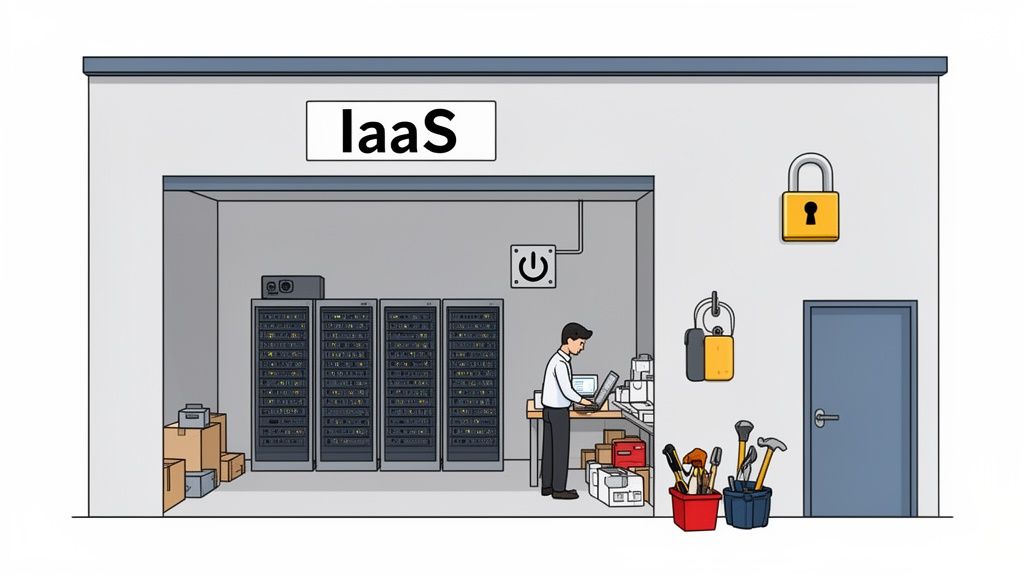
Infrastructure as a Service offers a more agile alternative. It’s like leasing a fully equipped, secure workshop where the electricity, plumbing, and structure are already handled for you. You just move in and start building. In the IT world, IaaS providers manage the physical data centres and hardware, while your team gains access to these resources through a virtualised environment.
This model provides the essential components to run your business applications and workloads. The real value? It shifts your team’s focus from routine hardware maintenance towards strategic innovation that drives your business forward.
The Core Value Proposition of IaaS
So, why are so many organisations making this switch? The benefits are clear and tackle common business challenges head-on. The shift is so significant that the UK's IaaS market, valued at £2,992.5 million in 2024, is projected to surge to £12,500 million by 2035. You can explore the full report on UK IaaS market growth to see the drivers behind this trend. This growth points to a fundamental move away from capital-heavy legacy systems towards more flexible, operational cloud solutions.
Here are the key advantages IaaS brings to the table:
- Eliminates Capital Expenditure: Forget the huge upfront costs of buying servers and networking gear. IaaS converts a large capital expense (CapEx) into a predictable, manageable operational expense (OpEx).
- Enhances Scalability: Need more processing power for a seasonal sales rush? You can scale up your resources in minutes. Once the rush is over, you can scale back down just as quickly, only ever paying for what you actually use.
- Improves Agility: Your teams can provision new servers and environments in minutes, not weeks or months. This speed allows for faster development, testing, and deployment of new applications, helping you respond to market opportunities before they disappear.
- Increases Reliability and Resilience: IaaS providers build their infrastructure on a massive scale, offering incredible redundancy and uptime. This ensures high availability and supports disaster recovery plans that would be too costly for most businesses to implement on their own.
In essence, IaaS provides the raw materials—the compute, storage, and networking—allowing your IT team to build and manage the operating systems, applications, and data on top. It offers maximum control over your software stack, without the burden of managing the physical hardware underneath.
The Building Blocks of IaaS Architecture
To truly understand Infrastructure as a Service, you need to look at its core components. These are the fundamental resources you rent from a provider, and they work together to form the foundation of any digital environment you can imagine.
Think of them like the raw ingredients a chef uses. IaaS provides the compute, storage, and networking power, and you decide how to combine them to create the perfect solution for your business.
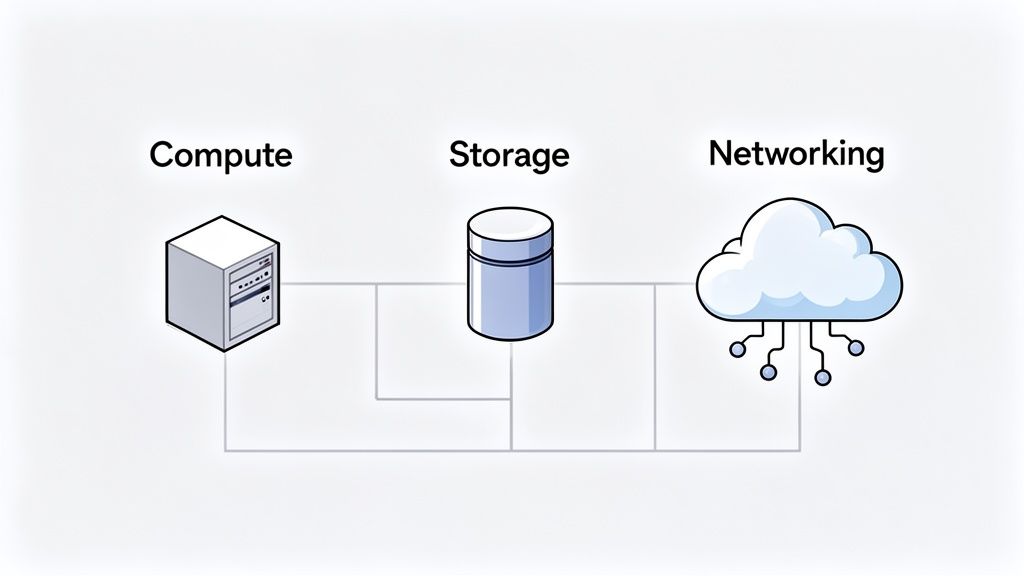
This structure is precisely what gives IaaS its incredible flexibility. Your team has complete control to configure these building blocks to meet the exact needs of your applications, just like a chef crafting a unique recipe. Let's break down each of these pillars.
Compute: Your Virtual Engine Room
The first pillar is compute, which you’ll mainly encounter as Virtual Machines (VMs). A VM is a complete computer—with its own CPU, memory, and operating system—that runs as software on a massive physical server in the provider's data centre. It's your digital server, without the actual box taking up space in your office.
Imagine your business relies on a custom CRM application. Instead of buying a hefty physical server to host it, you can spin up a VM on a platform like Microsoft Azure in minutes. You choose the processing power (vCPUs) and memory (RAM) you need, and you can adjust these on the fly. If application usage suddenly spikes, you simply allocate more resources—no physical hardware changes needed.
This on-demand capability is a game-changer for development and testing. Teams no longer have to wait weeks for hardware to arrive; they can provision new environments instantly, test their code, and then tear the VMs down when they're finished, paying only for the time they were active.
Storage: Your Digital Warehouse
Next up is storage, the infinitely scalable warehouse for all your digital assets. IaaS providers offer different types of storage designed for specific jobs, freeing you from the limits and costs of physical storage arrays.
- Object Storage: Perfect for storing massive amounts of unstructured data, like images, videos, backups, and log files. Think of it as a vast, limitless digital archive where each file is a self-contained object.
- Block Storage: This acts more like a traditional hard drive and gets attached directly to your VMs. It delivers the high performance needed for databases, transactional applications, and anything that requires fast, low-latency access to data.
For a media company, this means they could use object storage to house terabytes of video footage affordably, while using high-performance block storage for the database that powers their content management system. This separation keeps things both cost-effective and performant, which is especially important for businesses implementing modern approaches like container management.
Networking: Your Secure Connections
Finally, networking is the glue that securely connects everything. In an IaaS environment, you’re not dealing with physical cables and routers; it’s all about virtualised networking services that create secure, private connections for your resources.
The real power of IaaS networking lies in its ability to isolate your environment. A Virtual Private Cloud (VPC) acts as your own private, walled-off section of the provider's cloud, shielding your VMs and data from other customers.
Key networking services include:
- Virtual Private Clouds (VPCs): These create a logically isolated network where you define your own IP address range, subnets, and routing rules.
- Load Balancers: These automatically spread incoming application traffic across multiple VMs to ensure high availability and reliability. If one VM fails, the load balancer simply redirects traffic to the healthy ones, preventing downtime.
For an e-commerce website, this means creating a secure VPC to host the application and its database. A load balancer can then be used to manage the huge influx of traffic during a major sale, ensuring the site stays responsive and available for every customer—which is critical for protecting revenue and reputation.
IaaS vs PaaS vs SaaS: Decoding Cloud Service Models
Choosing the right cloud service model can feel like navigating a maze of acronyms. But it doesn't have to be complicated. Let’s cut through the jargon with a practical analogy: ordering a pizza. Each option offers a different balance of convenience and control, which perfectly mirrors how cloud services work.
Getting this choice right is crucial. It directly impacts your team’s day-to-day responsibilities, the technical skills you need, and ultimately, how much control you have over your digital environment. This isn’t just a tech decision; it's a strategic one that shapes your agility for years to come.
IaaS: The Professional Kitchen Rental
Infrastructure as a Service (IaaS) is like renting a fully equipped, professional kitchen. The cloud provider gives you all the fundamental building blocks: the oven (compute power), the countertop space (storage), and the gas and electricity (networking).
From there, it's all on you. You bring your own ingredients (data), write the recipe (your application code), and manage the entire cooking process yourself. This model gives you the most control and flexibility, making it the perfect fit for experienced IT teams who need to build and manage their entire software stack from the operating system up.
PaaS: The Take-and-Bake Pizza Kit
Platform as a Service (PaaS) is the next level of convenience. Think of it as buying a take-and-bake pizza kit. The provider gives you the dough, sauce, cheese, and toppings—all the essential platform components like operating systems, databases, and development tools.
Your job is simply to assemble the pizza and pop it in the oven. In tech terms, you only have to manage your application code and your data. The underlying infrastructure and platform are completely handled for you. PaaS is a favourite among developers, as it lets them focus purely on writing great code without worrying about server maintenance.
SaaS: The Delivered Pizza
Finally, Software as a Service (SaaS) is the pinnacle of convenience. This is like ordering a piping hot pizza delivered straight to your door. You don’t think about the kitchen, the ingredients, or the cooking; you just open the box and enjoy the finished product.
SaaS applications are ready-to-use software you access over the internet, like Microsoft 365 or Salesforce. The provider manages everything behind the scenes—the application, the data, and all the infrastructure. All you have to do is subscribe and log in.
The core difference boils down to the division of responsibility. As you move from IaaS to PaaS to SaaS, you trade granular control for greater simplicity. The right choice depends entirely on your business needs, your team’s technical capabilities, and how much of the IT stack you want to manage yourselves.
Making the right call often requires mapping your specific application requirements and long-term goals to the best model. Structured IT support ensures you build a system that is both cost-effective and ready to scale from day one.
Cloud Service Model Comparison: IaaS vs PaaS vs SaaS
To make things clearer, this table breaks down the responsibilities and use cases for each major cloud service model. Use it to help determine which solution is the right fit for your business.
| Aspect | Infrastructure as a Service (IaaS) | Platform as a Service (PaaS) | Software as a Service (SaaS) |
|---|---|---|---|
| Analogy | Renting a professional kitchen | Buying a take-and-bake pizza kit | Ordering a pizza for delivery |
| You Manage | Applications, Data, Runtime, Middleware, Operating System | Applications, Data | Nothing—you just use the software |
| Provider Manages | Virtualisation, Servers, Storage, Networking | Everything in IaaS, plus Runtime, Middleware, OS | Everything, including the application |
| Primary User | IT Administrators, System Engineers, DevOps Teams | Application Developers, Software Engineers | End Users, Business Teams |
| Example Use Case | Hosting a custom legacy application with specific OS needs | Building and deploying a new web application rapidly | Using a CRM system to manage customer relationships |
| Key Advantage | Maximum control and customisation | Speeds up development and deployment | Ultimate convenience and ease of use |
Ultimately, whether you need a full kitchen, a handy kit, or a ready-made meal depends on what you're trying to achieve. Each model serves a distinct purpose, empowering your business in different ways.
Why Adopting IaaS Is a Strategic Business Move
Making the switch to Infrastructure as a Service is more than a simple IT refresh. It's a fundamental strategic decision that gives your business a tangible competitive edge. This isn't just about swapping out old servers; it’s about rethinking how your organisation invests in technology, reacts to market shifts, and builds resilience for the future.
The true power of IaaS shows up on your balance sheet and in how quickly your teams can operate. Instead of pouring huge sums of money into hardware that becomes dated the moment you unbox it, you unlock a new level of agility and efficiency. Let’s break down what these technical features actually mean for your business outcomes.
Drive Significant Cost Savings
Traditionally, building out IT infrastructure meant facing a massive upfront capital expense (CapEx). You had to buy powerful servers and networking equipment, often overprovisioning for future growth that might never happen. That old approach locks up capital that could be better used to fuel innovation, marketing, or hiring top talent.
IaaS flips this model on its head. It shifts spending from a hefty CapEx hit to a predictable operational expense (OpEx). You pay a monthly fee based on what you actually use, consuming resources only when you need them. This removes the financial burden of owning hardware, along with hidden costs like maintenance contracts, electricity, and physical data centre space.
The growth of small and medium-sized businesses is a key driver of IaaS market expansion because providers manage all infrastructure components. This drastically reduces maintenance costs that would otherwise burden smaller organisations, eliminating the need for large, upfront capital investments.
This cost-effective approach is a game-changer for companies looking to modernise. A well-planned cloud transformation strategy allows you to move away from legacy systems without the steep price tag of buying new physical kit.
Achieve Unmatched Scalability and Flexibility
Business demand is rarely a flat line. An e-commerce site might see a 500% traffic surge during a Black Friday sale, while a financial services firm needs a burst of processing power at the end of the quarter. With on-premise hardware, handling these peaks means buying and maintaining enough servers for your busiest moments, only for them to sit idle most of the time—a significant waste of resources.
IaaS provides elastic scalability, meaning you can add or remove resources in minutes.
- Scale Up: When your e-commerce platform is bracing for a holiday rush, you can instantly add more virtual machines and storage to ensure the site stays lightning-fast and responsive for every customer.
- Scale Down: As soon as the rush is over, you can release those extra resources just as quickly, so you stop paying for them immediately.
This is the key difference between a rigid, expensive system and an agile, cost-effective one that flexes right alongside your business.
Enhance Business Agility and Innovation
In today's fast-moving markets, speed is everything. The time it takes to get from an idea to a live product can be the deciding factor between leading the pack or following competitors. On-premise infrastructure often acts as a brake, with procurement and setup cycles that can drag on for weeks or even months.
IaaS shortens that timeline dramatically. Your development teams can spin up entire environments for testing new applications in minutes. This fosters a culture of innovation by allowing for rapid prototyping, experimentation, and faster feedback loops. If a new project doesn't pan out, you simply tear down the environment with no wasted hardware investment.
Strengthen Disaster Recovery and Business Continuity
For many small and medium-sized businesses, building a truly robust disaster recovery (DR) plan has always been prohibitively expensive. It typically involves duplicating your entire production environment in a separate physical location—a cost very few can justify.
IaaS providers build enterprise-grade resilience right into their service. With their global footprint of data centres, you can replicate your critical applications and data across different geographic regions easily and affordably. If a disaster strikes one location, you can fail over to a backup site with minimal downtime, keeping your business running. This provides a level of protection that was once reserved for only the largest corporations, securing your operations against unforeseen events.
How to Plan Your Migration to IaaS
Moving from on-premise hardware to IaaS can transform your business, but it's not as simple as flipping a switch. A successful transition hinges on a solid, well-structured plan. This turns a daunting project into a series of manageable steps, ensuring a smooth transition instead of a costly disruption.
The process breaks down into four clear stages. Each one builds on the last, taking your team from the initial "what do we even have?" phase right through to long-term success in the cloud. Skipping any of these steps is where most migrations hit a wall, leading to unexpected costs and performance issues.
Stage 1: Assessment and Discovery
Before you can map out your journey, you need to know exactly where you're starting from. This assessment stage is a deep audit of your current IT setup. The goal is to create a complete inventory of every application, server, and database you're planning to move.
But this isn't just a box-ticking exercise. It’s about digging into dependencies. Which applications need to talk to each other? What are the non-negotiable performance requirements for your most important databases? Answering these questions now will prevent major issues later. A common pitfall is underestimating an application's complexity or missing "shadow IT" systems that are undocumented but critical to business operations.
Stage 2: Strategic Planning
Once you have a crystal-clear picture of your current environment, you can start planning for the future. This is where you make the big decisions that will define your migration's success. It means choosing the right provider—like Azure or AWS—based on your specific needs, technical requirements, and your team's existing skills.
You’ll also need to pick a migration strategy. Will you "lift and shift" your applications as-is for a quick move? Or will you use this as an opportunity to "refactor" them, rebuilding parts to take full advantage of cloud-native features? This is also the time to map out your security and compliance framework from the ground up.
Your plan should detail:
- Provider Selection: Compare the services, pricing models, and support options from the leading providers.
- Migration Strategy: Decide between rehosting (lift and shift), replatforming, or refactoring for each workload.
- Security Framework: Define how you’ll configure firewalls, access controls, and encryption in the new environment.
- Cost Projection: Build a detailed budget that covers compute and storage, but crucially, don't forget data transfer costs—they catch many people by surprise.
Think of a well-defined plan as your roadmap. It sets clear expectations, assigns responsibilities, and establishes timelines, ensuring everyone on the project is aligned and pulling in the same direction. Without it, you're just flying blind.
Stage 3: Execution and Migration
Now for the technical heavy lifting—the actual process of moving your workloads to the IaaS platform. Depending on the strategy you chose, this could involve creating new virtual machines, transferring large amounts of data, and reconfiguring network connections.
The secret to a smooth execution is to migrate in phases. Start with a non-critical application as a pilot project. This gives your team a chance to learn the ropes, spot potential problems, and fine-tune your approach in a low-risk environment before you touch anything mission-critical. Rigorous testing at every step is non-negotiable to confirm that everything is performing as expected.
This infographic shows the core business benefits—cost savings, scalability, and agility—that a properly executed IaaS migration unlocks.
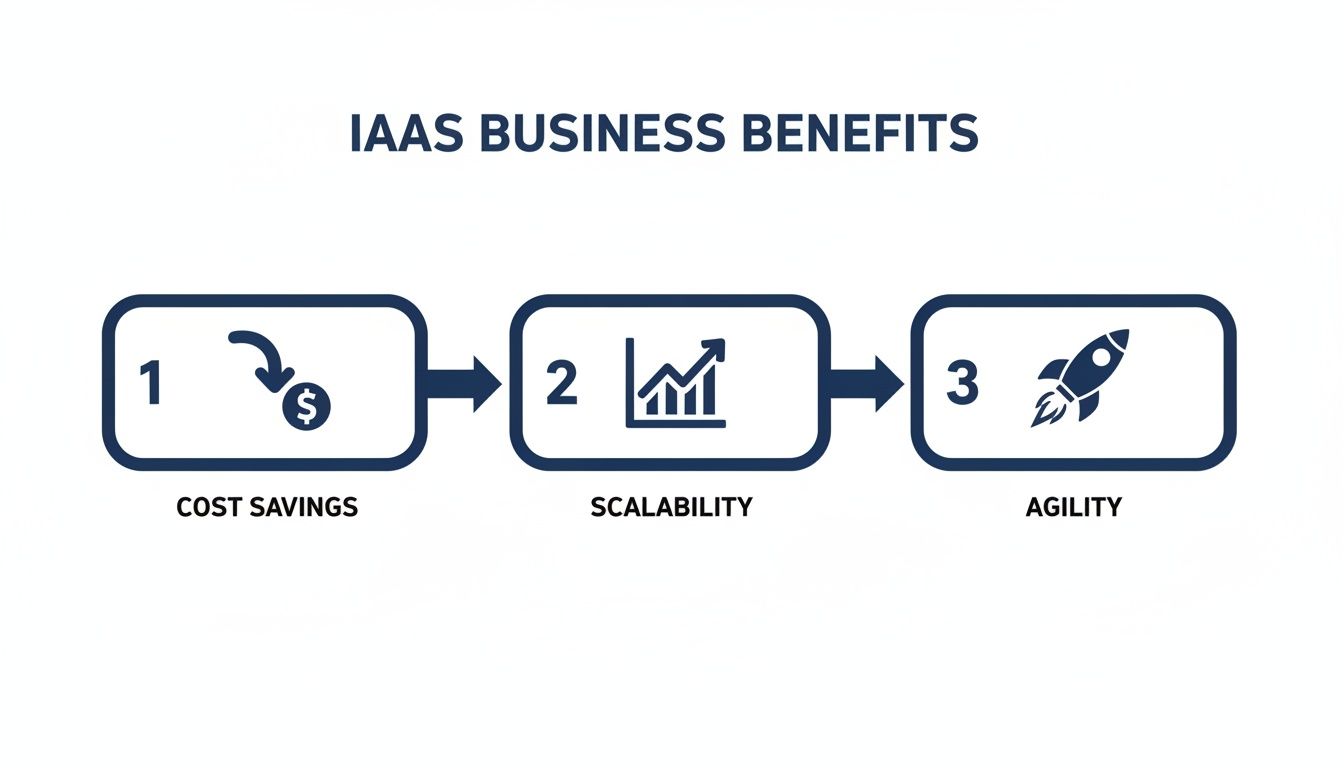
You can see how moving to IaaS directly leads to a more flexible and financially efficient way of working.
Stage 4: Post-Migration Optimisation
Getting your applications running in the cloud isn't the finish line; it’s the new starting line. The final—and ongoing—stage is all about optimisation. Now that your infrastructure is live, you must continuously monitor its performance, security, and costs to ensure you're getting the value you're paying for.
This involves fine-tuning your resource allocation, a process often called "right-sizing," to ensure you aren’t paying for more server power than you need. You'll also set up robust monitoring tools to keep an eye on application health and configure automated security alerts to catch threats early. The cloud is dynamic, which means optimisation isn't a one-and-done task; it's a continuous cycle of improvement.
For many businesses, navigating these four stages requires deep expertise. Partnering with specialists can be the difference between a migration that stalls and one that drives real business growth. A comprehensive view of the cloud migration journey highlights how expert guidance can streamline the entire process.
Real-World IaaS Applications and Leading Providers
The theory behind Infrastructure as a Service is one thing, but seeing how it solves real-world business problems is where it truly clicks. IaaS isn’t an abstract concept; it's the engine running under the hood of countless digital experiences we rely on every day. Across every industry, companies are using it to build more robust, scalable, and innovative operations.
One of the most common applications is web and application hosting. Businesses use IaaS to lay a scalable foundation for their websites and apps. Instead of buying and maintaining expensive physical servers to handle peak traffic, they can rely on cloud infrastructure that scales up or down automatically. This ensures a smooth experience for customers while keeping costs under control.
Powering Analytics and Development
Another huge area is big data analytics. Sifting through massive datasets to find valuable business insights demands enormous computational power—the kind that used to be reserved for giant corporations. With IaaS, any organisation can rent the necessary compute and storage resources on demand, run their analysis, and then simply turn them off. It makes advanced analytics both accessible and affordable.
The same on-demand principle transforms development and testing environments.
- Speedy Setups: Developers can spin up a complete, isolated testing environment in minutes. The days of waiting weeks for hardware procurement are over.
- Risk-Free Experiments: Teams can try out new ideas and features without committing to long-term hardware costs, which encourages a culture of innovation.
- Perfect Consistency: IaaS makes it easy to ensure that development, testing, and production environments are identical, helping to eliminate common deployment errors.
The power to create and tear down entire IT environments on the fly is a core IaaS advantage. It massively shortens development cycles and gives businesses the agility to respond to market changes at incredible speed. That's a serious competitive edge.
Leading Providers and Their Offerings
When you look at the IaaS market, two heavyweights dominate the scene: Microsoft Azure and Amazon Web Services (AWS). These providers offer a massive portfolio of services designed for the exact use cases we've just discussed. At the heart of most IaaS deployments are their virtual machine services, which form the foundational building blocks.
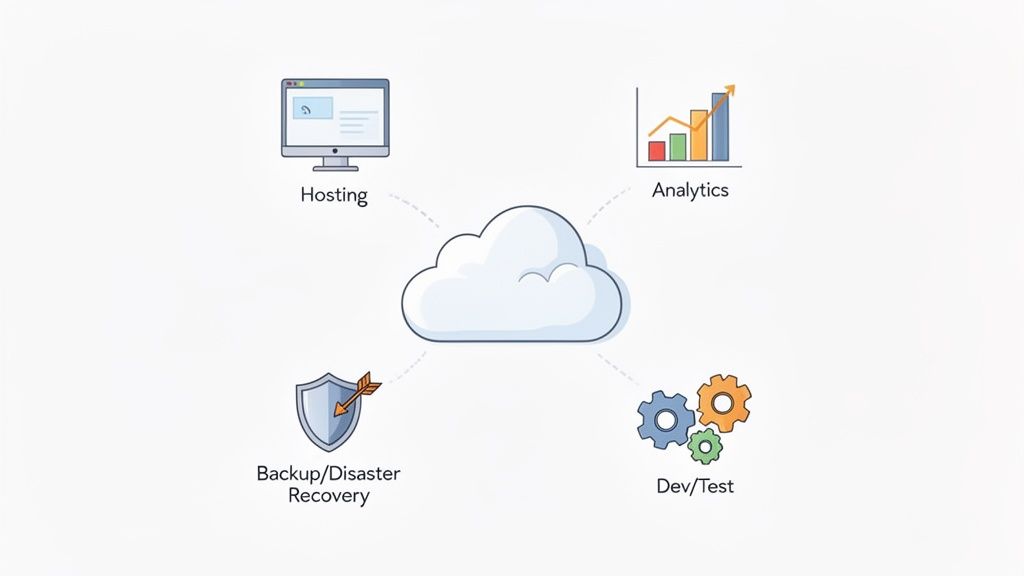
You get granular control over everything from the operating system to the CPU and storage. But with so much choice, figuring out the right mix of services can be tricky. Strategic guidance is key to aligning the technical tools with your specific business goals, ensuring your setup is both secure and cost-effective.
Getting to Grips with IaaS: Your Questions Answered
When you start exploring what Infrastructure as a Service is and whether it’s the right fit for your business, a few common questions always come up. Getting clear answers is the first step to making a smart decision.
Let’s tackle the big one first: security. Just how secure is IaaS? Security in the IaaS world runs on a shared responsibility model. The cloud provider is responsible for securing the physical data centres, but you are responsible for securing your data, applications, and operating systems within the cloud. This means properly configuring firewalls, managing access controls, and patching your operating systems are your responsibilities.
Another common myth is that IaaS is only for huge corporations. That couldn't be further from the truth. Its pay-as-you-go pricing is a massive advantage for small and medium-sized businesses. It gives you access to enterprise-grade infrastructure without needing a massive upfront investment in your own hardware.
Clarifying Control and Common Uses
Business leaders often want to know exactly how much control they get with IaaS. The simple answer is: the most. Compared to other cloud models, IaaS gives you the highest level of control over your environment. You’re managing everything from the operating system up, which means you have total flexibility to build custom solutions or host legacy software with specific requirements.
So, where does this level of control really shine? What is IaaS actually used for in the real world?
- Web and Application Hosting: It’s the perfect foundation for websites and apps that experience spikes in traffic. You can scale resources up or down as needed.
- Backup and Disaster Recovery: IaaS offers a remarkably cost-effective and robust way to protect your critical data and ensure business continuity.
- Development and Testing: Your tech teams can spin up and tear down development environments in minutes, not weeks. This speeds up innovation massively because they're no longer waiting around for physical hardware.
At the end of the day, understanding these points is crucial. IaaS isn't just a technical swap-out; it's a strategic shift. It empowers your business to be more agile and financially efficient by renting the fundamental IT building blocks you need, exactly when you need them.
Making sense of these options and aligning them with your business goals can be complex. Expert guidance can make all the difference in building a cloud strategy that’s successful, secure, and genuinely cost-effective for the long term.
Navigating your cloud journey requires a clear roadmap and deep expertise. Zachsys Ltd provides the structured IT support and strategic guidance your organisation needs to build a scalable, secure, and future-ready system. Book a free consultation to start your cloud transformation.