
Subtotal $0.00

Under the UK's General Data Protection Regulation (GDPR), a data protection policy alone is not enough to ensure compliance. An organisation's greatest asset—its people—can also be its most significant compliance risk. Accidental data breaches, mishandled subject access requests, and other common incidents often stem from a simple lack of awareness. This makes effective GDPR training for staff the critical control that transforms written policies into active, organisation-wide practice.
This guide evaluates seven leading training providers for UK businesses, helping you select a solution that fits your specific operational roles, budget, and compliance objectives. For learning and development professionals, understanding how to stay on top of employee compliance training is the first step toward building a robust human firewall.
1. Information Commissioner’s Office (ICO)
The Information Commissioner’s Office (ICO) is the UK's independent regulator for data protection and serves as the definitive source for authoritative, cost-free UK GDPR training materials. For organisations establishing their compliance framework, the ICO provides an essential baseline and a structured approach to delivering effective gdpr training for staff. Their resources are designed to be adapted for internal use, making them a practical and credible starting point.
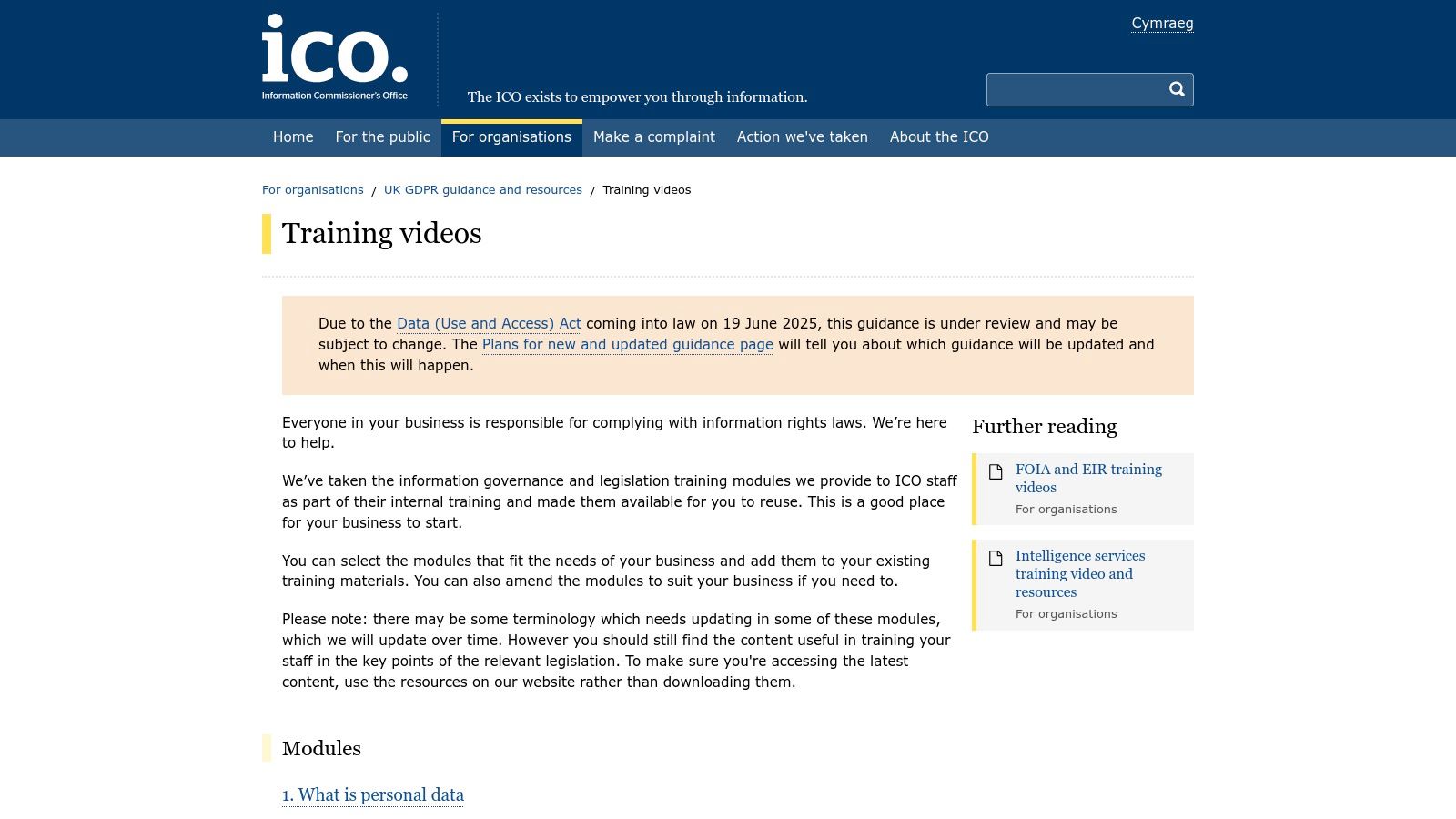
This platform stands out because its guidance comes directly from the official regulator, ensuring it is perfectly aligned with UK law. The ICO's free training videos, slide modules, and staff programme templates are invaluable for structuring a compliant rollout without initial financial investment. This approach aligns with broader strategies for strong information management, as detailed in our guide to data governance best practices.
Key Features & Considerations
- Pros: Authoritative, UK-specific guidance directly from the regulator. All materials are free to use and adapt, which is ideal for SMEs and non-profits.
- Cons: It is not a commercial Learning Management System (LMS), so it lacks built-in learner tracking, assessment, or certification. Materials must be manually checked for updates.
- Best For: Organisations needing a foundational, cost-effective toolkit to build and evidence their internal GDPR training programme from a credible source.
Website: ico.org.uk
2. IT Governance (UK)
IT Governance provides a well-established commercial solution for organisations seeking a ready-to-deploy e-learning programme. Its courses are specifically aligned with the UK GDPR and Data Protection Act 2018, offering a streamlined method for delivering mandatory gdpr training for staff. The platform operates on an annual licence model that includes administrative reporting features, which are essential for demonstrating compliance and evidencing training completion during audits.
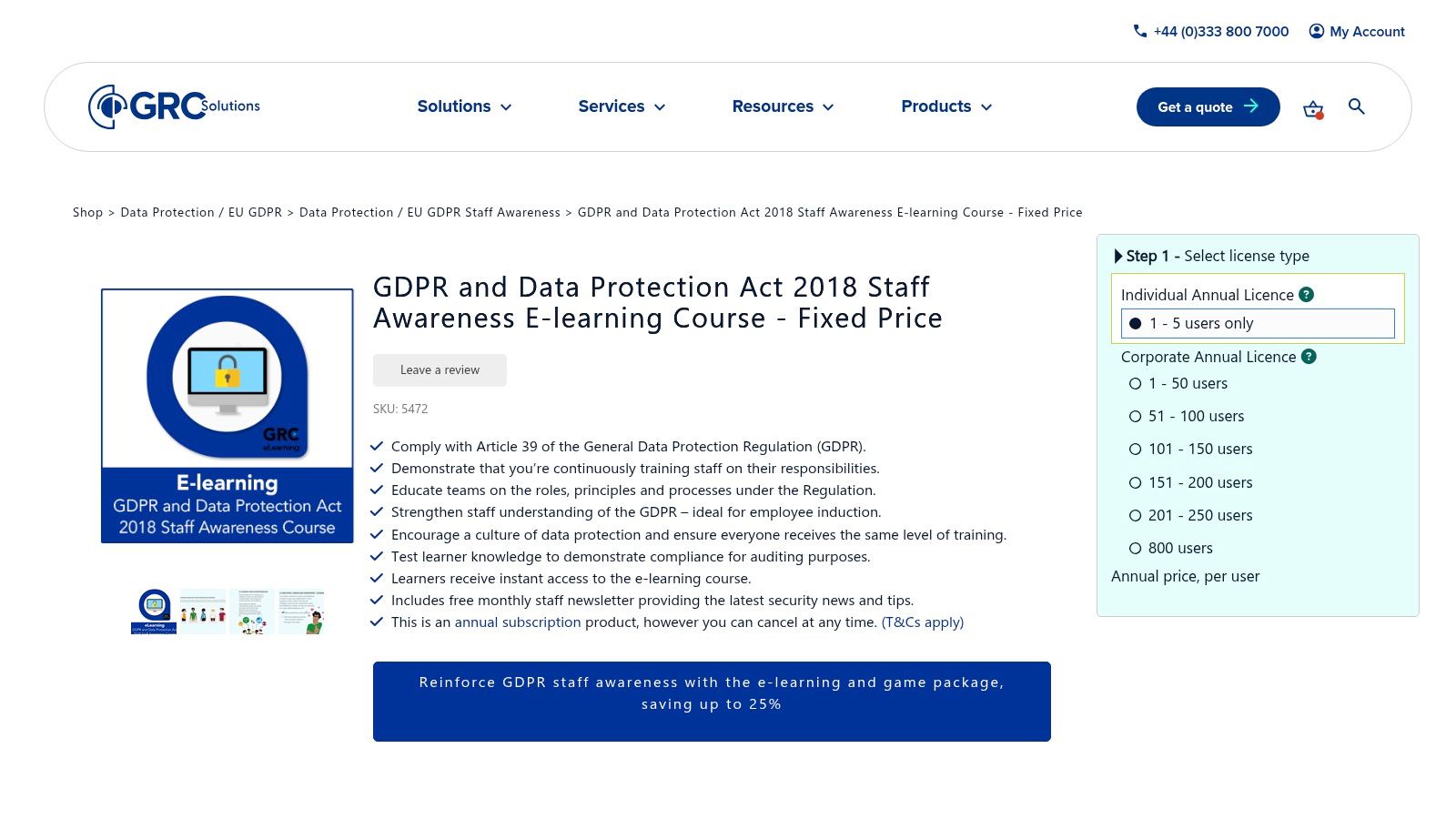
This platform is a strong choice for its enterprise-ready features, including custom branding options and the ability to embed links to internal policies directly within the training modules. This customisation helps integrate the training into a company's existing compliance framework and reinforces the connection between data protection principles and broader security posture—a key factor in resilience, as detailed in our guide on how to prevent ransomware attacks. Its mobile and desktop compatibility ensures a smooth rollout for diverse workforces.
Key Features & Considerations
- Pros: An established UK provider with clear coverage of UK GDPR and DPA 2018. Includes built-in reporting for audit trails and is mobile-friendly for flexible learning.
- Cons: The annual per-user licensing model can become costly for larger organisations compared to one-off course purchases. The extensive catalogue may require careful review to select the right product.
- Best For: Organisations that require a quick-to-implement, auditable e-learning solution with options for custom branding and policy integration.
Website: itgovernance.co.uk
3. iHASCO
iHASCO offers a suite of IIRSM-approved e-learning courses designed for rapid deployment and user-friendly engagement. Their platform provides distinct training modules for general staff, individuals with advanced responsibilities, and management, simplifying the process of tailoring learning paths to different roles. This makes it an ideal off-the-shelf solution for organisations seeking a straightforward gdpr training staff programme with clear pricing and instant access.
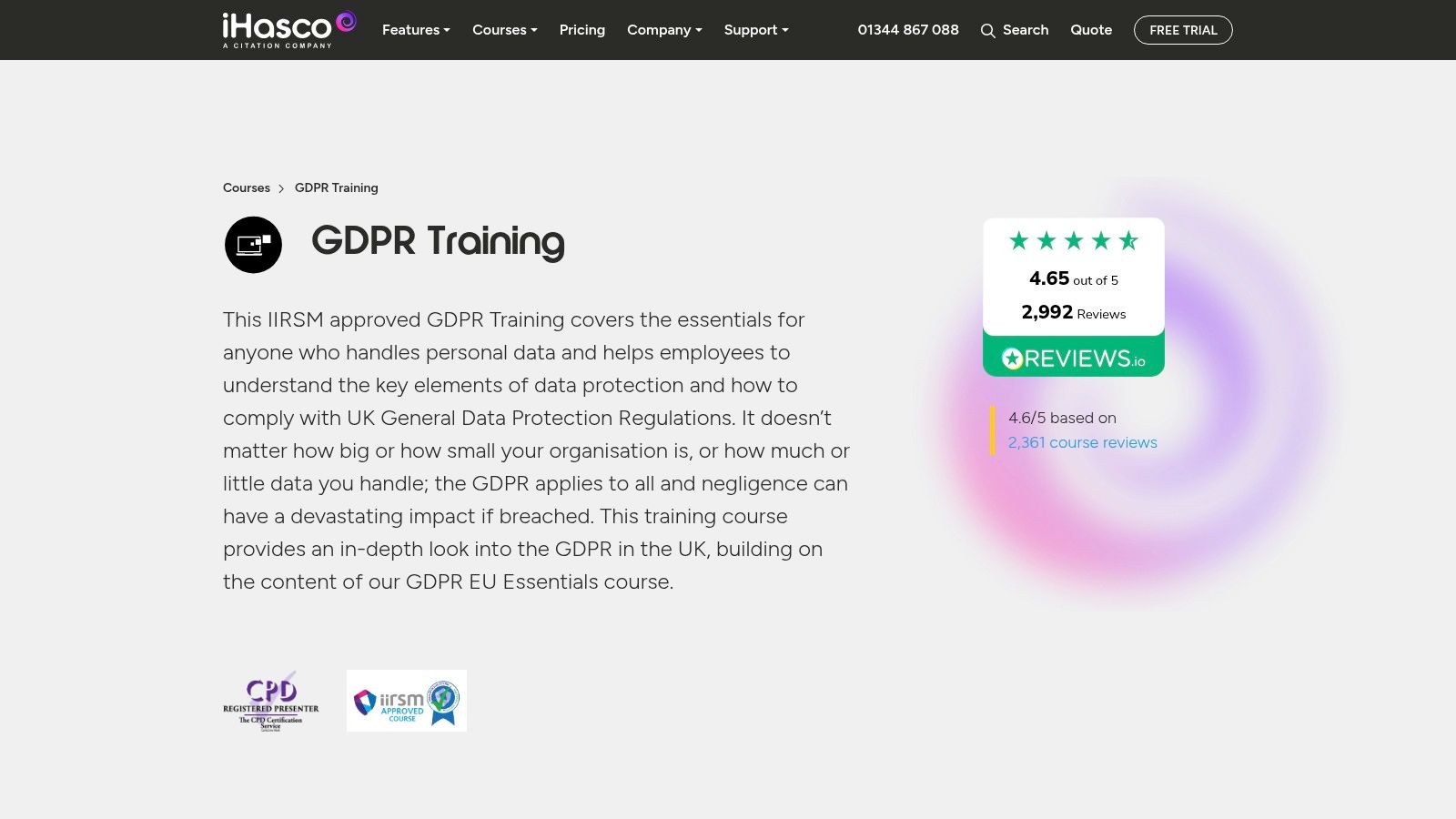
This platform stands out for its intuitive interface, transparent per-seat pricing, and the ability to purchase and begin training immediately. With short course runtimes (around 35-65 minutes) and multi-language support, it caters to diverse and busy workforces. The availability of a free trial and strong user reviews makes it a low-risk option for small to medium-sized businesses looking for a reliable, externally managed training solution without a complex procurement process.
Key Features & Considerations
- Pros: Easy to deploy for SMBs with transparent pricing and free trials. Strong user ratings and reviews provide confidence in the course quality.
- Cons: Primarily offers awareness-level training; it is not a substitute for in-depth DPO or practitioner courses. Certification is per-course rather than a formal qualification.
- Best For: Teams and SMBs needing a quick, compliant, and well-regarded e-learning solution with role-specific content for general awareness and management.
Website: ihasco.co.uk
4. Highfield e‑learning
Highfield e-learning delivers a streamlined and cost-effective solution for organisations that need to deploy foundational GDPR awareness training at scale. Its core offering is a concise, 30-minute interactive online module designed for rapid rollout to a large number of employees, particularly those in frontline roles. The platform simplifies procurement with a transparent, tiered pricing model and an easy online checkout process, making it an efficient choice for delivering essential gdpr training for staff without complex setup.
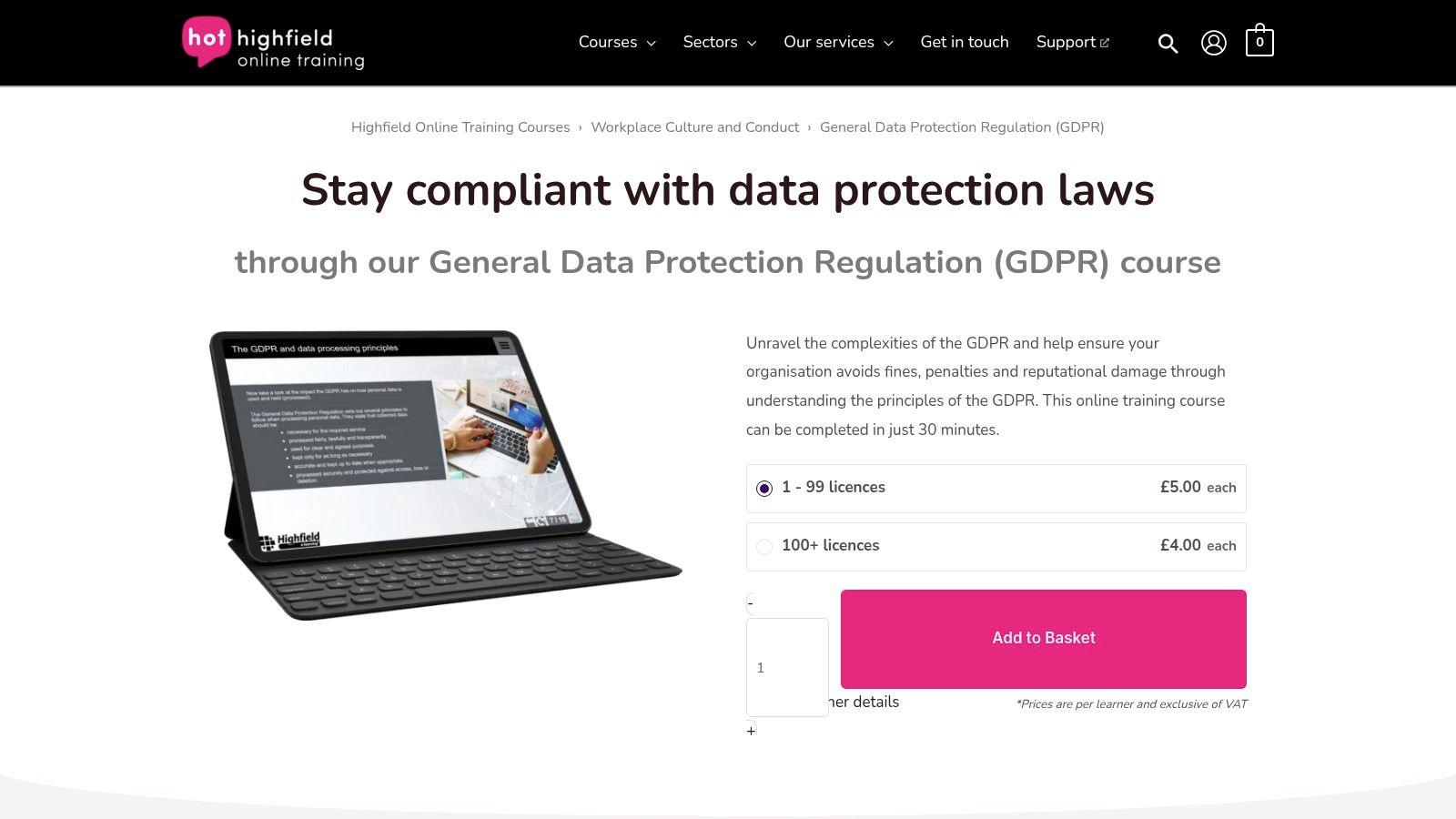
This platform's key strength is its simplicity and focus on scalable awareness. For businesses that must quickly evidence that all staff have received basic data protection instruction, Highfield's model is ideal. The combination of low per-licence costs, bulk discounts, and the credibility of a recognised UK training brand makes it a pragmatic choice for meeting baseline compliance requirements across an entire workforce, especially where in-depth, role-specific knowledge is not the primary objective.
Key Features & Considerations
- Pros: Extremely cost-effective at scale with low per-licence costs for bulk purchases. Delivered by a recognised UK training brand with a wide sector reach.
- Cons: The short, awareness-level content may not be sufficient for specialist roles or managers with greater data protection responsibilities. It has fewer advanced compliance features than full LMS suites.
- Best For: Organisations needing to rapidly and affordably deploy baseline GDPR awareness training to a large volume of frontline staff.
Website: highfieldelearning.com
5. BSI (British Standards Institution)
The BSI (British Standards Institution) provides a more formal, instructor-led approach to data protection training, targeting specific roles within an organisation. It offers practitioner and implementer-level courses, such as its 2-day GDPR Implementer/Self-Assessor programme, which are ideal for Data Protection Officers (DPOs), compliance leads, and IT teams tasked with building robust privacy frameworks. This is a crucial resource for businesses looking to deliver in-depth, role-based gdpr training for staff with governance responsibilities.
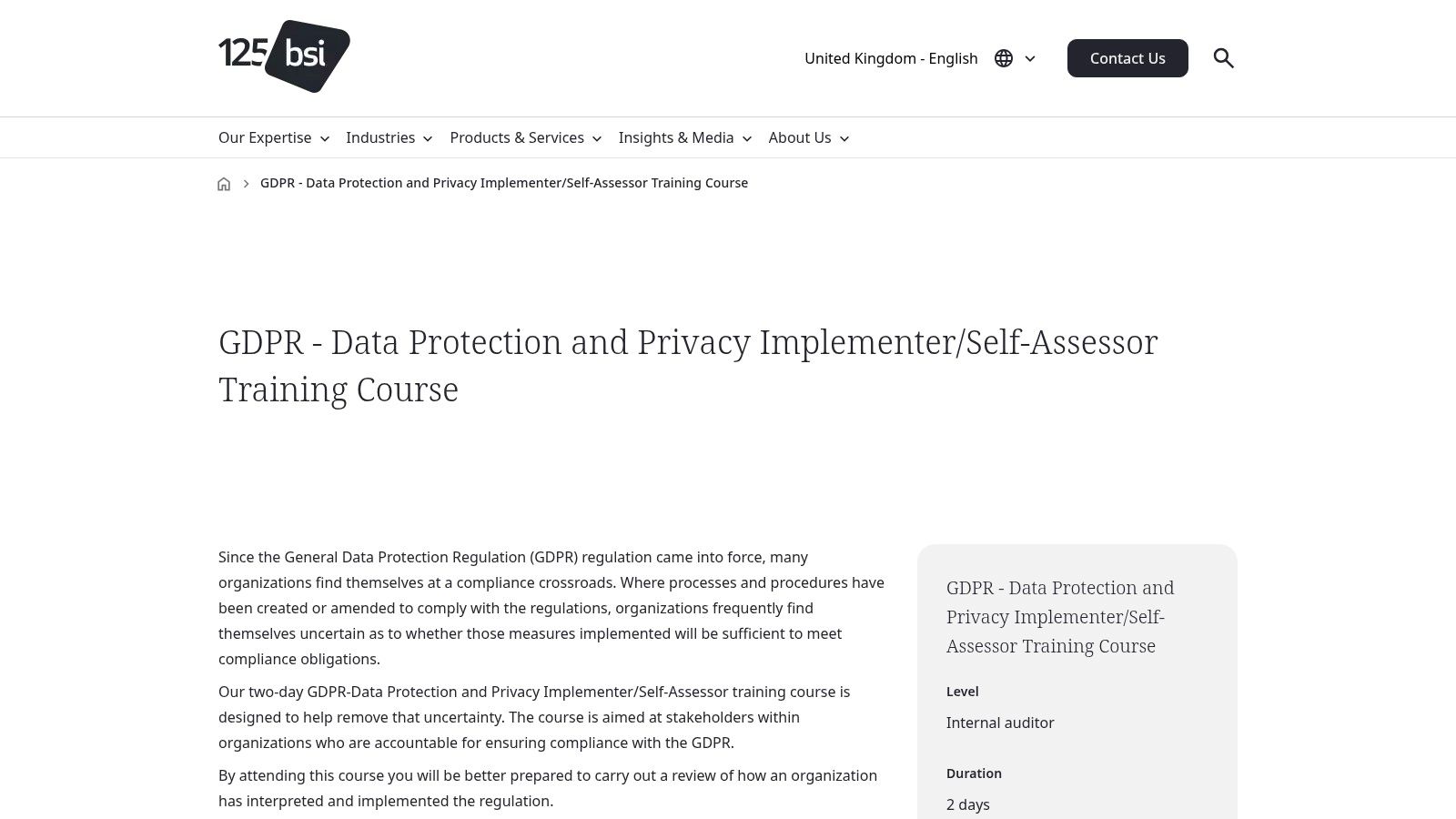
This platform stands out by aligning its training with internationally recognised standards like ISO 27701 for Privacy Information Management Systems (PIMS). This structured learning path is perfect for organisations in regulated sectors or those aiming to demonstrate a higher level of compliance maturity. The in-depth knowledge gained helps create robust internal controls, a key component in any strategy for preventing data loss. BSI offers both public courses on scheduled dates and options for private, in-house delivery tailored to a specific team.
Key Features & Considerations
- Pros: High credibility and standards-aligned training from a respected institution. Excellent for deep, role-based education for DPOs and privacy implementers.
- Cons: Higher price point than general e-learning, making it better suited for key roles rather than an all-staff rollout. Scheduled courses offer less flexibility than on-demand modules.
- Best For: Organisations needing to upskill specific compliance, legal, or IT roles with certified, in-depth GDPR implementation and privacy management expertise.
Website: bsigroup.com
6. QA
QA offers certified GDPR foundation and practitioner courses that are ideal for organisations seeking structured, instructor-led training with a clear progression path. Their programmes are designed for cross-functional teams, including HR, IT, security, and marketing, making them a strong choice for building deep, role-specific data protection expertise. This approach ensures key personnel receive tailored knowledge that goes beyond general awareness, providing robust gdpr training for staff with specific compliance responsibilities.
This platform stands out by offering both public schedules and private onsite delivery, catering to the logistical needs of larger enterprises and allowing for consistent training across multiple departments. By providing a route from a foundation course to a practitioner-level qualification, QA helps organisations develop internal GDPR champions and subject matter experts—a critical component of a mature data governance framework.
Key Features & Considerations
- Pros: A large UK footprint supports consistent enterprise-wide delivery. Offers a clear training progression from foundation to practitioner level with a role-based focus.
- Cons: Pricing is often provided on enquiry only, reducing upfront transparency. It is less suitable for quick compliance refreshers compared to on-demand e-learning.
- Best For: Organisations needing formal, certified GDPR training for specific roles and a pathway to develop in-house data protection practitioners.
Website: qa.com
7. Udemy
Udemy is a vast online learning marketplace offering numerous self-paced GDPR staff awareness courses. It presents a highly practical option for individuals, freelancers, or small teams who need quick, low-cost access to foundational training without the complexity of a corporate Learning Management System (LMS). Its flexible, on-demand model allows learners to access content via mobile or desktop apps at their own convenience.
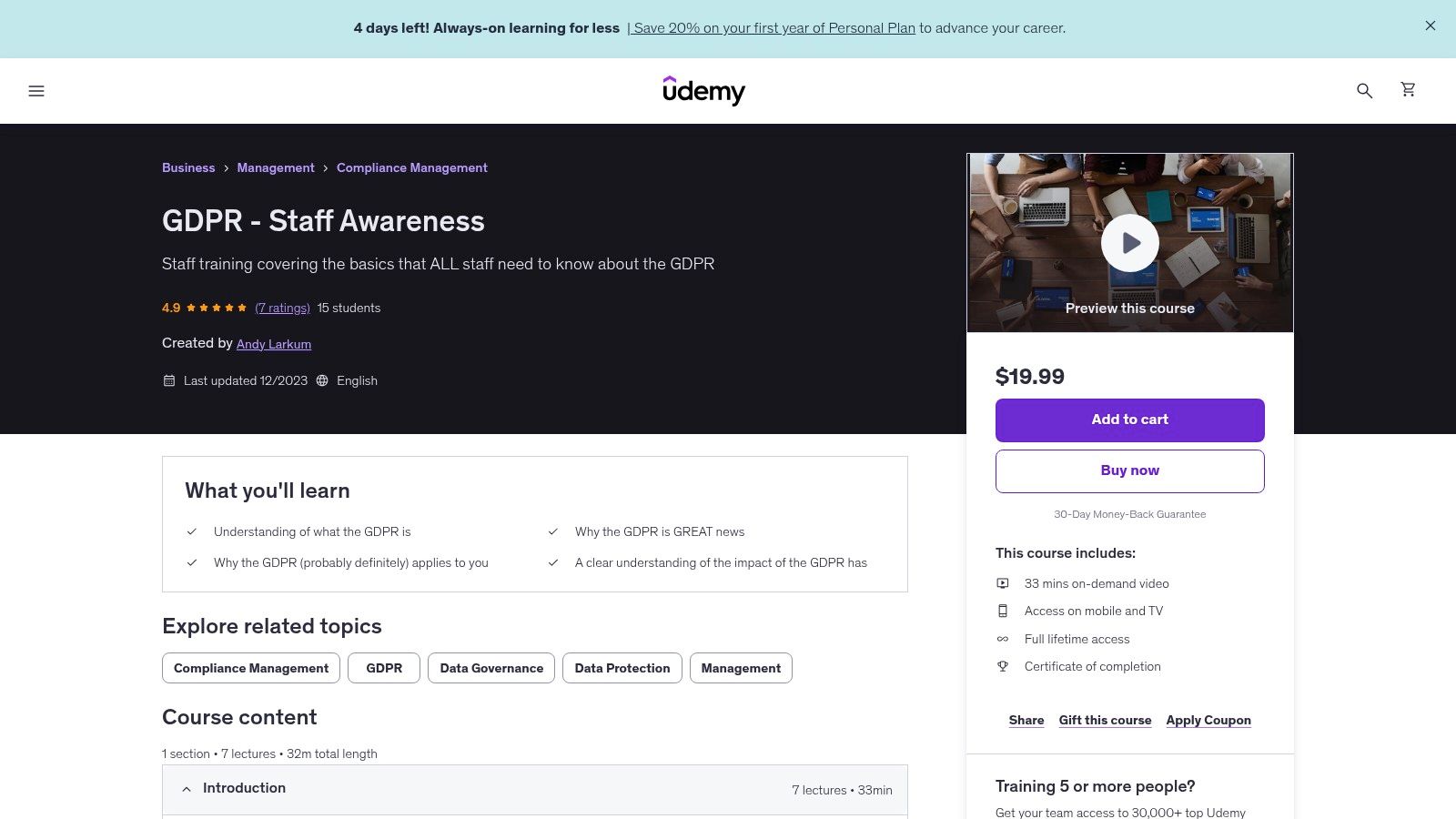
This platform's main advantage is its sheer volume of choice and affordability, with frequent promotions making courses highly accessible. While it doesn't offer regulator-authored content, user reviews and ratings help identify high-quality instructors. For organisations needing to quickly onboard a few new team members or provide a basic level of gdpr training for staff to contractors, Udemy offers an efficient, off-the-shelf solution. The lifetime access to purchased courses is also a significant benefit for future reference.
Key Features & Considerations
- Pros: Very low per-learner costs, especially during promotional periods, with instant enrolment. An excellent choice for individuals or micro-teams without an LMS.
- Cons: Course quality and accuracy can vary significantly by instructor. Lacks the enterprise-grade tracking and reporting needed for organisational compliance audits unless using the Udemy Business subscription.
- Best For: Individuals, contractors, or small businesses needing fast, affordable, and flexible GDPR awareness training for a limited number of staff.
Website: https://www.udemy.com/course/gdpr-staff-awareness/?utm_source=openai
7-Provider GDPR Staff Training Comparison
| Provider | Implementation complexity | Resource requirements | Expected outcomes | Ideal use cases | Key advantages |
|---|---|---|---|---|---|
| Information Commissioner’s Office (ICO) | Low — download and adapt materials, no LMS integration | Minimal staff time; no licensing costs | Baseline UK‑GDPR awareness; evidence for compliance planning | SMEs and organisations needing authoritative, free UK‑specific content | Official regulator guidance; free and reusable templates |
| IT Governance (UK) | Moderate — licence management and admin reporting setup | Annual per‑user licences, admin overhead, budget for SKUs | Staff awareness aligned to UK GDPR/DPA 2018 with reporting for audits | Organisations needing rapid rollout with admin reporting and branding | Established UK provider; tailored content and reporting features |
| iHASCO | Low — self‑service purchase and quick onboarding | Transparent per‑seat pricing; optional subscriptions; minimal admin | Short awareness to manager‑level training (IIRSM approved) | SMBs and teams wanting easy procurement and trials | Instant start, visible pricing, free trial available |
| Highfield e‑learning | Low — quick online checkout and deployment | Low per‑licence cost, bulk discounts for scale | Short (≈30 min) awareness training deployed at scale | Large frontline teams needing brief refreshers | Very cost‑effective at scale; simple pricing |
| BSI (British Standards Institution) | High — scheduled instructor‑led courses or in‑house delivery | Higher fees, time for 2‑day courses, travel or private cohort logistics | Role‑based practitioner competence and ISO 27701/PIMS alignment | DPOs, compliance leads and regulated sectors requiring standards alignment | High credibility; standard‑aligned, in‑depth practitioner training |
| QA | Moderate‑High — public cohorts or private onsite scheduling | Enquiry-based pricing, coordination for multi‑team delivery | Certified foundation to practitioner progression across roles | Organisations needing cross‑functional, role‑based training at scale | Large UK footprint; clear progression and role focus |
| Udemy | Very low — individual enrolment, self‑paced | Very low cost (promotions); no enterprise tracking unless upgraded | Variable awareness‑level knowledge; quality depends on instructor | Individuals, micro‑teams, contractors seeking low‑cost quick access | Fast start, low price, lifetime access and mobile apps |
Building a Sustainable Data Protection Culture
Choosing the right training platform is a critical first step, but the ultimate goal is to embed a lasting culture of data privacy that moves beyond a one-off, "tick-box" exercise. An effective programme is built on clear learning objectives, role-specific content, and consistent reinforcement, ensuring every employee understands their role in protecting personal information.
The most successful approaches integrate data protection principles directly into daily workflows. The objective is to make privacy an instinctive part of your organisational DNA, transforming the abstract rules of GDPR into practical, everyday actions. This proactive stance on how you conduct GDPR training for staff is what turns a compliance requirement into a powerful business asset that safeguards your reputation and builds customer trust.
To build a resilient, security-conscious culture, you must continuously measure, report, and refine your training programme. Whether you choose an all-in-one provider like iHASCO for simplicity or a specialised platform like BSI for accredited certification, the objective remains the same: to create a workforce that is not just compliant, but competent and confident in handling personal data securely.
Navigating the complexities of implementing a robust, evidence-based training framework can be a significant undertaking. Many organisations rely on structured IT support to integrate effective data protection practices into their core infrastructure, ensuring training is not only compliant but also sustainable and impactful. Expert guidance in structuring a programme that aligns with your specific technology and compliance needs can be invaluable for achieving long-term success.