
Subtotal $0.00


Managed IT services support is best understood as a strategic partnership. Rather than calling an IT expert only when a crisis hits (the traditional 'break-fix' model), this approach centres on proactive management to prevent issues before they impact your business. It provides predictable costs, access to a deep pool of specialist expertise, and a measurable improvement in operational efficiency.
What Are Managed IT Services Support?
Managed IT services represent a fundamental shift from reactive IT support. A Managed Service Provider (MSP) assumes the daily responsibility for monitoring, managing, and securing your entire technology infrastructure for a predictable monthly fee. This operational model frees your team to concentrate on core business objectives instead of constantly reacting to IT disruptions.
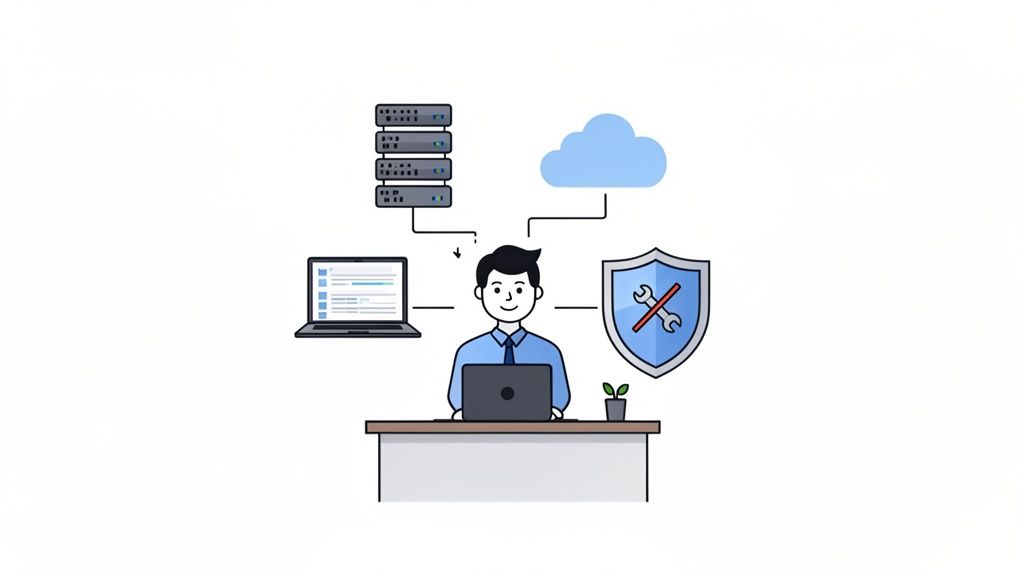
This model offers a structured alternative to the significant investment required to build and maintain an in-house IT department. While an internal team provides a dedicated on-site presence, partnering with an MSP grants immediate access to a broad team of certified experts in complex areas like cloud infrastructure and cybersecurity. Exploring the different IT services for businesses helps clarify which model best aligns with your organisation's current needs and future ambitions.
In-House IT vs Managed IT Services Support
Deciding between an in-house IT team and a managed services partner is a critical strategic choice. Each path has distinct implications for your budget, technical capabilities, and long-term focus. The key differences highlight which approach best fits your business goals.
| Aspect | In-House IT Team | Managed IT Services Support |
|---|---|---|
| Cost Structure | High capital expenditure (salaries, benefits, training) | Predictable operational expenditure (fixed monthly fee) |
| Expertise | Limited to the knowledge of hired staff | Access to a wide range of specialists (cloud, security, networking) |
| Scalability | Slow and costly to scale the team up or down | Flexible and rapid scalability to match business growth |
| Focus | Often reactive, dealing with daily user issues | Proactive monitoring and strategic long-term planning |
Ultimately, the choice depends on your priorities. If you require a team laser-focused on day-to-day user support and have the resources to build specialist skills internally, an in-house team can be effective. However, for businesses needing broad, scalable expertise and a shift from IT maintenance to strategic growth, a managed services partner offers a clear advantage.
Core Components of Modern Managed IT Services
Modern managed IT services have evolved far beyond simple break-fix support. They now comprise a comprehensive suite of proactive services designed to keep your technology environment secure, efficient, and aligned with your business objectives. These components work together to create a resilient and productive digital foundation for your organisation.
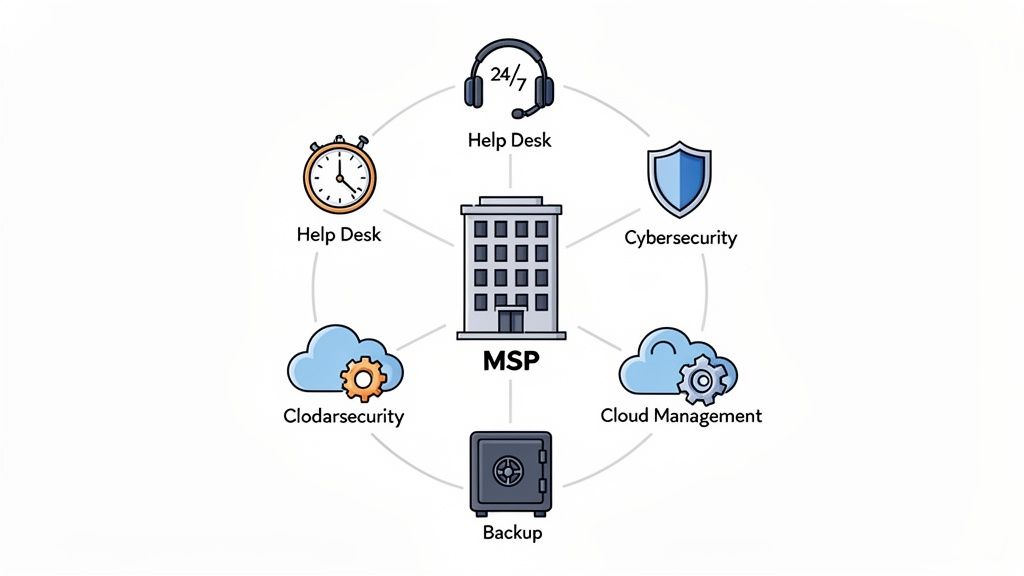
This support structure is built on several key pillars. Each one addresses a critical component of your IT operations, ensuring a comprehensive and reliable framework.
Foundational Support and Monitoring
The most fundamental services ensure your systems remain operational and your team has access to support when they need it. This forms the bedrock of any solid managed IT agreement.
- 24/7 Proactive Network Monitoring: Continuous surveillance of servers, network devices, and critical applications allows potential issues to be identified and resolved before they cause downtime.
- Responsive Help Desk Support: A dedicated team of technicians provides fast and effective assistance to employees, resolving everything from software glitches to hardware failures.
Advanced Infrastructure and Security
Beyond daily support, a modern MSP manages complex infrastructure and deploys multi-layered security to defend against evolving threats. This is where strategic value becomes apparent, particularly in managing essential platforms like Microsoft Azure and AWS.
A provider's capability to manage hybrid cloud environments and implement robust security frameworks like Zero Trust is no longer a luxury—it is a business necessity for resilience and growth.
Furthermore, forward-thinking providers integrate advanced tools into their service delivery. The use of innovations like the 11 essential AI customer support tools demonstrates a commitment to efficiency and staying ahead of the curve, delivering value that extends beyond basic IT maintenance.
The Strategic Benefits for Your Business
Partnering with a managed IT services provider is more than outsourcing; it's a strategic move to transform technology from a cost centre into a business asset. The most immediate advantage is financial predictability. Instead of facing unexpected capital outlays for hardware or emergency repairs, you transition to a stable, manageable operational cost. This simplifies budgeting and frees up capital for growth initiatives.
A key part of this is gaining control over cloud spending. A skilled partner helps businesses implement effective financial governance through proven methods like FinOps best practices.
Beyond financial gains, you gain instant access to a deep pool of specialised talent. Hiring certified cloud engineers or Zero Trust security experts in-house is often expensive and time-consuming, particularly for SMEs. An MSP provides this expertise on demand, immediately strengthening your security posture and facilitating compliance with standards like Cyber Essentials. This partnership model delivers the agility to scale your IT infrastructure in alignment with your business growth.
The UK's IT services market, which includes managed IT support, has hit USD 112.5 billion. SMEs are set to be a major growth driver, with forecasts pointing to a potential USD 78.1 billion in AI productivity gains.
This strategic approach ensures technology doesn't just support operations—it actively drives business objectives. To explore how these advantages manifest in practice, our detailed guide on the benefits of managed IT services provides further insights.
Comparing Different Managed IT Support Models
Choosing the right managed IT support model is a strategic decision that must align with your business goals, operational requirements, and budget. In the UK, providers typically offer several core engagement models, and understanding the differences is key to securing value.
Most models fall into one of three categories: all-inclusive, per-user/per-device, or tiered plans.
- An all-inclusive model provides unlimited support for a flat monthly fee. This is an excellent choice for businesses that require predictable costs and want to avoid unexpected invoices.
- A per-user or per-device model offers greater flexibility. For a growing business adding new staff or equipment, this model scales with you, ensuring you only pay for what you use.
- Tiered packages—often labelled Bronze, Silver, and Gold—bundle services at different price points. This allows you to match the level of support to your specific operational needs, from basic help desk coverage to comprehensive cybersecurity and strategic IT consultancy.
Determining the best starting point can be challenging. This decision tree helps visualise which path makes the most sense based on your current IT landscape.
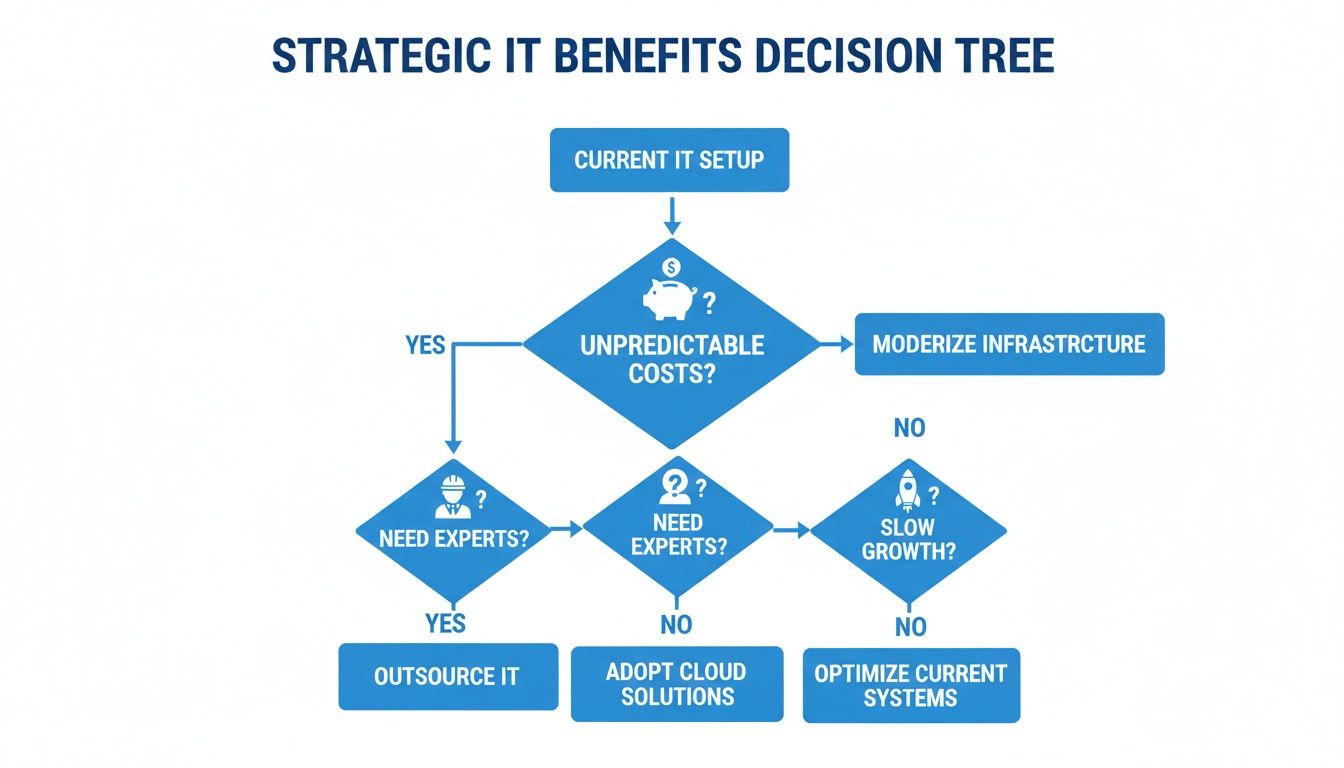
As the diagram illustrates, if you are grappling with unpredictable costs, internal skills gaps, or constraints on growth, managed support is a logical solution. The right model often depends on your underlying infrastructure; understanding the practical differences between on-premises vs cloud environments is a crucial first step.
Regardless of the model, the Service Level Agreement (SLA) is where commitments are formalised. It clearly defines metrics like response times and system uptime, holding your provider accountable and ensuring you receive the quality of service you are paying for.
How to Choose the Right Managed IT Provider
Selecting a provider for your managed IT services support is a critical business decision. This is not simply about hiring a contractor to fix technical issues; it is about forming a long-term partnership and entrusting an external team with a vital component of your operations. Therefore, due diligence must extend beyond marketing materials.

Begin by assessing technical expertise. A potential partner must demonstrate proven experience with the technologies central to your business, whether that is Microsoft Azure, modern security frameworks, or complex hybrid cloud environments. Request certifications and, more importantly, case studies relevant to your industry, especially if you operate in a regulated sector.
Evaluating a Potential IT Partner
Technical proficiency is essential, but so is a structured, transparent operational framework. A true partnership is built on clear communication and a shared understanding from the outset.
Consider these key areas:
- Onboarding Process: Is there a clear, documented plan for a seamless transition of your systems?
- Communication Protocols: How will they provide updates on performance, security threats, and strategic recommendations?
- Cultural Fit: Does their team feel like a natural extension of your own? Is there a basis for a strong working relationship?
The managed services market is competitive. The UK now has over 12,800 active MSPs, and their service offerings are evolving rapidly. Cloud computing is now a primary focus, and a provider's ability to manage modern application hosting has become significantly more important. The official UK managed services market research offers deeper insights. Understanding this landscape helps you select a partner whose capabilities align with your business trajectory.
Common Questions About Managed IT Services
Even with a clear understanding of the benefits, it is natural to have practical questions before engaging a managed IT partner. Here are answers to some of the most common queries we hear from UK organisations.
How Much Does Managed IT Services Support Cost in the UK?
In the UK, you can typically expect pricing to range from £25 to £100+ per user per month. The final cost depends on your business size, the complexity of your IT infrastructure, and the specific scope of services required.
Basic plans usually cover essentials like help desk support and system monitoring. More comprehensive packages cost more but include advanced cybersecurity, cloud management, and strategic planning. The objective is to establish a transparent, scalable model that converts unpredictable IT expenses into a fixed, manageable operational cost.
Will I Lose Control Over My IT by Using a Managed Service?
No, a reputable MSP partnership enhances strategic control rather than diminishing it. You delegate the day-to-day tactical responsibilities, which frees your internal resources to focus on high-value business initiatives.
A true partner provides detailed reports, holds regular performance reviews, and offers expert guidance. It's a collaborative relationship where you remain in control of your IT strategy, supported by specialised operational expertise.
How Long Does Onboarding with a Managed IT Provider Take?
The onboarding process can take anywhere from a few weeks to a couple of months, depending on the size and complexity of your organisation. A professional provider will have a well-structured onboarding methodology.
The process typically follows a clear path:
- Deep-Dive Audit: A thorough assessment of your entire IT infrastructure.
- Deployment: Rolling out necessary monitoring agents and security tools across your network.
- Documentation: Creating detailed records of all systems and processes to build a comprehensive knowledge base.
- Integration: Connecting your team with the help desk for a seamless handover.
A provider with a clear, efficient process ensures a smooth transition with minimal disruption to your daily operations.
Ready to build a scalable, secure, and future-ready IT foundation for your business? Organisations often rely on strategic guidance and structured support to turn technology into a competitive advantage. Book your free 30-minute consultation to receive a tailored plan.