
Subtotal $0.00


Cyber threats are no longer just a concern for large corporations; they are a daily operational reality for small and medium-sized businesses across the UK. For these organisations, professional small business cyber security services are not simply an IT expense—they are a fundamental investment in business continuity, resilience, and growth.
Why Cyber Security Is a Critical Business Risk for UK SMEs
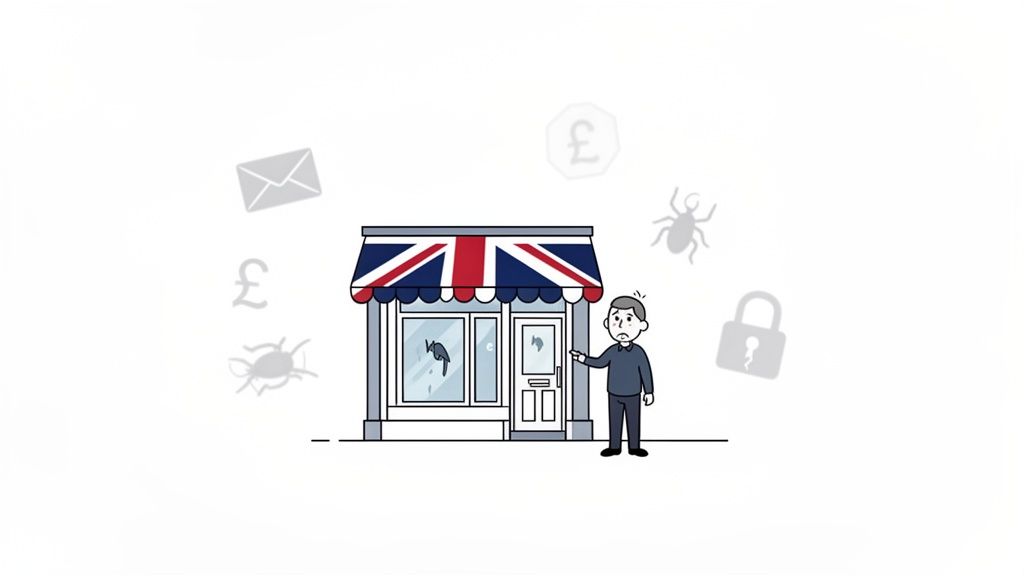
A common and dangerous misconception among small business owners is the belief that their company is too small to be a target for cybercriminals. The reality is precisely the opposite. Attackers often view SMEs as opportune targets precisely because their defences are perceived as less sophisticated. This gap between perceived risk and actual vulnerability creates a critical blind spot for many businesses.
The consequences of a security breach extend far beyond the immediate financial loss. They include severe operational disruption, a significant erosion of customer trust, and long-term damage to a hard-earned reputation. Real-world incidents, such as the rising threat of infostealer malware, starkly illustrate the severe financial risks that businesses face.
In fact, recent figures from the UK government indicate that a staggering 43% of businesses identified a cyber attack in the last 12 months. The average cost of an incident for a small business is estimated to be between £3,398 and £5,001. Acknowledging and understanding this modern threat landscape is the essential first step toward building a resilient and effective defence.
Quick Reference: Your Essential Cyber Security Services Checklist
For busy decision-makers, navigating the world of cyber security can feel overwhelming. This checklist is designed to cut through the complexity, outlining the core small business cyber security services every organisation should consider.
Use this as a starting point to assess your most urgent needs, then explore the detailed sections below to understand how each service functions to protect your business. A robust security strategy is built from these fundamental layers, ensuring your critical data, operations, and reputation are properly shielded.
A Look at Key Security Services for Small Businesses
Understanding the different types of security services available is the first step in building a cohesive defence. Let's break down the most important cyber security services for small businesses.
We will explore what each service delivers, how it applies in a real-world context, and why it is an indispensable component of a modern security framework. From 24/7 threat monitoring to ensuring you can recover from a major incident, these are the cornerstones of business protection.
For each service, we've included practical examples to demonstrate their value, helping you make informed decisions about safeguarding your company.
Managed Detection and Response (MDR)
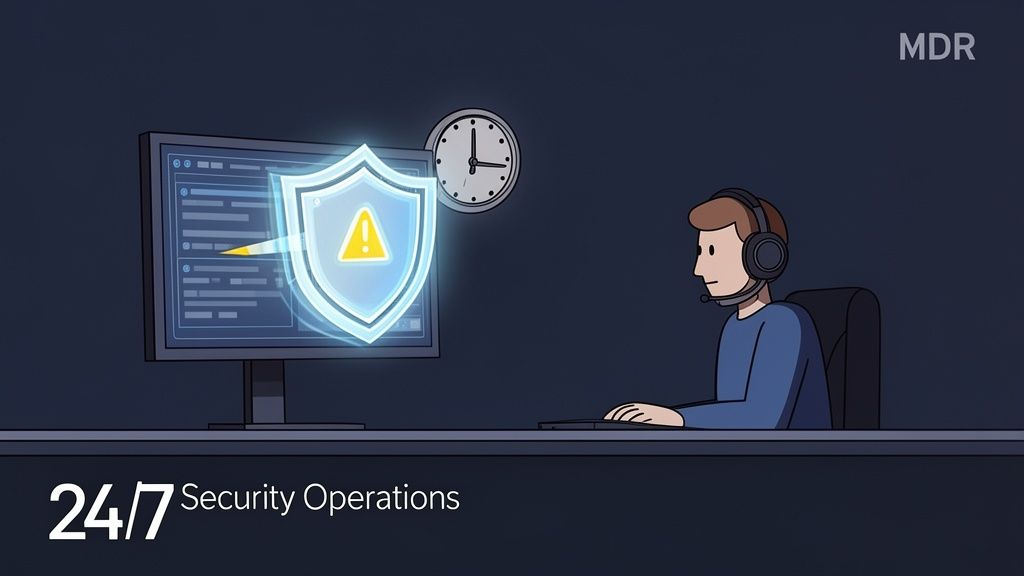
Think of Managed Detection and Response (MDR) as having an elite security operations team on watch 24/7, without the significant overhead of an in-house team. This service goes far beyond simply flagging potential issues; it involves actively hunting for, analysing, and neutralising threats as they emerge.
For a small business, this capability is a game-changer. Imagine an attacker gains a foothold in your network at 2 AM on a Sunday. An MDR service doesn’t just generate an alert that sits unread in an inbox until Monday morning. Their security analysts will detect the anomalous activity, isolate the compromised device, and begin remediation before your business day even starts. This is the difference between a minor, contained incident and a full-blown, business-halting breach.
Why Real-Time Response Matters
The true value of MDR lies in its ability to dramatically reduce "dwell time"—the critical window between when an attacker penetrates a network and when they are removed. The shorter this window, the less damage they can inflict.
While an automated security tool might generate an alert, a human-led MDR team provides essential context. They investigate why an alert was triggered, determine its severity, and then take decisive action. This human expertise is what separates a genuine threat from a false positive.
Many MDR providers integrate their operations with other powerful tools, like Managed SIEM Services, to gain a comprehensive view of your entire IT environment. By correlating security data from all your systems, they can identify subtle attack patterns that might otherwise go unnoticed. For a small business, this level of proactive defence provides a massive strategic advantage.
Advanced Endpoint Protection
Let's be clear: traditional antivirus software is no longer sufficient. Modern Endpoint Protection Platforms (EPP) represent the next evolution in device security. While legacy antivirus relies on matching files against a list of known viruses, a true EPP defends your laptops, servers, and mobile devices using far more intelligent and proactive methods.
These platforms are designed to identify suspicious behaviour. They leverage techniques like behavioural analysis and machine learning to stop new and complex attacks, including previously unseen threats known as zero-day exploits. This proactive approach is the only effective way to stay ahead of today's sophisticated cybercriminals.
How It Works in Practice
What does this look like in a day-to-day scenario? Imagine an employee clicks a malicious link in a phishing email, which attempts to run a harmful script. An advanced EPP doesn't need to have seen that specific script before. It recognises the malicious behaviour in real-time and blocks it instantly.
For a small business, attempting to manage this level of protection in-house is a significant challenge. This is where a managed service demonstrates its worth. It ensures this powerful protection is correctly configured, continuously monitored, and consistently updated on every company device. You gain expert oversight without the management burden, preventing a single laptop or phone from becoming the weak link in your security.
Backup and Disaster Recovery (BDR)
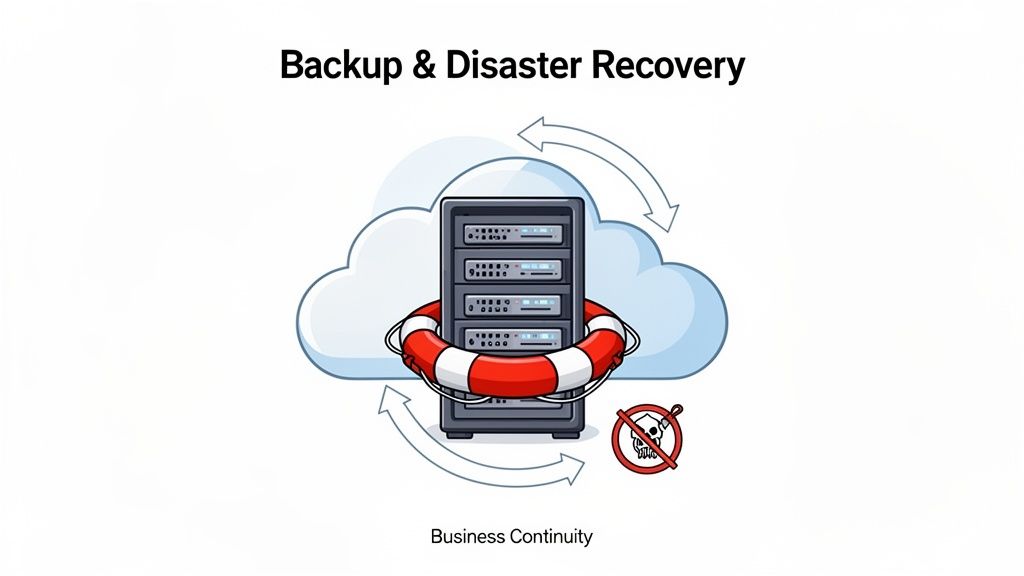
Consider Backup and Disaster Recovery (BDR) as your business's ultimate safety net. It is your recovery mechanism when things go wrong, whether from a cyber attack, hardware failure, or simple human error. This isn't just about copying files; it's a complete strategy designed to restore your entire operation swiftly after a crisis.
For instance, if ransomware encrypts all your servers, a robust BDR plan allows you to restore your systems to a clean, pre-attack state. This capability can render a ransom demand irrelevant, helping you avoid catastrophic downtime and financial loss. As we explore in our guide on how to prevent ransomware attacks, reliable, tested backups are your most potent defence against the impact of such attacks.
UK SMEs are prime targets, facing an estimated 65,000 hack attempts daily. Cybercriminals often view them as 'soft targets', which makes a robust recovery solution an absolute non-negotiable for business continuity. You can explore the current threat landscape in more detail in the government's latest Cyber Security Breaches Survey.
Identity and Access Management (IAM)
Identity and Access Management (IAM) is a foundational pillar of modern cyber security. Its purpose is to ensure that only the right people can access the right information at the right time. As more business data moves to the cloud and is accessed from anywhere, a user's identity has become the new security perimeter. This makes controlling access an essential part of any small business's security posture.
At its core, IAM is built on two simple but powerful principles that work together to secure your systems.
- Multi-Factor Authentication (MFA): This is a straightforward yet incredibly effective control. It requires a second form of verification before granting access. Even if a criminal steals a password, MFA can stop them from getting in.
- Principle of Least Privilege: This concept involves granting employees access only to the files and systems they absolutely need to perform their jobs. This dramatically limits the potential damage if one of their accounts is compromised.
A perfect real-world example is enabling MFA on your Microsoft 365 accounts. If a password is stolen, the attacker still cannot access company emails or files without the one-time code from the employee's phone. It's a simple, high-impact defence.
Achieving Cyber Essentials Certification
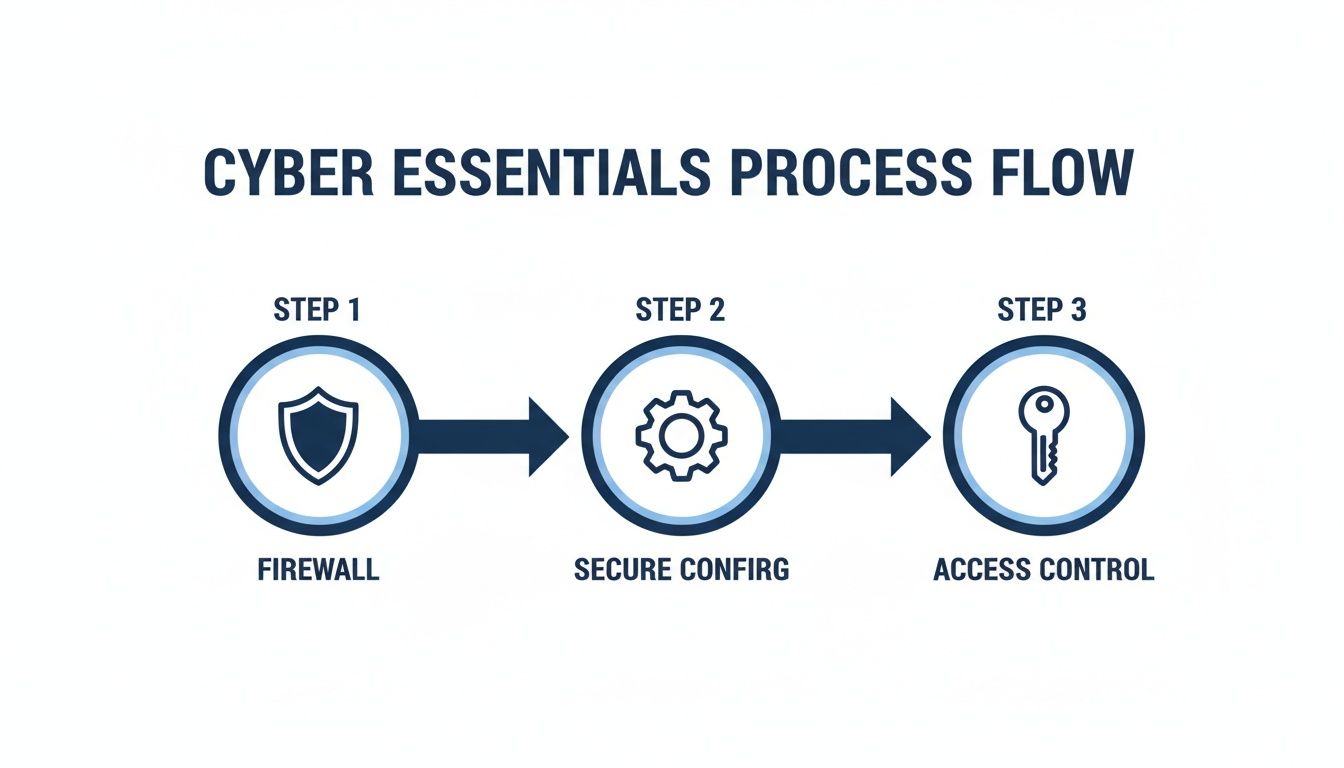
Cyber Essentials is a UK government-backed scheme that provides a clear, practical framework for protecting your business against the most common cyber threats. It focuses on getting the fundamentals right across five key technical controls: firewalls, secure configuration, user access control, malware protection, and patch management. Achieving certification not only strengthens your defences but also sends a powerful signal to clients and partners that you take security seriously.
This is a significant step in building trust. However, for many small businesses, knowing where to begin is a major hurdle. The latest cybersecurity survey findings show that 69% of UK SMEs lack a formal security policy, and awareness of these crucial standards remains worryingly low.
While the framework itself is straightforward on paper, implementing the technical details correctly can be complex. This is where partnering with a skilled IT provider makes a significant difference. They can streamline the certification process, ensuring your business meets every standard without the common headaches and pitfalls. Many organisations rely on this kind of structured IT support to navigate the process effectively, a topic we explore in our article on what Cyber Essentials certification is.
How to Choose the Right Cyber Security Partner
Selecting the right managed security service provider (MSP) is a strategic business decision that goes far beyond comparing price lists. You are looking for a true partner who understands your business, not just another supplier.
Look for a provider with demonstrable experience in your sector, strong client testimonials, and key industry certifications. A transparent approach to their own internal security practices is also a strong indicator of their professionalism and credibility.
Before committing, it is vital to ask the right questions. You should investigate their incident response procedures, the type and frequency of reporting you will receive, and how they will tailor their small business cyber security services to your unique operational needs and compliance requirements. For a deeper look at what to expect from a provider, you can read more about cyber security managed services.
A key UK certification to look for in a partner is Cyber Essentials. This diagram breaks down its core technical controls.
Ultimately, the best partner will act as a strategic advisor, helping you build a secure and scalable IT foundation that supports your long-term business goals.
Frequently Asked Questions
It's natural to have questions when evaluating cyber security services. To provide clarity, we have compiled straightforward answers to some of the most common queries from small business owners.
How Much Should a Small Business Budget for Cyber Security?
There is no single cost for small business cyber security services, as the investment depends on your company's size, the type of data you handle, and the specific solutions required. A practical approach is to allocate a portion of your overall IT budget specifically for security.
For a small team, foundational services like endpoint protection and managed backups might start from a few hundred pounds per month. The only way to get an accurate figure is to consult with a provider who can assess your specific risk profile and provide a tailored quote.
Are All These Services Really Necessary for My Business?
In today's threat environment, yes. Cybercriminals actively target small businesses, viewing them as more vulnerable than large enterprises. While you may not need every advanced service from day one, the foundational layers are non-negotiable.
Core protections like endpoint security, multi-factor authentication, and reliable backups are essential. A good IT partner will not try to sell you everything at once. Instead, they will work with you to develop a pragmatic security roadmap, starting with the most critical protections and scaling the strategy as your business grows.