
Subtotal $0.00


Think of Microsoft Azure managed services as hiring a specialist crew to run, maintain, and fine-tune your powerful cloud setup. This partnership with an external expert handles all the complex, day-to-day management, making sure your Azure environment is secure, cost-effective, and perfectly aligned with what your business needs to achieve.
Why Azure Managed Services Are a Strategic Business Decision
Getting onto Microsoft Azure is a fantastic first step in modernising your business, but just moving to the cloud is only the beginning of the journey. The Azure platform is a huge and powerful ecosystem, a bit like a high-performance engine. It has immense potential, but to get the most out of it, you need constant maintenance, expert tuning, and a skilled hand at the wheel to navigate its complexities.
Without that dedicated oversight, businesses often run into surprise costs, security holes, and performance dips that completely undermine the benefits they were trying to gain in the first place.
This is exactly the problem that Microsoft Azure managed services are built to solve. It’s the difference between just owning the engine and having a dedicated pit crew on standby. A managed services provider (MSP) becomes an extension of your own team, taking on the heavy lifting of cloud management.
Moving Beyond Basic IT Support
This isn't your standard break-fix IT support; it's a proactive, strategic partnership focused on continuous improvement. The goal is to turn your cloud infrastructure from something you just use into a strategic asset that actively helps your business grow.
By handing off the tricky and time-consuming operational tasks, your internal IT team is freed up to focus on innovation and projects that add real value, instead of being stuck in the weeds of routine maintenance. The key benefits that UK businesses see from this are clear and powerful:
- Enhanced Security Posture: You gain access to specialists who implement and manage advanced security controls, making sure your data and applications are shielded from ever-changing threats.
- Predictable and Optimised Costs: An MSP brings continuous cost-monitoring and optimisation strategies to stop budgets from spiralling and ensure you only pay for what you actually need.
- Access to Specialised Skills: You can tap into a deep pool of certified Azure experts without the huge expense and headache of trying to hire and retain them on your payroll.
- Improved Resilience and Reliability: Your systems are kept running through proactive monitoring, solid backup solutions, and proper disaster recovery planning.
Ultimately, working with an Azure managed services partner isn't just another operational cost; it's a vital investment in the efficiency, security, and long-term resilience of your business.
What Does Azure Management Actually Involve?
When you partner with a provider for Microsoft Azure managed services, you're essentially handing over the complex, day-to-day running of your cloud environment to a dedicated team of specialists. But what does that really mean in practice? It's a suite of crucial services working in harmony to elevate your Azure infrastructure from a mere utility into a secure, efficient, and cost-effective asset for your business.
Each component is designed to tackle a specific business headache, whether it's preventing frustrating downtime, plugging security holes, or simply keeping your cloud spend in check. Let's peel back the layers and look at what you should expect.
The diagram below shows how these services directly address the big three business challenges: security, cost, and the in-house skills gap.
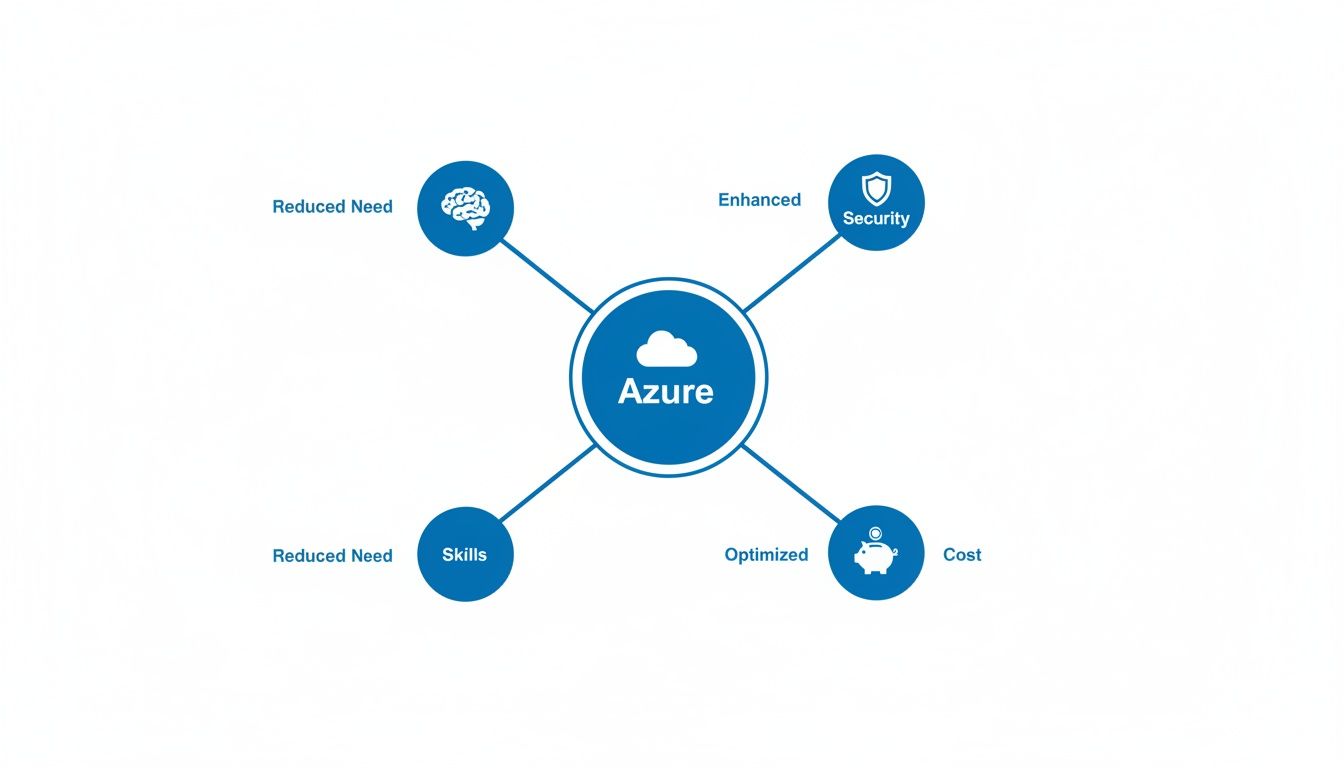
As you can see, a managed service model is a direct answer to major operational hurdles. It empowers businesses to tap into Azure's full potential without the need to build and maintain a large, specialist team in-house.
To give you a clearer picture, here’s a breakdown of the core services and the value they bring to your business.
Key Azure Managed Services and Their Business Impact
| Service Component | Core Function | Primary Business Benefit |
|---|---|---|
| Proactive Monitoring | Constant 24/7/365 surveillance of your Azure environment's health and performance. | Prevents downtime and performance issues before they impact your users and operations. |
| Security & Patching | Implementing robust security measures, patching vulnerabilities, and detecting threats. | Significantly reduces your risk of cyberattacks and costly data breaches. |
| Backup & Disaster Recovery | Creating and testing strategies to recover data and systems after an incident. | Ensures business continuity and rapid recovery from failures or disasters. |
| Cost Optimisation | Analysing cloud usage to eliminate waste and ensure you only pay for what you need. | Lowers your monthly Azure bill and provides predictable, optimised cloud spending. |
Each of these elements plays a vital role in creating a stable and strategic cloud foundation for your business to build upon.
Proactive Monitoring and Performance Tuning
Waiting for something to break is a recipe for disaster. Proactive monitoring flips the script, focusing on spotting potential trouble before it affects your business. An MSP uses sophisticated tools to keep a watchful eye on your entire Azure estate—virtual machines, databases, network traffic, you name it—24/7/365.
This constant vigilance means performance bottlenecks get ironed out before users even notice a slowdown. Potential outages can be headed off completely, resulting in a far more reliable and responsive system that keeps your business running smoothly.
Security and Patch Management
In the cloud, security isn't a "set it and forget it" task; it's an ongoing process. A fundamental role of any Azure MSP is to build and manage a strong security posture. This is about much more than just a firewall. It involves several key activities:
- Vulnerability Scanning: Regularly probing your systems to find known security weaknesses.
- Patch Management: Applying critical security updates to operating systems and applications, closing the door on vulnerabilities before attackers can exploit them.
- Threat Detection: Using advanced tools to spot and react to suspicious activity across your network.
- Identity and Access Management: Making sure only authorised people can access sensitive resources. If you'd like to learn more, check out our guide on what is Azure Active Directory.
This disciplined, multi-layered approach drastically reduces your attack surface and helps shield your business from data breaches and other cyber threats.
Backup and Disaster Recovery
What would happen if a critical server went down or key data was accidentally deleted? A managed services provider puts a solid backup and disaster recovery (DR) plan in place to ensure your business can bounce back quickly from any incident.
This involves setting up automated, regular backups of your crucial data and applications. Crucially, it also means creating and testing a full disaster recovery plan. That way, if a major outage does occur, there’s a clear, proven process to get operations back online with minimal disruption.
A well-managed Azure environment isn't just about uptime; it's about resilience. The real value of an MSP lies in their ability to ensure that when the unexpected happens, your business is prepared to recover swiftly and securely.
Governance and Cost Optimisation
Without disciplined oversight, cloud spending can easily spiral out of control. An MSP brings essential governance and cost optimisation to the table to stop this from happening. They put policies in place to control who can create resources, enforce tagging for better cost tracking, and constantly analyse your usage to find savings.
This could mean identifying and shutting down servers that are no longer needed, recommending more cost-effective service tiers, or making smart use of Azure Hybrid Benefit and Reserved Instances. The result is a predictable, optimised cloud budget that squeezes maximum value from every pound you spend.
This combination of proactive management, robust security, and financial oversight is what makes Microsoft Azure managed services such a powerful strategic advantage. It allows you to build on the cloud with confidence, knowing the foundations are being expertly handled.
The Strategic Advantages of an Azure MSP Partnership
Partnering with a provider for Microsoft Azure managed services is much more than just outsourcing IT tasks; it's a strategic move that delivers real, measurable business advantages. While the day-to-day management of monitoring, patching, and backups is vital, the true value comes from transforming your cloud from a simple cost centre into a powerhouse for growth, security, and innovation.
A good partner connects the technical dots to your wider business goals. They don't just put out fires—they stop them from starting, get your spending under control, and bring the high-level expertise you need to truly compete. Making that shift from being reactive to proactive is where you'll see the biggest wins.
Fortifying Security and Streamlining Compliance
In today's threat landscape, world-class security isn't optional. An expert Azure managed services provider does more than install a few security tools; they build and manage a complete security framework that’s designed around your business. This is essential for achieving and maintaining key UK standards like Cyber Essentials.
Your MSP will guide you towards a modern Zero Trust architecture, a security model that works on the principle of "never trust, always verify." This approach dramatically strengthens your defences by making sure every single access request is properly authenticated and authorised, no matter where it's coming from.
An experienced MSP turns compliance from a painful annual chore into a continuous, everyday part of your cloud operations. This proactive approach changes security from a defensive cost into a genuine competitive edge, building trust with your customers.
By weaving security best practices into your daily operations, a partner ensures your Azure environment isn't just secure today but is also ready for whatever threats come next. This gives you peace of mind and frees you up to concentrate on what you do best.
Gaining Predictable Costs and Financial Control
One of the most common traps in the cloud is runaway spending. Without a watchful eye, costs can easily spiral, wiping out the very financial benefits you moved to Azure for. It's a problem that trips up even the most tech-savvy companies.
A strategic MSP partner adds that critical layer of financial governance. Through constant analysis and optimisation, they make sure you only pay for the resources you're actually using. This typically involves:
- Rightsizing Services: Adjusting virtual machines and databases to match real-world performance needs, cutting out the waste.
- Identifying Redundancies: Finding and shutting down unused or forgotten resources that are quietly racking up costs on your monthly bill.
- Leveraging Cost-Saving Plans: Smartly using Azure reservations and savings plans to get significant discounts on your consistent, long-term workloads.
This hands-on cost management gives you what every business leader wants: predictable, optimised monthly spending. It puts an end to budget shocks and guarantees your cloud investment delivers maximum value for every pound spent, hitting your bottom line directly.
Unlocking In-House Innovation
Perhaps the most powerful benefit of an Azure MSP partnership is the freedom it gives your own team. Trying to hire and retain a full-time crew of certified Azure specialists—experts in networking, security, databases, and automation—is incredibly expensive and difficult for most businesses.
When you partner with an MSP, you get instant access to that deep bench of expertise whenever you need it. This frees your talented in-house IT staff from the endless cycle of daily maintenance and firefighting. Instead of getting bogged down in routine tasks, they can focus their energy on high-value projects that push the business forward, like building new applications, improving customer experiences, or exploring new ways to generate revenue. To see how this can elevate your cloud strategy even further, it's worth looking into the benefits of dedicated Azure DevOps consulting services.
At the end of the day, an Azure managed services partnership is an accelerator. It lets you tap into world-class expertise to build a secure, cost-effective foundation, freeing up your own team to focus on the innovation that makes your business stand out.
How Azure Managed Services Drive Real-World Success
The real value of Microsoft Azure managed services isn't just theory; it’s about how they solve genuine business problems. Let's move past the technical jargon and look at a few practical scenarios that UK businesses face every day. This is where an expert partnership turns the potential of the cloud into tangible, measurable results.
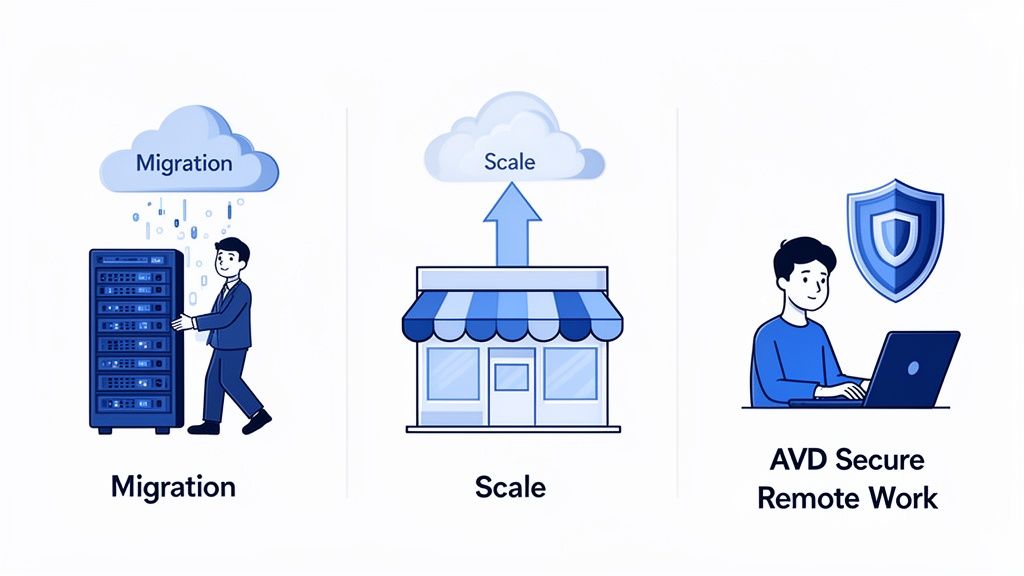
From dragging old legacy systems into the modern era to enabling secure remote working, these examples show how a managed service gives you the structure, security, and agility you need to get ahead.
Executing Complex Legacy Migrations
Many established businesses are running on systems that, while reliable, are getting old and inflexible. Shifting these critical workloads to Azure is a massive project, and it’s loaded with risks—think data loss, painful downtime, and performance headaches once you’re finally live.
This is where an Azure MSP proves its worth. They take the risk out of the equation, starting with a deep-dive discovery phase to map out every dependency before creating a sensible, phased migration plan. They handle all the technical heavy lifting during the switch, ensuring a smooth transition with minimal disruption. Afterwards, they fine-tune the new setup to squeeze out every drop of performance and keep costs down.
If this sounds like a move you're considering, you might find our guide on what is cloud migration helpful.
Real-World Example: A UK Manufacturer
A manufacturing firm needed to shift its decade-old ERP system to the cloud for better access and resilience. An MSP handled the entire migration over a single weekend, validated all the data, and now manages the system in Azure. The result? 99.9% uptime and a robust disaster recovery plan that was simply impossible before.
Managing Secure Hybrid Cloud Environments
For many UK organisations, especially in regulated industries like finance or healthcare, going "all-in" on the public cloud just isn't an option. The common reality is a hybrid approach, blending on-premise infrastructure with Azure services. The trouble is, managing and securing this mixed environment is notoriously difficult.
An expert partner provides that single pane of glass you need to make hybrid work. They roll out consistent security policies across both environments, manage how data flows between them, and ensure you’re meeting compliance standards everywhere. This is crucial in the UK, where hybrid cloud adoption is growing rapidly, largely thanks to Azure's strengths in compliance and data sovereignty.
Scaling an E-Commerce Platform for Peak Demand
Picture this: a UK online retailer is gearing up for Black Friday. A massive surge in traffic could easily crash their site, leading to lost sales and unhappy customers. But keeping enough servers running all year just to handle that one peak is a huge waste of money.
This is a classic cloud problem with a smart solution. A managed services provider sets up auto-scaling rules in Azure, allowing the platform’s resources to expand automatically when traffic spikes and then shrink back down when things quieten down. The MSP keeps a close eye on performance during the sales event, making sure every customer has a smooth experience while keeping the hosting bill under tight control.
Enabling a Secure and Productive Remote Workforce
The move to remote and hybrid work has piled pressure on IT teams to provide secure, reliable access to company files and applications from anywhere. Azure Virtual Desktop (AVD) is a brilliant solution, but managing it properly requires a specific, and often rare, skill set.
An MSP can take care of the entire AVD lifecycle. They’ll design and deploy the environment, manage all the user profiles, apply security policies to keep company data safe, and make sure the platform runs smoothly for every single employee. This lets you offer a truly flexible and secure desktop experience without burying your internal IT team in the complexities of VDI management.
Choosing The Right Azure Managed Services Provider
Picking a partner for your Microsoft Azure managed services is one of the most important technology decisions your business will face. Get it right, and they become a true extension of your team, boosting efficiency and locking down your security. Get it wrong, and you could be looking at runaway costs, gaping security holes, and missed opportunities.
Making a smart choice means going deeper than a simple service catalogue. You have to size up their technical skills, check their security credentials, and most importantly, see if they actually understand what you're trying to achieve as a business. There’s a world of difference between a partner that offers strategic advice and one that just waits for things to break.
Verifying Technical Expertise and Certifications
First things first, you need to check their credentials. Any prospective partner worth their salt should be able to prove their expertise with official Microsoft designations.
- Microsoft Solutions Partner: This is the current badging system from Microsoft. You should be looking for titles like "Solutions Partner for Infrastructure (Azure)" or "Solutions Partner for Security." These badges show that the provider has passed strict tests on performance, skills, and customer success.
- Azure Specialisations: These are a step up. Previously known as "Advanced Specialisations," they require a tough, third-party audit to validate deep, specific knowledge in areas like migrating Windows Server and SQL Server to Azure.
These aren't just fancy logos for a website. They're concrete proof that the provider has a team of certified experts and a history of successful Azure projects.
Assessing Security Credentials and Compliance
Security is not a "nice-to-have"; it's a deal-breaker. In the UK, a crucial benchmark for any IT provider is how seriously they take their own security.
You must ask potential partners if they are Cyber Essentials Plus certified. This is a government-backed scheme that involves a hands-on technical audit to prove their own systems are protected against common cyber threats. If they can't protect themselves, how can you trust them with your data? A solid understanding of modern frameworks like Zero Trust is also vital for building a secure cloud environment from the ground up.
A partner’s commitment to security should be evident in their own operations. A Cyber Essentials Plus certification demonstrates they practice what they preach, providing a baseline of trust before you even sign an agreement.
Scrutinising the Service Level Agreement
The Service Level Agreement (SLA) is the rulebook for your relationship. It’s absolutely vital to read the fine print and make sure it actually meets your business needs. Pay close attention to:
- Guaranteed Response and Resolution Times: What do they promise for different levels of urgency? Are these promises realistic for your most critical systems?
- Uptime Guarantees: What percentage of uptime are they guaranteeing? And more importantly, what are the penalties if they don’t meet that target?
- Support Channels and Availability: Do they offer genuine 24/7 support? How do you raise an issue—by phone, email, or through a proper ticketing portal?
A well-defined SLA creates transparency and holds your provider accountable, making sure you get the service you’re paying for. Talking through the options with experienced Azure consultants can shed light on what a strong service agreement should look like. A great partner will focus on a strategic relationship, not just fixing problems as they appear, ensuring your Azure setup is built for the long haul.
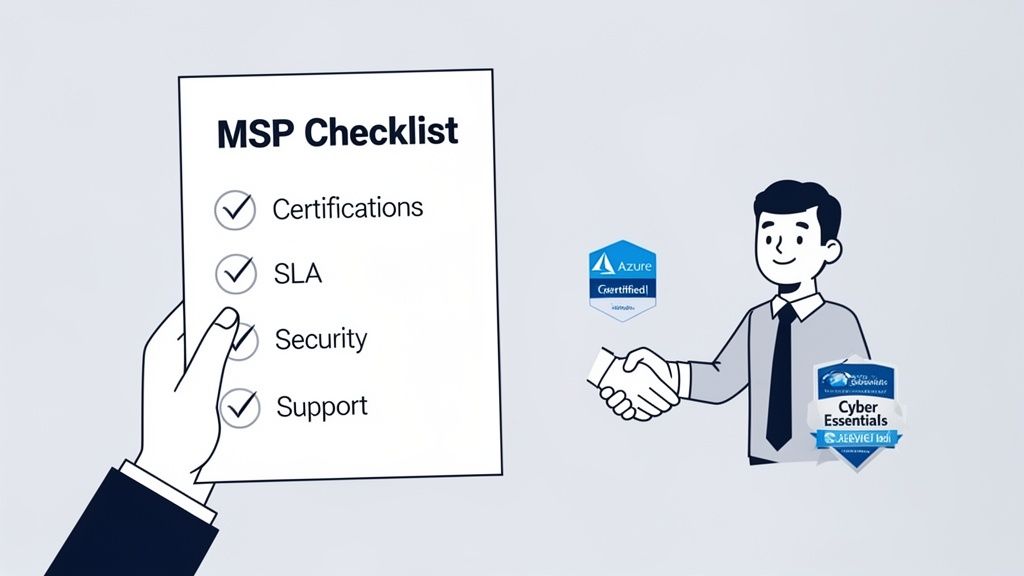
To simplify the process, we've put together a checklist to help you compare potential partners effectively.
Checklist for Selecting Your Azure MSP Partner
This table provides a practical framework for evaluating potential Microsoft Azure Managed Service Providers. Use it to compare candidates side-by-side and ensure you're asking the right questions.
| Evaluation Criteria | What to Look For | Why It Matters |
|---|---|---|
| Microsoft Certifications | Look for "Solutions Partner" designations (e.g., for Infrastructure) and advanced "Azure Specialisations". | These aren't just badges; they are proof of validated skills, customer success, and a deep, audited understanding of Azure. |
| Security Posture | Are they Cyber Essentials Plus certified? Do they have a clear understanding of Zero Trust principles? | This shows they take their own security seriously. If they aren't secure, they can't secure you. |
| Service Level Agreement (SLA) | Clear, guaranteed response/resolution times, uptime guarantees with penalties, and genuine 24/7 support channels. | The SLA is your contract. It needs to be unambiguous and aligned with your business's operational needs. |
| Proactive Management | Do they offer strategic guidance, cost optimisation, and forward-planning, or just reactive "break-fix" support? | A proactive partner prevents problems and helps you grow, while a reactive one just puts out fires. |
| Technical & Business Alignment | Do they understand your industry and business goals? Can they translate technical solutions into business value? | Technology is a tool to achieve business outcomes. Your partner needs to understand both sides of the equation. |
| Client References & Case Studies | Ask for references from businesses similar to yours in size and industry. Review their case studies. | Past performance is the best indicator of future success. See real-world proof of their capabilities. |
Choosing the right Azure MSP is a strategic decision that goes beyond a simple technical evaluation. It's about finding a partner you can trust to manage a critical part of your business, drive innovation, and help you achieve your long-term goals.
Time to Build Your Scalable, Secure Cloud Future
We've covered a lot of ground, and hopefully, it's clear that Microsoft Azure managed services are much more than just a way to offload IT tasks. Think of them as a strategic move—one that enables innovation, tightens up your security, and fuels real business growth. When you hand over the keys to your cloud infrastructure to genuine experts, you get predictable costs, a much stronger security posture, and the freedom to get back to what you do best.
Of course, the real trick is picking the right partner to walk with you on this journey. A huge part of building a solid, scalable cloud environment is making sure you meet all the necessary industry standards and regulations. For many tech companies, a practical guide to SOC 2 compliance is essential reading, which just goes to show how vital it is to have a partner who gets both the tech and the red tape.
A successful journey to a modernised, secure cloud environment is rarely a solo endeavour. The real value emerges from a partnership built on shared goals, technical excellence, and a deep understanding of your business objectives.
The logical next step? Chat with seasoned experts who can turn Azure's potential into real-world business results. A great partner won't just manage your systems; they'll work with you to get the absolute most out of your cloud investment, making sure it's a future-ready foundation for your business. This is what separates basic IT support from a true strategic partnership that drives success for years to come.
Working with an experienced provider ensures your Azure setup isn't just running smoothly but is perfectly aligned with your bigger vision. It’s a team effort to build a cloud that's secure, scalable, and cost-effective, allowing your organisation to adapt and thrive. By bringing in structured IT support, you can confidently handle the complexities of the cloud and turn your technology from a cost centre into a real competitive advantage.
Frequently Asked Questions
When you're looking into Microsoft Azure managed services, a few key questions always come up. Here are some straightforward answers to the things business leaders like you are asking, giving you the clarity you need to move forward.
What's The Typical Cost Structure For Azure Managed Services?
There’s rarely a one-size-fits-all price, which is a good thing. Most experienced providers offer flexible models, so you can find an agreement that actually fits your budget and the way you operate.
You'll usually see a few common approaches:
- Tiered Packages: Think of these as Bronze, Silver, and Gold levels. Each tier adds more proactive management and a deeper level of support.
- Per-Device or Per-User Pricing: A simple, predictable model where your costs are based directly on the number of virtual machines, users, or other specific resources being managed for you.
- Bespoke Agreements: For businesses with more complex setups, this is a fully customised plan built from the ground up to match your exact technical and commercial needs.
The goal for any good partner is to build a model that gives you predictable monthly costs. No more budget surprises.
How Exactly Does An MSP Improve Our Azure Security?
A good MSP doesn't just react to problems; they get ahead of them. It's about shifting your security from a simple checklist to a continuous, multi-layered strategy that actively shrinks your organisation's attack surface and keeps you compliant.
This is achieved by:
- Proactive Threat Monitoring: Using advanced tools, we keep a 24/7 watch over your environment. This means we can spot and shut down suspicious activity in real-time, not after the damage is done.
- Diligent Patch Management: Systematically applying the latest security updates to your servers and applications. This closes vulnerabilities before attackers even know they exist.
- Best-Practice Implementation: Configuring your Azure environment based on proven security frameworks like Cyber Essentials and modern Zero Trust principles.
A partnership with an MSP transforms security from an occasional task into an ongoing, embedded process. It's about building a resilient security culture, not just installing a firewall.
Can We Still Have Control Over Our Azure Environment?
Absolutely. This is a partnership, not a takeover. You always retain complete ownership of your Azure subscription, your data, and all your intellectual property. Nothing changes there.
The relationship is designed for co-management. Your team can still get into the environment, deploy applications, and drive new projects. The MSP simply handles the agreed-upon operational heavy lifting—the monitoring, backups, and security management—that frees up your internal team to focus on initiatives that actually grow the business.
How Long Does It Take To Onboard With An Azure MSP?
The timeline depends on how complex your current setup is, but a well-planned onboarding process usually takes just a few weeks. A professional provider will make sure the whole transition is smooth and doesn't disrupt your day-to-day operations.
It generally unfolds in three clear phases:
- Discovery: First, the MSP gets under the bonnet to properly assess your current Azure setup, security posture, and what you want to achieve as a business.
- Planning: Next, both teams sit down together to define the scope of work, set up clear lines of communication, and finalise the Service Level Agreement (SLA).
- Transition: Finally, the provider integrates their monitoring and management tools, establishes all the support channels, and officially takes over the day-to-day oversight of your environment.
At ZachSys IT Solutions, we know that a successful journey to the cloud is built on a strong, collaborative partnership. If you're ready to tighten your security, get costs under control, and unlock what Azure can really do for your business, we're here to help.
Book a complimentary 30-minute consultation to discuss a plan that’s built for your specific business goals.