
Subtotal $0.00


For many small businesses, IT is a reactive, often expensive chore. When technology works, it’s invisible; when it breaks, it brings operations to a halt. The traditional "break-fix" model—waiting for a server to fail or a security threat to appear before calling for help—is not just stressful; it’s a direct drain on productivity and profitability.
This is where small business managed IT services change the game. Instead of firefighting, a managed service provider (MSP) acts as a proactive technology partner. For a predictable monthly fee, they take full responsibility for monitoring, managing, and securing your IT infrastructure. This strategic shift turns technology from a source of frustration into a powerful tool for growth, security, and long-term stability.
Moving from Firefighting to Future-Proofing
The break-fix approach to IT treats technology like a series of isolated emergencies. A laptop dies, a critical application crashes, or a suspicious email lands in an inbox, and the scramble begins to find a solution. This constant state of reaction is inefficient, unpredictable, and costly, creating a cycle of downtime and disruption that no small business can afford.
Managed IT services flip this model on its head. The core principle is proactive maintenance and continuous oversight to prevent problems before they impact your business. This simple yet profound shift transforms IT from a volatile operational cost into a strategic investment in business resilience and future growth.
The Strategic Shift to Proactive IT
Engaging a managed services partner provides access to a dedicated team of specialists who continuously monitor, maintain, and secure your entire technology stack. This proactive management delivers immediate, tangible advantages:
- Predictable Budgeting: A fixed monthly fee covers everything from day-to-day helpdesk support to advanced cybersecurity. This eliminates surprise repair bills and allows for accurate financial planning.
- Access to Expertise: You gain the knowledge of certified experts in cloud computing, networking, and security—a talent pool that would be prohibitively expensive to hire in-house.
- Enhanced Security: A provider implements robust security measures, monitors for threats 24/7, and ensures all systems are patched and up to date, safeguarding your business against the catastrophic impact of a data breach.
This forward-thinking model is becoming the standard for modern businesses. The UK's managed service provider market reflects this trend, with recent research highlighting its significant economic impact and expansion. You can review the government's findings on the MSP market's expansion to understand the scale of this shift.
By entrusting your technology to a dedicated partner, you are not just outsourcing tasks; you are gaining a strategic ally focused on your long-term success, scalability, and security.
This partnership model allows small businesses to leverage enterprise-grade tools and expertise, levelling the competitive playing field. As you explore available options, looking into specialised offerings like Purple's SMB solutions can demonstrate how tailored this support can be. The right provider ensures your technology actively drives business growth rather than holding it back.
Core Managed IT Services Your Business Needs to Thrive
Effective managed IT extends far beyond a simple support contract. It’s a comprehensive suite of interconnected services designed to protect your business, ensure operational stability, and support scalable growth. These core components work in concert to form a strategic foundation for your entire technology environment.
A robust managed IT strategy blends proactive maintenance with reliable reactive support, creating a resilient framework for your technology. The diagram below illustrates this fundamental difference, showing how IT support diverges into either the proactive "managed services" path or the reactive "break-fix" route.
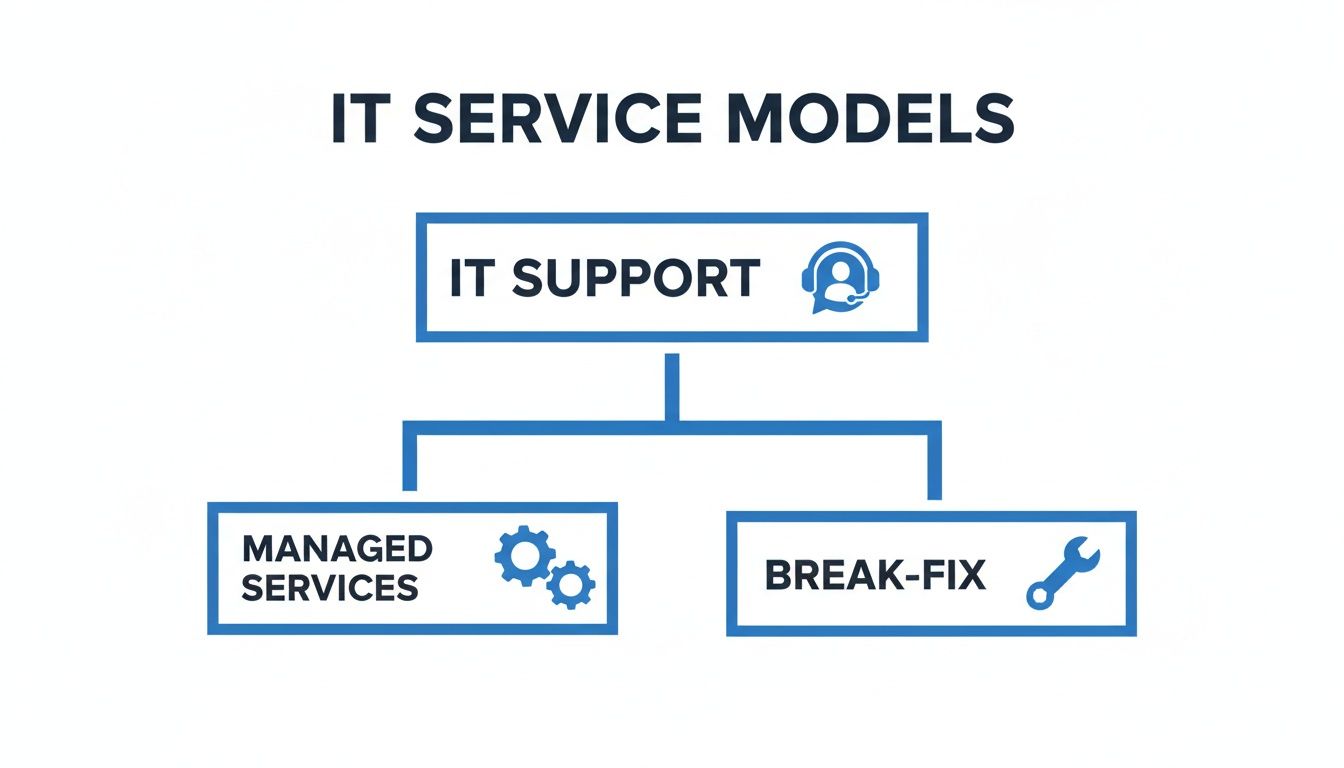
This distinction is critical. Managed services are architected to prevent issues, whereas break-fix support only engages after something has failed. Let's examine the essential services that define a modern, proactive partnership.
A well-rounded managed IT offering provides a comprehensive technology shield for your business. The table below outlines the key service categories and what they mean for your day-to-day operations and long-term goals.
Key Managed IT Services and Their Business Impact
| Service Category | Description | Key Business Benefit |
|---|---|---|
| Managed Security | Implements multi-layered defences like Zero Trust, continuous threat monitoring, and regular patching. | Significantly reduces the risk of costly cyberattacks and data breaches, protecting your reputation. |
| Cloud Management | Optimises your Microsoft Azure or AWS environments for cost, performance, and security. | Prevents surprise cloud bills and ensures your cloud infrastructure is a scalable, reliable asset. |
| Network Monitoring | Provides 24/7 surveillance of your IT infrastructure to detect and fix issues before they cause downtime. | Minimises disruptions and keeps your team productive by preventing problems before they start. |
| Backup & Recovery | Establishes automated, secure, and regularly tested backups with a clear plan for restoring operations. | Acts as an insurance policy, guaranteeing you can get back up and running quickly after a disaster. |
| Helpdesk Support | Offers fast and effective technical support from knowledgeable experts to resolve employee IT issues. | Boosts employee productivity by removing technical roadblocks and reducing frustration. |
These services are not standalone offerings; they integrate to create a complete support system that allows you to focus on running your business, not your IT.
Managed Security and Zero Trust Implementation
Modern cybersecurity goes far beyond basic antivirus software. A strategic partner will implement a Zero Trust framework, which operates on the principle: "never trust, always verify." In practice, this means every access request is rigorously authenticated and authorised before entry is granted, dramatically reducing your attack surface.
This involves continuous threat monitoring, consistent security patching, and employee awareness training to build multiple layers of defence. For a deeper look, our detailed guide covers the components of https://zachsys.com/2026/01/23/managed-it-security-services/.
Cloud Services Management for Azure and AWS
Many businesses migrate to the cloud only to face spiralling costs and complex security challenges. Expert cloud services management ensures your Microsoft Azure or AWS environment is not just operational but fully optimised. This involves vigilant performance monitoring, cost management to prevent bill shock, and configuring security controls specific to your cloud platform. The goal is to transform the cloud into a scalable, cost-effective asset rather than an unpredictable expense.
Proactive Network and Infrastructure Monitoring
Instead of waiting for a server to crash or a network to slow to a crawl, proactive monitoring provides 24/7 surveillance of your critical systems. Specialised tools detect early warning signs—such as low server memory or unusual network traffic—allowing technicians to intervene and resolve issues long before they cause downtime.
This shift from reactive repair to proactive maintenance is the cornerstone of effective managed IT. It minimises disruptions, keeps your team productive, and prevents minor glitches from escalating into major, costly outages.
Reliable Data Backup and Disaster Recovery
What would happen if your business data disappeared tomorrow? Whether due to hardware failure, a cyberattack, or human error, a robust backup and disaster recovery (BDR) plan is your business's essential insurance policy. This is more than just backing up files; it involves a tested, documented plan to restore your entire operation quickly.
A competent managed provider ensures your backups are:
- Regular and Automated: Data is copied consistently without manual intervention.
- Securely Stored: Backups are encrypted and stored in multiple locations (on-site and cloud) for redundancy.
- Routinely Tested: Recovery drills are performed to validate that the plan works, providing confidence that you can recover when it matters most.
Responsive and Knowledgeable Helpdesk Support
When technical issues arise, your team needs fast, effective assistance. A core component of any managed service is a reliable helpdesk, and there are excellent service desk tips that define what best practice looks like. This isn’t just about logging a ticket; it's about providing employees with direct access to experts who can resolve problems efficiently, explain the solution clearly, and reduce frustration. This service is a direct driver of productivity, ensuring staff can overcome technical hurdles and return to their primary responsibilities.
The Tangible ROI of Managed IT Services
Technology should be an investment that delivers a clear return, not just another line item on the expense report. When evaluating managed IT services for a small business, the critical question is always about the return on investment (ROI). The answer lies not in replacing one cost with another, but in unlocking tangible value that positively impacts your bottom line.
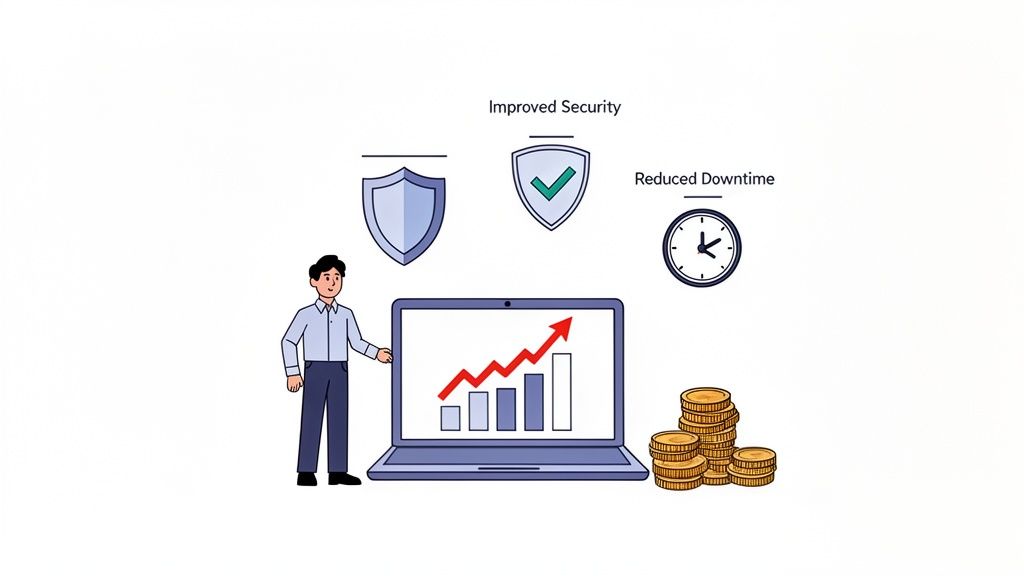
A strategic IT partnership creates benefits that ripple across your entire operation—boosting productivity, strengthening security, and fuelling sustainable growth. It represents a fundamental shift from viewing IT as a reactive expense to leveraging it as a proactive driver of business success.
Reducing Costs and Boosting Productivity
One of the most immediate benefits is a dramatic reduction in downtime. Proactive monitoring and maintenance prevent system failures before they occur, keeping your team online and productive. Every hour of downtime translates to lost revenue and wasted wages, making prevention a powerful cost-saving measure.
Furthermore, an MSP removes the burden of IT troubleshooting from your team. Instead of struggling with technical issues outside their expertise, your staff can focus on their core responsibilities. This directly increases operational efficiency, with some analyses suggesting that businesses can improve performance by up to 60% after transitioning to a managed services model.
Strengthening Security to Protect Your Bottom Line
For a small business, the financial and reputational damage from a single data breach can be catastrophic. The ROI of managed IT is heavily weighted in the robust security framework it provides. An expert partner implements advanced cybersecurity measures that most small businesses could not afford or manage independently, including:
- Proactive Threat Hunting: Continuously scanning systems for signs of malicious activity.
- Regular Security Patching: Keeping all software updated to close known vulnerabilities.
- Expert Configuration: Properly deploying firewalls and security tools for maximum protection.
This level of security is not a cost; it is an insurance policy against catastrophic financial loss. As cyber threats grow in sophistication, this protective layer is essential for business resilience.
Gaining a Competitive Edge Through Technology
Many advanced technologies, from scalable cloud environments to powerful data analytics, can feel out of reach for smaller businesses. A managed IT partnership levels the playing field, providing access to enterprise-grade solutions and expertise without the enterprise-level cost.
By leveraging managed services, you can adopt modern tools that streamline processes, improve customer experiences, and unlock new growth opportunities—turning your technology into a genuine competitive advantage.
This strategic approach enables you to scale infrastructure on demand, adapting quickly to market changes without being constrained by outdated systems. For a more detailed breakdown, you can explore our overview of managed IT services benefits.
Finally, the shift to a fixed monthly fee introduces predictability to your budget. It eliminates the risk of unexpected, high-figure repair bills that can derail financial planning. This stability allows you to allocate resources more effectively and invest in growth with confidence, knowing your IT costs are controlled and predictable.
How Managed IT Services Pricing Models Work
Understanding how managed IT services are priced is a critical step for any small business. The right model delivers predictable costs and tangible value, while a poor fit can lead to budget overruns and misaligned services. Fortunately, most providers use a few common pricing structures designed to suit different business needs.
The goal is to replace the chaotic, unpredictable costs of emergency IT support with a clear, fixed monthly fee. This financial stability is a primary benefit of a managed partnership, allowing you to budget effectively and treat technology as a planned investment. Understanding these models empowers you to ask the right questions and select a plan that aligns with your business reality.
Per-Device or Per-User Pricing
This is one of the most common and transparent models. You pay a flat monthly fee for each device (e.g., server, laptop) or for each employee (user) that the provider manages.
- Per-Device: This approach is ideal for businesses where workstations are shared or where the number of critical machines (like servers or POS systems) is the key cost driver.
- Per-User: This model works well when your team uses multiple devices, such as a laptop, tablet, and smartphone. The fee covers the individual and all their technology, simplifying billing as your team grows.
Both options offer excellent predictability. When a new employee is hired or a new server is added, you know precisely how your monthly costs will change, making it easy to scale IT support alongside your business.
It is crucial to clarify what is included in any per-user or per-device agreement. Does the plan cover mobile phones? Are servers and network equipment included? A reputable provider will outline this clearly in their service proposal.
Tiered Service Packages
Another popular structure is the tiered model, where providers bundle services into different packages (e.g., Bronze, Silver, Gold). Each tier builds upon the previous one, offering a more comprehensive service level for a set price. A basic tier might cover essentials like network monitoring and helpdesk support, while a premium tier could include advanced cybersecurity, cloud cost management, and strategic IT planning.
This structure allows you to select a package that fits your immediate needs and budget, with a clear upgrade path as your business matures. The main consideration is ensuring you will use most of the services within a given tier to maximize its value. You can get a deeper analysis in our complete guide to managed IT services pricing.
To help compare these common models, here is a quick overview.
Comparing Common Managed IT Pricing Models
| Pricing Model | How It Works | Best For | Potential Pitfalls |
|---|---|---|---|
| Per-User | A flat monthly fee for each employee, covering all their devices (laptop, phone, tablet). | Businesses where staff use multiple devices; simplifies billing as the team grows. | Can be less cost-effective if many users only have one simple device. |
| Per-Device | A flat monthly fee for each managed device (server, desktop, laptop, network switch). | Businesses with shared workstations or more devices than users (e.g., manufacturing). | Can get complex to track and bill if the number of devices changes frequently. |
| Tiered Packages | Bundled services offered in different levels (e.g., Bronze, Silver, Gold) for a fixed price. | Businesses wanting a clear upgrade path and a package that matches their specific needs. | You might pay for services within a tier that you don't actually use. |
| A La Carte | You select and pay for individual services one by one. | Companies with in-house IT teams that only need to fill specific skill gaps. | Can become expensive quickly; lacks the integrated approach of a package. |
The best model ultimately depends on your specific operational needs. A transparent provider will guide you through the pros and cons of each to find the right fit.
The Importance of the Service Level Agreement
Regardless of the pricing model, the most important document is the Service Level Agreement (SLA). This contract defines in precise terms what you are paying for and is a non-negotiable component of any professional IT partnership. A robust SLA moves beyond vague promises to provide concrete, measurable commitments, including:
- Response Times: A guarantee of how quickly the provider will acknowledge an issue.
- Resolution Times: The target timeframe for fixing problems based on severity.
- System Uptime: A percentage guarantee for the availability of critical systems (e.g., 99.9% uptime).
- Scope of Services: A detailed list of what is and is not covered by the monthly fee to prevent hidden costs.
Carefully reviewing the SLA ensures there is no room for misunderstanding. It sets clear expectations, holds your provider accountable, and turns their proposal into a contractual obligation.
How to Choose the Right Managed IT Partner
Selecting an IT provider is more than a procurement decision; it is about establishing a long-term strategic partnership. The right choice can become a powerful asset for growth, while the wrong one can lead to operational disruption, security vulnerabilities, and wasted investment. The decision requires a thorough evaluation to ensure the provider aligns with your business goals, technology stack, and company culture.
It is essential to look beyond the sales pitch to understand a provider's true capabilities. You need a partner genuinely invested in solving your unique business challenges, not a vendor selling a one-size-fits-all solution.

Assessing Technical Expertise and Industry Knowledge
Not all managed service providers are created equal. Their technical competencies and industry experience vary widely, directly impacting the quality of support you receive. The first step is to verify they possess the specific expertise your business requires now and in the future.
Ask direct questions about their technical certifications. Do their engineers hold qualifications for key platforms like Microsoft Azure or AWS? Are they accredited for security standards such as Cyber Essentials or ISO 27001? These are not just logos; they are verifiable proof of a commitment to maintaining high standards of excellence.
Equally important is their experience in your industry. A provider who has worked with businesses similar to yours will already understand your regulatory landscape, operational workflows, and common technology challenges. They can offer relevant advice and implement proven solutions tailored to your sector.
Evaluating Security Practices and Protocols
In today's threat landscape, a potential partner's approach to cybersecurity is non-negotiable. A superficial security offering is a significant red flag. You need a provider that integrates security into every aspect of their service, from initial onboarding to ongoing support.
A prospective IT partner should be able to clearly explain their security strategy, detailing how they protect not only your infrastructure but their own as well. This kind of transparency is a key sign of a mature and trustworthy provider.
Investigate their specific security practices. Do they adhere to a Zero Trust model? What is their incident response plan, and what are their guaranteed response times? Their answers should demonstrate a proactive, multi-layered approach to security, not a reactive one. This is where structured IT support proves its value, transforming security from a constant concern into a well-managed business function.
Understanding the Onboarding and Communication Process
A smooth and transparent onboarding process sets the tone for the entire partnership. A competent provider will have a well-defined plan for transitioning your systems with minimal disruption. They should be able to walk you through each step, from the initial system audit to the final go-live.
Ask them to outline their client onboarding process in detail. What do the first 30, 60, and 90 days look like? This provides insight into their project management capabilities and commitment to a seamless handover.
Beyond onboarding, clear and consistent communication is the foundation of a successful long-term relationship. It is vital to understand their communication protocols:
- Who is your main point of contact? A dedicated account manager who understands your business is essential.
- What are the communication channels? Clarify the process for raising support tickets, requesting strategic advice, or escalating urgent issues.
- How often will you have strategic reviews? Regular meetings are necessary to ensure the IT strategy remains aligned with your evolving business goals.
Choosing the right small business managed IT services partner requires due diligence, but the effort yields significant returns. By asking these critical questions, you can move beyond a simple price comparison to find a true strategic ally who will help secure, stabilise, and scale your business for the future.
Answering Your Questions About Managed IT
Making the shift to managed IT is a significant business decision. Even after understanding the benefits and pricing, it is natural to have questions. This section addresses the most common queries from small business owners to provide clarity and confidence.
Is My Business Too Small for Managed Services?
This is a frequent concern, and the answer is almost always no. In reality, managed services are often more critical for smaller businesses. A company with only a handful of employees typically lacks any dedicated IT personnel, making its operations incredibly vulnerable to technical failures and security threats.
Small businesses face the same sophisticated cyber threats and operational challenges as large enterprises but with fewer resources. Managed IT levels the playing field by providing access to enterprise-grade tools and expertise for a predictable monthly fee. The model is inherently scalable, offering a stable technology foundation that can grow with your business.
What Does the Onboarding Process Look Like?
A professional managed service provider will have a structured onboarding process designed to be as non-disruptive as possible. While specific steps may vary, the transition from your current state to a fully managed environment should be smooth and transparent.
A typical onboarding journey includes:
- Initial Discovery and Audit: The MSP conducts a thorough assessment of your current IT environment, documenting all hardware, software, security configurations, and user accounts.
- Strategic Planning: Based on the audit, they develop a tailored roadmap outlining immediate fixes, long-term goals, and a step-by-step plan for assuming management of your systems.
- Deployment and Configuration: Monitoring agents are installed, security tools are configured, and backup systems are put in place. This phase is carefully managed to avoid interrupting daily operations.
- User Training and Go-Live: Your team receives an introduction to the new support system, including how to log tickets and who to contact, before the service officially goes live.
A good partner ensures this process is seamless, keeping you informed at every stage.
How Do You Handle Major IT Emergencies?
The proactive nature of managed services is designed to prevent emergencies. Through continuous monitoring and maintenance, the primary goal is to resolve issues before they escalate. However, when an unexpected incident occurs, a top-tier MSP has a robust, pre-defined incident response plan. This is a critical component of your Service Level Agreement (SLA).
When a critical incident hits—think a server going down or a suspected cyberattack—a clear protocol is triggered instantly. This guarantees a rapid response to contain the problem and keep you informed, all within the strict timelines defined in your SLA.
This pre-planned process eliminates panic and guesswork. A dedicated team of experts follows established procedures to restore services as quickly as possible, minimising downtime and business impact.
Can I Keep Some IT Functions In-House?
Absolutely. This hybrid approach, often called "co-managed IT," is an excellent option for businesses with an existing IT person or small team. The model is based on collaboration, not replacement.
In a co-managed arrangement, the MSP acts as an extension of your internal team, filling knowledge gaps and handling specialised tasks. For example:
- Your in-house staff could manage day-to-day helpdesk requests while the MSP handles complex server maintenance and advanced cybersecurity.
- The MSP could manage routine monitoring and software patching, freeing your team to focus on strategic, business-driving projects.
This flexible approach allows you to leverage the deep expertise and advanced tools of a dedicated provider while retaining the valuable institutional knowledge of your own staff. It's an effective way to get the best of both worlds. Finding the right small business managed it services is about finding a partner that fits how you work.
By modernising your technology with a strategic partner, you are not just fixing today's problems—you are building a more resilient, secure, and scalable foundation for the future. Organisations often rely on structured IT support and strategic guidance to turn their technology into a competitive advantage.
Ready to see how a proactive IT partnership can drive your business forward? Learn more at https://zachsys.com.