
Subtotal $0.00


At its core, the decision between cloud and on-premises infrastructure is a fundamental strategic choice. Cloud solutions are hosted by a third-party provider and accessed over the internet, converting IT costs into a flexible operational expense (OpEx). In contrast, on-premises solutions are hosted in-house, demanding an upfront capital expense (CapEx) but granting complete control over the physical environment.
This choice isn't merely about where your servers are located; it's about how your business invests capital, manages risk, and maintains the agility to adapt to market changes. The right path depends on a clear-eyed assessment of your specific priorities: are you optimising for scalability and innovation, or for direct control and deep customisation?
Understanding The Core Decision
Choosing your infrastructure model is one of the most consequential decisions a modern business will make. It sets the foundation for security, operational efficiency, and your capacity for future growth. To make an informed choice, understanding the fundamental difference between cloud and on premise is the critical first step.
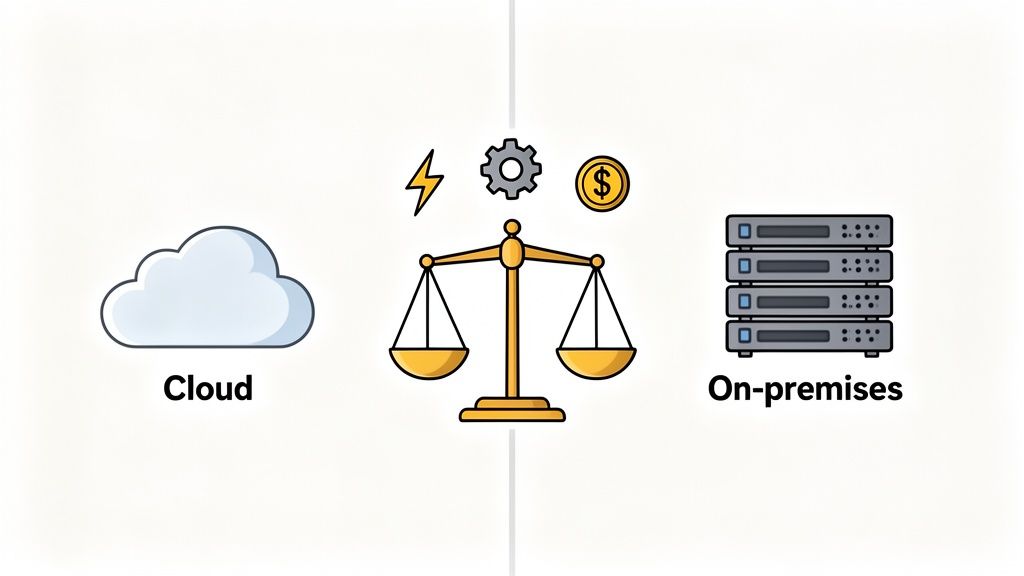
The On-Premises Model: The Traditional Path
The on-premises model represents the classic approach to IT: you purchase, own, and manage all your hardware and software within your own facilities. This provides absolute, granular control over your systems and data. For businesses operating in industries with stringent regulatory requirements or data sovereignty laws, this level of direct oversight is often a critical, non-negotiable requirement.
However, this control comes at a significant cost. It requires a substantial upfront investment in hardware and licenses, along with the ongoing responsibility for maintenance, security patching, and eventual hardware replacement. The operational burden rests entirely on your internal team.
The Cloud Model: The Modern Approach
In the cloud model, the responsibility for managing physical infrastructure shifts to a specialised provider like Microsoft Azure or AWS. Instead of buying servers, you rent computing resources on a pay-as-you-go basis.
This delivers exceptional agility, enabling you to scale resources up or down in minutes as business demands change. While you cede direct control over the physical hardware, you gain access to enterprise-grade security, global reach, and a vast portfolio of advanced services—from AI to data analytics—that would be prohibitively expensive and complex to build and maintain in-house.
Key Takeaway: The cloud vs on-premises debate isn't about which is inherently "better." It's about which model best aligns with your business's operational workflow, financial structure, and long-term strategic goals.
This initial decision dictates everything from daily operations to future innovation. For many organisations, navigating this choice requires a thorough analysis of their specific workloads and business objectives. This is often when they seek structured IT support to build a foundation that is both scalable and secure for the long term.
At a Glance: Cloud Vs On-Premises Key Differences
To clarify the core distinctions, this table breaks down how the two models compare across key business and technical attributes, highlighting the fundamental trade-offs involved.
| Attribute | Cloud Infrastructure | On-Premises Infrastructure |
|---|---|---|
| Initial Cost | Low (OpEx Model) | High (CapEx Model) |
| Scalability | High and Elastic | Limited and Planned |
| Control | Shared Responsibility | Complete Control |
| Maintenance | Managed by Provider | Managed by In-House Team |
| Accessibility | Global, via Internet | Local, Network-Dependent |
| Security | Provider secures infrastructure; you secure data & apps | You secure everything from physical to application layer |
Ultimately, this comparison is more strategic than technical. Each model presents a distinct set of benefits and responsibilities that will profoundly impact your business's financial health, operational efficiency, and ability to innovate.
A Deeper Financial Analysis Of Total Cost Of Ownership
When comparing cloud vs on-premises, the conversation often begins and ends with Capital Expenditure (CapEx) versus Operational Expenditure (OpEx). While this is a valid starting point, it's a dangerously simplistic view. A meaningful financial comparison requires a deeper analysis of the Total Cost of Ownership (TCO), which uncovers the hidden and ongoing expenses that truly impact your bottom line.
A thorough TCO analysis almost always reveals that the optimal solution depends entirely on your specific workload, growth trajectory, and operational discipline.
The Hidden Costs Of On-Premises Infrastructure
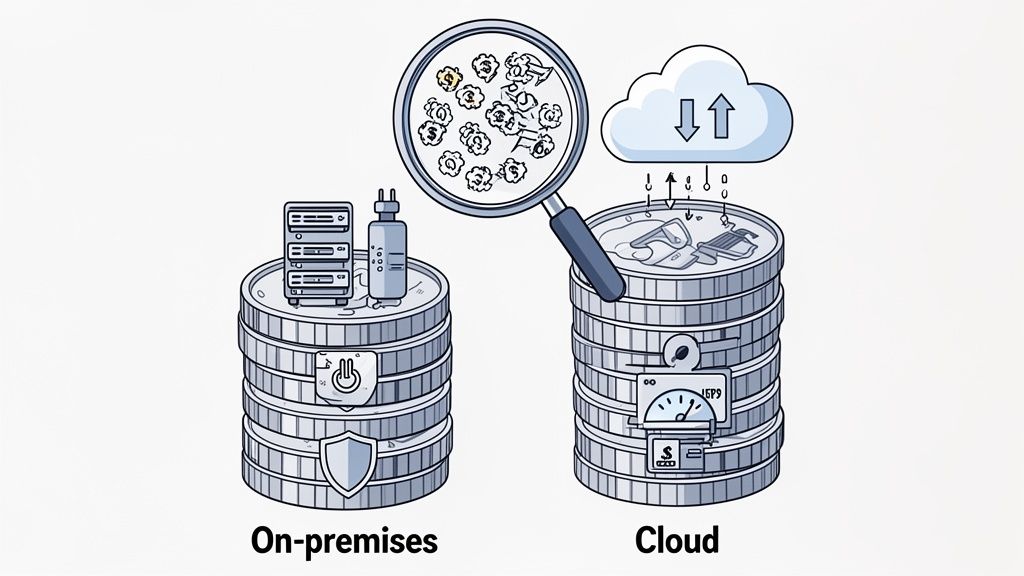
With on-premises infrastructure, the initial server purchase is merely the tip of the iceberg. The true TCO is a long-term commitment composed of numerous, easily underestimated expenses.
A complete on-premises financial model must account for:
- Hardware Refresh Cycles: Servers and networking equipment have a finite lifespan. A realistic budget must factor in a full hardware replacement every three to five years.
- Software Licensing and Renewals: This includes operating systems, virtualisation platforms (e.g., VMware), and security software—all carrying recurring fees and complex licensing agreements.
- Physical Infrastructure and Security: Your server room requires power, cooling, and physical security. This means factoring in rising energy costs, uninterruptible power supply (UPS) systems, and physical access controls.
- IT Staffing and Training: Your team needs the expertise to manage, patch, and troubleshoot the entire stack, requiring ongoing training to stay current with evolving technologies.
For some UK businesses, particularly those with highly predictable and stable workloads, a fully depreciated on-premises environment can appear cheaper over a five-year horizon. However, this calculation often overlooks the opportunity cost of tying up capital and the operational drag of managing physical infrastructure.
Unpacking The Real Costs Of The Cloud
The cloud’s pay-as-you-go model provides significant financial flexibility, but it introduces its own potential for hidden costs. Without diligent governance, the very elasticity that makes the cloud so attractive can lead to significant budget overruns.
Cloud TCO extends far beyond the monthly invoice from Azure or AWS. Key costs to monitor include:
- Data Egress Fees: While uploading data to the cloud is typically free, retrieving it is not. These "egress" fees can become a substantial expense for applications that frequently transfer large datasets to users or other systems.
- Third-Party Integration Costs: Connecting cloud services to other SaaS platforms or legacy on-premises systems may require specialised connectors or middleware, adding another layer of cost and complexity.
- Misconfigured and Orphaned Resources: A single oversized virtual machine or a forgotten storage bucket can quietly drain your budget. Cloud cost management requires continuous monitoring and optimisation—a discipline many organisations learn the hard way.
A common pitfall is treating cloud spend like a traditional utility bill. Effective cloud financial management, or FinOps, is an active, ongoing practice. It requires aligning technology decisions with financial objectives—a strategic process that many businesses rely on expert guidance to implement correctly.
Workload Predictability: The Deciding Factor
Ultimately, the financial equation often hinges on one critical variable: workload predictability.
Consider a UK-based accountancy firm with consistent, 9-to-5 usage patterns. Their workload is highly predictable. For this organisation, investing in correctly sized on-premises hardware might genuinely result in a lower TCO over five years, as the hardware becomes a known, fixed cost.
Now, imagine an e-commerce startup preparing for unpredictable seasonal sales peaks. Their workload is highly variable. Building an on-premises environment to handle peak demand would mean paying for idle capacity for 90% of the year. For them, the cloud’s ability to scale resources on demand is vastly more cost-effective, preventing wasted capital on underutilised hardware.
Making the right choice demands a clear-eyed assessment of how your business operates today and where you expect it to be in the future.
Navigating Security And Compliance In A Modern Threat Landscape
The long-standing debate over cloud versus on-premises security has fundamentally shifted. For years, the prevailing wisdom was that on-site infrastructure was inherently more secure. This is a dangerously outdated perspective. Real security is not determined by physical location; it is the direct result of expertise, continuous investment, and robust, well-executed processes.
Therefore, the critical question is not "Where is my data?" but rather, "Which model provides the strongest security framework for my specific risks?"
With on-premises infrastructure, the security burden is entirely yours. You are responsible for everything: securing the server room door, patching every operating system, and managing every firewall rule. This provides ultimate control, but it also demands a significant, continuous investment in both technology and specialised talent just to keep pace with evolving threats.
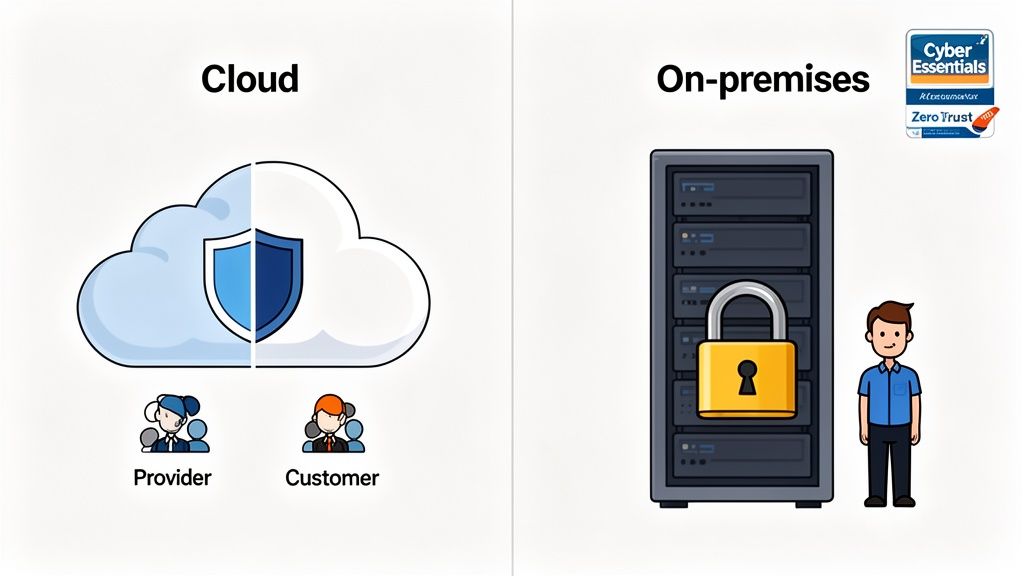
The cloud, by contrast, operates on a shared responsibility model. The provider—such as Microsoft Azure or AWS—is responsible for the security of the cloud. This includes the physical data centres, the global network, and the core infrastructure. Your responsibility is to secure what you put in the cloud: your data, applications, and user access controls.
This partnership allows you to leverage the multi-billion-pound security operations of major cloud providers. You gain access to world-class security tools and a global threat intelligence network that most businesses could never afford to build or maintain themselves.
Adopting Modern Security Frameworks
Today's sophisticated cyber threats require a more dynamic approach than traditional perimeter-based security. This is where frameworks like Zero Trust become essential. Zero Trust operates on a simple but powerful principle: "never trust, always verify." It treats every access request as a potential threat until it is authenticated and authorised.
Implementing a Zero Trust strategy is often far simpler in a cloud environment. Major cloud platforms provide built-in tools for identity management, multi-factor authentication (MFA), and conditional access policies—all core components of Zero Trust. While achievable on-premises, it typically requires integrating multiple, often complex, third-party products.
For UK businesses, certifications like Cyber Essentials or Cyber Essentials Plus are often a key objective. Both on-premises and cloud environments can achieve compliance, but the cloud streamlines the process significantly. Providers offer detailed compliance reports and tools that simplify audits, making it easier to demonstrate control over your data and systems.
This is particularly important when considering that unpatched systems are a primary target for attackers. The automated patching and centralised security management native to cloud platforms dramatically reduce this risk, closing security vulnerabilities before they can be exploited.
Data Governance and Compliance Considerations
For businesses in regulated industries, data sovereignty and governance are non-negotiable. A persistent myth suggests that maintaining compliance requires keeping all data on-premises. This is no longer the case. Major cloud providers now operate UK-based data centres, ensuring your data can remain within national borders to meet GDPR and other data residency requirements.
Effective data management requires a robust framework. We cover this in more detail in our guide to data governance best practices, which helps establish the right policies from the start.
Cloud platforms also provide powerful tools for data classification, retention policies, and comprehensive audit logging. This makes demonstrating compliance far easier than attempting to consolidate reports from disparate on-premises systems. For instance, Microsoft Purview allows you to discover, classify, and protect sensitive data across your entire digital estate, from cloud services to employee laptops. Replicating this capability in-house would be a monumental undertaking.
Let's break it down:
- On-Premises: You are responsible for the entire compliance stack. This involves manually managing audit logs, implementing data loss prevention (DLP) tools, and proving data residency through physical controls.
- Cloud: You inherit the provider's extensive compliance certifications (e.g., ISO 27001, SOC 2). You then use the platform's built-in tools to manage your data-level compliance, significantly reducing audit time and effort.
When it comes down to it, a well-architected cloud environment, managed with expertise, nearly always delivers a more robust and resilient security posture than a typical on-premises setup. It allows you to shift focus from basic infrastructure maintenance to proactively managing data security and responding to threats—which is precisely where your attention should be.
Comparing Performance, Scalability And Business Resilience
Beyond financial models and security frameworks, the real-world performance of your infrastructure directly impacts user experience and, ultimately, your bottom line. The cloud vs on-premises discussion here centres on a fundamental trade-off: the raw, close-to-the-metal speed of local hardware versus the near-infinite capacity for growth and recovery offered by the cloud.
How your systems perform under pressure—whether from a sudden surge in traffic or an unexpected outage—is a critical factor in this decision.
Evaluating Performance and Latency
On-premises infrastructure often wins the race where ultra-low latency is a non-negotiable requirement. For applications in high-frequency trading, real-time industrial process control, or heavy-duty video editing with massive local files, physical proximity between data and processing is paramount. In these use cases, every millisecond counts, and the physical distance to a cloud data centre can introduce unacceptable delays.
However, for the vast majority of business applications, this on-premises advantage is diminishing. Cloud providers like Azure and AWS have invested billions in building extensive global networks with local UK regions, dramatically reducing latency for most users. Furthermore, modern networking solutions can close the gap. As we explore in our guide to SD-WAN benefits, intelligent traffic routing can optimise performance even when data is hosted remotely.
The key is to perform an honest assessment of your workloads. If your core operations are critically dependent on microsecond response times, on-premises or a hybrid model is likely the right choice. For nearly everything else, a well-architected cloud solution will deliver more than sufficient performance.
Scalability and Elasticity When Demand Changes
This is where the cloud doesn't just lead; it changes the rules of the game. Scalability refers to the ability to handle increased workloads, but the cloud offers an elastic form of scalability that is practically impossible to replicate with on-premises hardware.
Imagine a UK e-commerce retailer preparing for the Black Friday sales event.
- On-Premises Scaling: Months in advance, the IT team must forecast peak demand, then purchase, install, and configure additional servers to handle the anticipated load. For the other 51 weeks of the year, this expensive hardware sits largely idle, consuming power and requiring maintenance.
- Cloud Scaling: The same business can configure its cloud environment to automatically provision more resources as traffic increases. Crucially, it can scale them back down just as quickly when the rush subsides. They pay for that peak capacity only for the few days they actually need it.
This concept, known as elasticity, is a genuine game-changer. It transforms scalability from a high-stakes, capital-intensive guessing game into a dynamic, automated function that precisely aligns costs with real-time business activity.
Scaling on-premises is a slow, manual, and expensive process. In the cloud, it is a flexible, on-demand capability that allows you to seize market opportunities without the dead weight of over-provisioning.
Business Resilience and Disaster Recovery
Modern business continuity is not just about backing up files; it's about ensuring your entire operation can withstand a major disruption. On this front, the cloud and on-premises models are worlds apart, with the cloud providing a far more robust and cost-effective path to high availability.
Traditional on-premises disaster recovery (DR) is notoriously difficult and expensive to implement correctly. True resilience requires building and maintaining a complete mirror of your primary data centre in a geographically separate location. This means duplicating everything—hardware, software licenses, networking—at a cost that is prohibitive for most small and medium-sized businesses. As a result, many settle for basic backups, which can lead to days of downtime in a disaster scenario.
In contrast, cloud platforms are architected for resilience from the ground up.
- Geo-Redundancy: You can replicate your applications and data across multiple, physically separate data centres with just a few clicks.
- Automated Failover: If one facility experiences an issue, traffic can be automatically rerouted to a healthy one, often with no perceptible disruption to users.
- High Availability: Cloud services are designed with multiple layers of redundancy, from power to networking, enabling providers to offer service level agreements (SLAs) with uptime guarantees (often 99.9% or higher) that would be astronomically expensive to achieve in-house.
For most organisations, the cloud delivers a level of business resilience that was once exclusive to large enterprises. It effectively democratises disaster recovery, making it feasible for any business to build highly available, fault-tolerant systems without the prohibitive cost of a second physical site.
The Rise Of Hybrid Cloud: Getting The Best Of Both Worlds
The cloud versus on-premises debate often presents a false dichotomy. For a growing number of UK businesses, the most strategic answer is not "either/or" but a deliberate blend of both. This is the essence of hybrid cloud: integrating your private, on-site infrastructure with the vast capabilities of public cloud services like Azure or AWS.
This approach acknowledges a simple reality: not every workload belongs in the same place. You may have a performance-critical database or a legacy application that must remain on-site for latency or compliance reasons. Simultaneously, you want the freedom to develop new applications, manage unpredictable traffic spikes, or leverage advanced analytics without purchasing more physical servers. A hybrid model provides that flexibility.
It allows you to modernise your IT at your own pace, maximising the value of existing hardware while strategically adopting the cloud for specific, high-impact use cases.
Practical Applications of a Hybrid Strategy
A hybrid cloud is not just a theoretical concept; it's a practical solution to real-world business challenges. It offers the architectural flexibility to place workloads where they will perform best and be most cost-effective.
Common hybrid cloud implementations include:
- Cloud Bursting: You can run an application on-premises for day-to-day operations but automatically "burst" into the public cloud for additional computing power during peak demand. This is ideal for handling seasonal e-commerce traffic or intensive, month-end data processing without over-provisioning your local hardware.
- Phased Migration: A full-scale "lift-and-shift" migration to the cloud can be a complex and risky undertaking. A hybrid architecture allows you to move applications and data in stages, dramatically reducing risk and minimising business disruption. We explore this approach in our guide explaining what cloud migration entails.
- Disaster Recovery: Using the cloud as a disaster recovery site for your on-premises systems is far more resilient and cost-effective than maintaining a secondary physical location. You can replicate critical systems to the cloud and fail over to them in minutes during an emergency.
This model is rapidly becoming the standard for modern IT. While public cloud dominated 69.55% of the UK market in 2025, hybrid architectures are growing at a 19.4% compound annual rate. Businesses are blending on-premises data control with cloud bursting for scalability, a strategy that can reduce CapEx by up to 40% while keeping sensitive data in-house.
Designing a Cohesive Hybrid Environment
While a hybrid approach offers tremendous benefits, it also introduces a new layer of complexity. Success hinges on creating a single, secure, and manageable environment that spans both your data centre and the public cloud. This requires careful planning and deep technical expertise.
The goal of a hybrid cloud isn't to run two separate IT systems, but to create a single, unified platform. This means ensuring consistent networking, integrated security policies, and unified management tools that give you visibility across the entire environment.
Indeed, the growth of hybrid cloud shows that understanding modern approaches like hybrid application development is crucial to getting it right. Without a cohesive strategy, you risk creating operational silos, security gaps, and unpredictable costs—the very problems you were trying to solve.
This is precisely where expert IT support becomes invaluable. Designing a robust hybrid architecture involves complex decisions around network connectivity, identity management, and data synchronisation. Getting this foundation right is critical for building a future-ready system that is both scalable and secure, allowing you to innovate with confidence rather than being constrained by your infrastructure.
A Decision Framework For Choosing Your IT Infrastructure
How do you translate this detailed analysis into a confident, final decision? The cloud vs on-premises choice is not merely a technical exercise; it's a strategic business decision. It must be guided by your organisation's unique operational realities, risk tolerance, and growth ambitions.
To make the right call, you need to convert the key differences we've discussed into a series of focused questions about your own business. This involves a clear-eyed assessment of your workloads, your team's capabilities, and your long-term goals. This honest evaluation will illuminate the most logical path forward, ensuring your infrastructure becomes a business enabler, not a constraint.
Evaluating Your Core Business Needs
The right answer always starts with how your business operates day-to-day. The nature of your work, the skills of your team, and your financial strategy will heavily influence which model offers the best long-term value.
Begin by asking these fundamental questions:
- How predictable are your workloads? If your demand is stable and consistent, the fixed costs of on-premises infrastructure can be advantageous. However, if you face seasonal spikes or unpredictable growth, the elasticity of the cloud is almost certainly a better fit.
- What is your in-house IT expertise? Do you have a skilled team ready to manage hardware, patch systems, and handle physical security? If not, the managed nature of a cloud model can free your team to focus on more strategic, value-adding work.
- What is your long-term growth strategy? If you plan to expand into new markets or launch new digital services, the cloud provides the agility to scale rapidly without a massive upfront capital investment.
Answering these questions honestly will clarify whether the hands-on control of on-premises or the pure flexibility of the cloud better aligns with your operational DNA.
The decision tree below helps visualise how to navigate these primary considerations, from data sensitivity to workload variability.
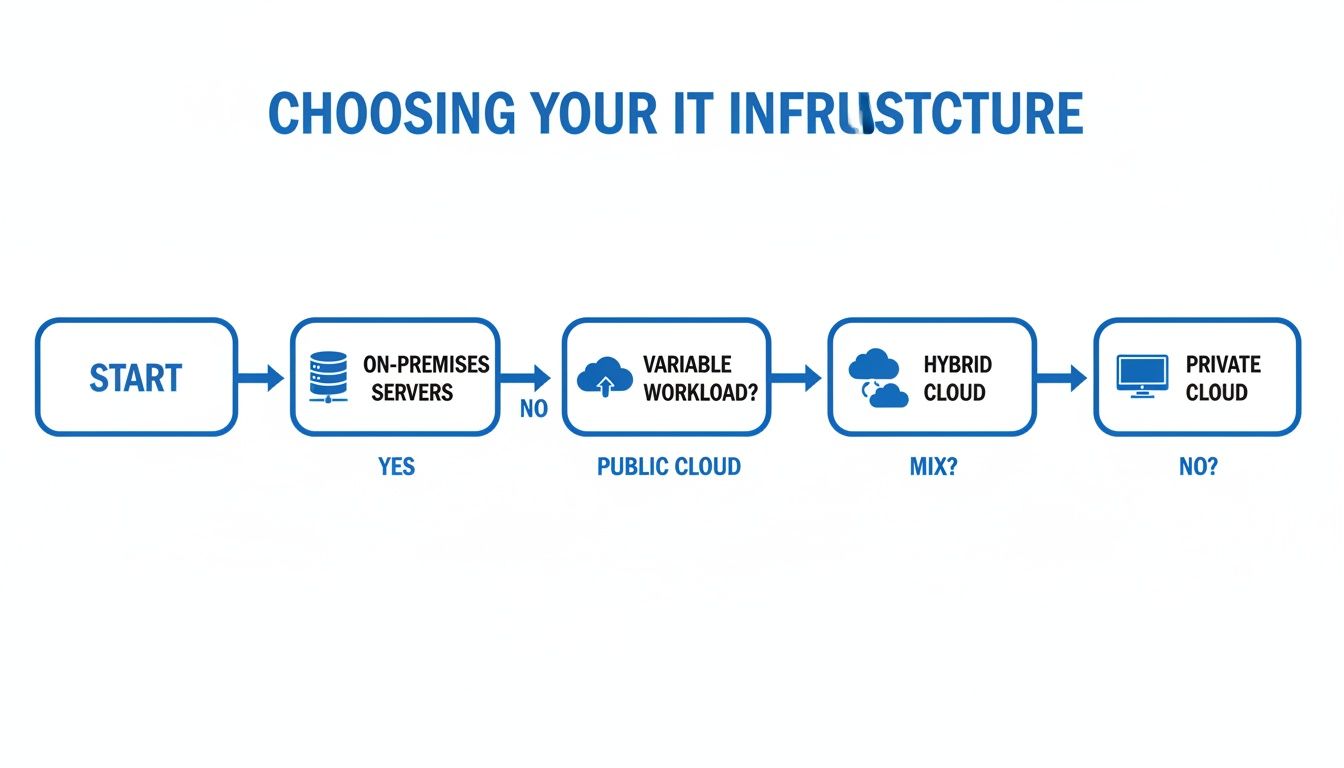
This flowchart simplifies the initial steps, guiding you toward an on-premises, cloud, or hybrid solution based on your answers to key questions about your data and operational demands.
Situational Recommendations in Practice
Let's apply this framework to real-world scenarios to see how different business needs lead to different infrastructure choices.
A UK manufacturing firm relies on latency-sensitive applications to control its factory floor machinery. For this core function, any delay is unacceptable. Here, a hybrid model makes perfect sense: they keep their production control systems on-premises for maximum performance and reliability, while moving their ERP and sales systems to the cloud for better accessibility and scalability.
Conversely, consider a digital-native startup with a small, remote team aiming for rapid user acquisition. Their priority is speed and agility, not managing physical hardware. A cloud-first strategy is the obvious choice, allowing them to scale on demand and leverage advanced cloud services with no upfront capital expenditure.
This trend is accelerating across the UK. Small and mid-sized businesses (SMBs) are adopting cloud solutions at a blistering 20.1% compound annual growth rate through 2025. In fact, 72% of UK firms with fewer than 50 employees now run their primary IT on SaaS platforms, indicating a clear shift away from traditional on-site servers. You can explore more data on this rapid adoption and its drivers by reading the full research on UK cloud adoption statistics.
Ultimately, this framework is not about finding a single "correct" answer. It's about making a deliberate, informed decision that aligns your technology foundation with your business objectives. For many, this strategic planning is best done with expert guidance to ensure the chosen path is secure, scalable, and built for long-term success.
Your Questions Answered
When weighing cloud versus on-premises, a few questions consistently arise. Let's address them directly with practical answers based on real-world experience.
Is The Cloud Always Cheaper Than On-Premises?
Not necessarily. The idea that the cloud is an automatic cost-saver is a common misconception. The financial reality is more nuanced.
While the cloud eliminates the significant upfront capital expenditure (CapEx) for servers and hardware, its pay-as-you-go operational expense (OpEx) model requires diligent management. Costs can escalate if usage is not actively monitored and optimised. For businesses with highly stable and predictable workloads, a fully depreciated on-premises setup can sometimes result in a lower TCO over a five-year period.
However, if your business needs to scale rapidly or deals with fluctuating demand (like seasonal retail), the cloud’s elasticity almost always represents the more financially prudent choice. It prevents you from investing capital in expensive hardware that would sit underutilised for most of the year.
Which Is More Secure: Cloud Or On-Premises?
This question is not about location; it's about expertise and execution. Hosting servers in your own facility provides ultimate physical control, but it also means you are solely responsible for every layer of security—from the lock on the server room door to patching the latest software vulnerability.
In contrast, major cloud providers like Azure and AWS invest billions annually in their security infrastructure. They employ dedicated teams and sophisticated automated systems for threat detection at a scale most businesses could not afford.
Under the cloud’s shared responsibility model, the provider secures the foundational infrastructure. This allows your team to focus on what you control: securing your applications, data, and user access. When properly configured and managed, a cloud environment is often the more secure option for the majority of UK businesses.
Can I Move From On-Premises To The Cloud Later?
Absolutely. Migrating from on-premises servers to the cloud is a well-established process in modern IT. It does not need to be an all-or-nothing, overnight switch. Most businesses undertake this transition in carefully planned phases, often starting with a hybrid model. You might begin by moving less critical applications to build experience and minimise disruption.
A successful migration hinges on meticulous planning. Key considerations include:
- Application Dependency Mapping: Understanding precisely how all your systems interact before you begin moving components.
- Choosing the Right Strategy: Deciding whether to simply "lift-and-shift" an application as-is (rehosting) or modify it to better leverage cloud-native features (re-platforming).
- Ensuring Data Integrity: Guaranteeing that all data is transferred securely and without corruption.
This is a complex undertaking where cutting corners can lead to downtime, budget overruns, and significant operational friction. Partnering with an experienced IT advisor can de-risk the process, ensuring your new cloud environment is secure, cost-effective, and engineered for high performance from day one.
Making the right infrastructure choice is a strategic decision that impacts your entire business. At zachsys IT Solutions, we provide the expert guidance and hands-on support needed to design, implement, and manage secure, scalable, and future-ready IT environments. Whether you are considering a full cloud migration, optimising a hybrid model, or securing your existing systems, our team is here to help you build a foundation for long-term success.
Book a free 30-minute consultation to discuss your IT strategy