
Subtotal $0.00
In today's fast-paced economy, viewing IT as a mere cost centre is a critical business misstep. The conversation has shifted from 'How do we fix broken tech?' to 'How can our technology create a strategic advantage?'. For small and medium-sized businesses (SMBs), especially those in regulated industries, the challenge is balancing innovation with security, scalability, and budget constraints. This is where managed IT services transition from a support function to a core business enabler.
Effective IT management is not about outsourcing problems; it's about insourcing expertise, gaining proactive oversight, and building a technology foundation that is secure, resilient, and perfectly aligned with your business goals. This approach allows organisations to focus on their primary mission while a dedicated team handles the complexities of modern IT infrastructure, from cybersecurity threats to cloud optimisation. Many companies discover that the strategic managed it services benefits extend far beyond simple helpdesk support, offering a clear path to greater operational efficiency and market competitiveness.
This article unpacks the key advantages that organisations leverage to not only solve immediate challenges but to build a future-ready, competitive enterprise. We will move beyond theory to explore how a managed model can fundamentally transform your operations, finances, and security posture. We will cover ten crucial areas, including:
- Cost Control: Achieving a predictable IT budget and optimising expenditure.
- Security & Compliance: Enhancing your defensive posture with frameworks like Cyber Essentials and Zero Trust.
- Expertise on Demand: Accessing specialised skills for cloud migration, infrastructure modernisation, and data governance without the overhead of direct hiring.
We will provide practical insights and real-world scenarios to illustrate how these benefits translate into tangible business value.
1. 24/7 Proactive Monitoring and Incident Response
One of the most significant managed IT services benefits is the shift from reactive problem-solving to proactive prevention. Instead of waiting for a system to fail and disrupt your operations, a Managed Service Provider (MSP) implements continuous, round-the-clock monitoring of your entire IT infrastructure. This includes servers, networks, cloud environments like Azure and AWS, and critical applications. Using advanced tools and Security Information and Event Management (SIEM) systems, they watch for anomalies that signal impending trouble.
This constant vigilance allows for the rapid detection and resolution of issues before they escalate into costly outages. Think of it as a digital early-warning system that safeguards your productivity and revenue. A proactive approach is fundamental for maintaining business continuity in today's digital-first landscape.

Real-World Impact
The value of proactive monitoring becomes clear in practice. For a manufacturing company, this might mean detecting server performance degradation six hours before a potential failure, preventing a complete halt in production. In healthcare, it could involve identifying a memory leak in a patient data system, allowing for a scheduled reboot outside of clinical hours and avoiding critical downtime. Similarly, a financial services firm can benefit from structured IT support that provides round-the-clock monitoring to identify and neutralise suspicious cloud activity within minutes, preventing a potential data breach.
Actionable Tips for Implementation
To maximise this benefit, organisations should:
- Define Clear Service Level Agreements (SLAs): Work with your MSP to establish guaranteed response and resolution times based on incident severity. A critical server failure should have a much faster response time than a minor software glitch.
- Establish Escalation Procedures: Clearly map out who is contacted and in what order when an incident occurs. This ensures the right people are informed without delay.
- Conduct Quarterly Reviews: Regularly review monitoring reports and incident logs with your provider to assess effectiveness and identify recurring issues or areas for improvement.
- Ensure Comprehensive Coverage: Verify that monitoring extends to all business-critical applications and infrastructure components, whether on-premises, in the cloud, or in a hybrid setup.
2. Predictable IT Budget and Cost Optimisation
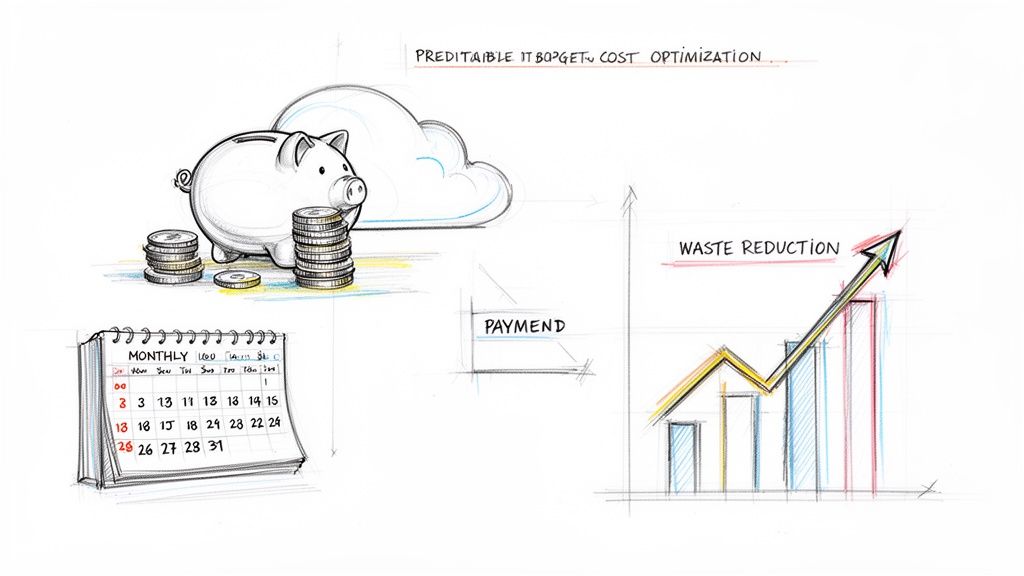
One of the most compelling managed IT services benefits for any business is gaining control over technology expenditure. Instead of facing unpredictable capital outlays for hardware upgrades or unexpected, costly emergency repairs, a Managed Service Provider (MSP) shifts your IT spending to a fixed, monthly operational expense (OpEx). This model provides complete financial transparency and allows for precise, predictable budgeting.
This strategic shift eliminates the financial shocks that can derail business plans, such as a critical server failure or an urgent cybersecurity response. By consolidating IT costs into a single, manageable monthly fee, organisations can better allocate resources, forecast expenses, and invest in growth initiatives with confidence. It’s about transforming IT from a volatile cost centre into a predictable, value-driving asset.
Real-World Impact
The financial advantages become tangible very quickly. A mid-market manufacturer, for instance, might move from an average of £200,000 per year in emergency repairs and reactive support to a stable £12,000 per month managed services plan, not only stabilising cash flow but also improving system reliability. Similarly, a regional retail chain can leverage an MSP's cloud expertise to reduce its Azure spend by 35% through resource right-sizing and reservation optimisation. Relying on proven expertise, a SaaS startup can identify and eliminate over £40,000 in annual waste from unused or over-provisioned cloud resources.
Actionable Tips for Implementation
To maximise this benefit, organisations should:
- Conduct a Comprehensive IT Cost Audit: Before engaging an MSP, document all current IT-related expenses, including hardware, software licensing, support contracts, and previous emergency repair costs. This provides a clear baseline for comparison.
- Request Transparent Monthly Reporting: Your MSP agreement should include detailed monthly reports that break down costs and provide variance analysis against the budget.
- Review Cloud Usage Quarterly: Work with your provider to review cloud consumption patterns every quarter. This proactive analysis helps identify new opportunities for cost optimisation in environments like Azure and AWS.
- Define Scope for Non-Standard Requests: Establish clear chargeback or project-based billing mechanisms for work that falls outside the standard monthly agreement to avoid scope creep and maintain budget predictability.
3. Enhanced Security and Compliance (Cyber Essentials, Zero Trust, GDPR)
Beyond just fixing problems, a core managed IT services benefit is embedding security and compliance into the very fabric of your digital operations. A Managed Service Provider (MSP) moves security from an afterthought to a foundational principle, implementing layered defences from the user’s device (endpoint protection) to the network and cloud. This involves deploying advanced solutions like Microsoft Defender and Sentinel and architecting your systems to meet stringent regulatory standards.
This comprehensive approach is crucial for mitigating the ever-present risk of cyber-attacks and data breaches. It also provides demonstrable proof of your security posture, which is vital for building trust with customers and satisfying regulatory bodies. An expert IT partner helps businesses achieve certifications like Cyber Essentials and implement sophisticated security models to protect their most valuable assets.
Real-World Impact
In practice, this proactive security management yields tangible results. A healthcare provider can achieve and maintain HIPAA compliance by leveraging Azure's robust security controls and data governance tools deployed by their MSP. Similarly, a financial services firm can significantly reduce the risk of insider threats by adopting a Zero Trust architecture, where every access request is verified. A manufacturing company, using advanced Endpoint Detection and Response (EDR) managed by their provider, could neutralise a ransomware attack within hours, preventing operational catastrophe and data loss.
Actionable Tips for Implementation
To maximise this benefit, organisations should:
- Prioritise Cyber Essentials: Attain this certification as a foundational security baseline to defend against the most common cyber threats and demonstrate your commitment to security.
- Adopt Zero Trust Incrementally: Begin implementing Zero Trust principles by focusing on your most critical data and applications first, then expanding coverage over time. Learn more about the Zero Trust security model.
- Conduct Regular Security Training: Organise ongoing security awareness training for all staff to create a human firewall against phishing and social engineering attacks.
- Establish a Governance Committee: Form a security committee that includes business leaders to ensure security policies are aligned with organisational goals and are consistently enforced.
4. Seamless Cloud Migration and Hybrid Infrastructure Management
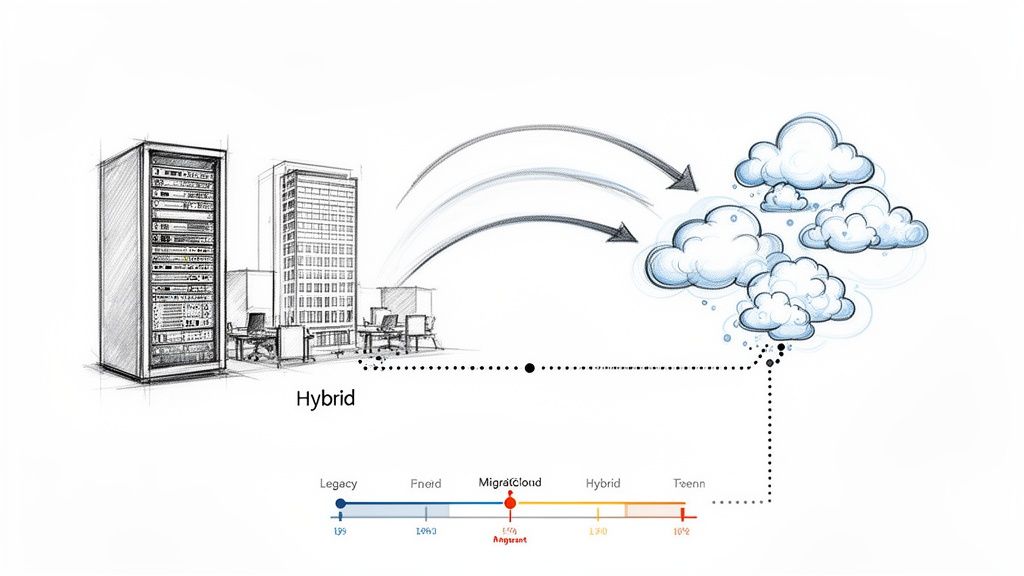
Moving business operations to the cloud is a critical step in modernising your organisation, but the process is fraught with complexity. A key managed IT services benefit is gaining an expert partner to orchestrate this transition, handling the intricate process of migrating workloads from legacy on-premises systems to platforms like Azure or AWS, or managing a sophisticated hybrid environment. This involves detailed assessment, strategic planning, seamless execution, and continuous optimisation to minimise business disruption and accelerate your return on investment.
A proficient Managed Service Provider (MSP) does more than just move data; they deliver end-to-end digital transformation. This requires a holistic approach, combining deep cloud migration expertise with the practical skills needed to manage hybrid networking, including fibre, Wi-Fi, and structured cabling. An experienced partner ensures your on-premises and cloud systems communicate flawlessly, creating a single, powerful, and secure infrastructure. For a deeper dive into the specifics, you can learn more about what cloud migration entails on zachsys.com.
Real-World Impact
The value of expert-led cloud migration becomes tangible across various industries. A multi-site retail chain, for instance, might migrate over 500 users to Azure Virtual Desktop in just eight weeks with zero operational downtime, enhancing collaboration and security. A manufacturing company could move its entire ERP system from an on-premises server to Azure, achieving a 30% reduction in operational costs while improving performance. Similarly, a healthcare organisation can implement a hybrid cloud model to enable robust disaster recovery and ensure business continuity, safeguarding critical patient data.
Actionable Tips for Implementation
To ensure a successful cloud transition, organisations should:
- Start with a Pilot Migration: Test your processes, tools, and team readiness by migrating a non-critical application first. This provides valuable insights and builds confidence.
- Establish Clear Success Metrics: Define what success looks like before you start. Measure key performance indicators (KPIs) such as cost savings, performance improvements, and uptime.
- Plan for Thorough Testing: Allocate sufficient time for user acceptance testing (UAT) before the final cutover. This ensures applications perform as expected and minimises post-launch issues.
- Document Dependencies: Meticulously map out all applications, data relationships, and system dependencies to prevent unexpected failures during the migration.
5. Access to Specialized Expertise and Technology without Hiring
One of the most compelling managed IT services benefits is gaining immediate access to a deep pool of specialised talent without the significant overheads of hiring. Recruiting, training, and retaining experts like cloud architects, cybersecurity engineers, or DevOps specialists is a costly and time-consuming process. An MSP offers these capabilities on demand, allowing you to leverage high-level expertise precisely when you need it for specific projects or ongoing support.
This model is particularly transformative for small and mid-sized businesses (SMBs) where a full-time, specialised role may not be justifiable. Instead of shouldering the expense of a permanent hire, you gain a partner with a diverse team. This gives you the strategic advantage of enterprise-grade knowledge, covering everything from complex cloud migrations to implementing advanced Zero Trust security frameworks, all at a fraction of the cost of building an in-house team.
Real-World Impact
The practical application of this benefit is vast. A growing manufacturing company, for instance, might need to redesign its entire network to support expansion but doesn't require a full-time network architect afterwards. By engaging an MSP, they complete the project with certified experts. Similarly, a financial services firm can access cybersecurity specialists to guide a Zero Trust implementation, ensuring compliance without adding permanent headcount. A tech startup could also leverage a provider’s DevOps team to containerise its applications, accelerating its time-to-market without the delay and expense of recruitment.
Actionable Tips for Implementation
To fully leverage this on-demand expertise, organisations should:
- Define Clear Project Scopes: Work with your provider to document precise goals, timelines, and success criteria before any project begins. This ensures alignment and avoids scope creep.
- Request Knowledge Transfer: Ensure the MSP’s plan includes documenting processes and training your internal staff. This builds your team's capabilities and reduces long-term dependency.
- Establish a Steering Committee: Create a joint committee with key stakeholders from both your organisation and the MSP to oversee progress, make decisions, and resolve issues swiftly.
- Use Agile Methodologies: For complex projects, adopt an agile approach with regular reviews and iterative delivery. This allows for flexibility and ensures the final outcome meets evolving business needs.
6. Business Continuity, Disaster Recovery, and High Availability
One of the most crucial managed IT services benefits is the implementation of a robust framework for business continuity and disaster recovery (BCDR). This goes beyond simple data backups; it involves creating a comprehensive strategy to ensure your organisation can withstand and quickly recover from any disruptive event, such as a natural disaster, cyber-attack, or critical hardware failure. A Managed Service Provider (MSP) establishes clear Recovery Time Objectives (RTO) and Recovery Point Objectives (RPO) to minimise downtime and data loss.
This strategic approach uses advanced technologies like automated backups, geo-redundant storage, and cloud-based failover mechanisms to build resilience. An MSP ensures that your critical systems remain available and your operations continue, even in the face of a catastrophe. This capability is not just an insurance policy but a fundamental requirement for maintaining customer trust and competitive advantage.
Real-World Impact
The value of a managed BCDR strategy is most apparent during a crisis. For a healthcare provider, this could mean implementing a solution like Azure Site Recovery for a near-zero-downtime failover to a secondary region, ensuring patient records are always accessible. A financial services firm might execute a successful disaster recovery test, proving they can switch to a secondary data centre within minutes of an outage, meeting strict regulatory requirements. Similarly, a manufacturing company that leverages strategic guidance can protect against ransomware by using automated, immutable backups to geo-redundant storage, enabling rapid restoration without paying a ransom.
Actionable Tips for Implementation
To maximise this benefit, organisations should:
- Define RTO and RPO Targets: Conduct a business impact analysis to determine how quickly you need to recover (RTO) and how much data you can afford to lose (RPO) for each critical system.
- Automate Backup Processes: Eliminate manual errors and ensure consistency by automating all backup and replication procedures for on-premises and cloud data.
- Test DR Procedures Quarterly: Don't wait for a disaster. Conduct regular, full failover exercises to validate your recovery plan and identify any weaknesses in the process.
- Document and Maintain Runbooks: Create detailed, step-by-step guides (runbooks) for common failure scenarios to ensure a fast, organised, and effective response from your team.
7. Unified Security Operations and Threat Intelligence
A crucial benefit of managed IT services is the centralisation of your entire security apparatus. Rather than juggling disparate security tools, a Managed Service Provider (MSP) unifies security monitoring, threat detection, and incident investigation into a cohesive Security Operations Centre (SOC). This approach leverages powerful platforms like Microsoft Sentinel and Defender XDR, integrating them with real-time threat intelligence feeds to create a formidable defensive shield.
This consolidation provides a single-pane-of-glass view across all your infrastructure, whether on-premises, in the cloud, or at the edge. By correlating data from multiple sources, an MSP can detect sophisticated attack patterns that isolated systems would miss. This unified strategy is key to reducing the time between threat detection and response, minimising potential damage.
Real-World Impact
The value of unified security is most evident during an active threat. An enterprise, for instance, could detect an attacker’s lateral movement just 15 minutes after the initial compromise, containing the breach before critical assets are reached. A manufacturing firm might identify a credential theft attack in progress, allowing security teams to lock out the intruder before any sensitive intellectual property is exfiltrated. Similarly, a financial services organisation can leverage up-to-the-minute threat intelligence to proactively block a zero-day exploit before it’s even widely known, demonstrating a significant managed IT services benefit in risk reduction.
Actionable Tips for Implementation
To fully leverage unified security operations, your organisation should:
- Start with Baseline Tuning: Work with your MSP to tune security alerts from day one. This initial effort significantly reduces false positives, allowing your security team to focus on genuine threats.
- Use Industry-Relevant Threat Intelligence: Ensure the threat intelligence feeds being used are specific to your sector. A healthcare provider needs different intelligence than a retail company.
- Create Automated Response Playbooks: Develop and implement automated responses (playbooks) for common attack scenarios, such as isolating an infected machine or blocking a malicious IP address.
- Schedule Monthly Threat Hunting: Proactively search for emerging threats within your environment. Regular, scheduled threat hunting sessions help uncover hidden adversaries that automated systems might not have detected.
8. Infrastructure Modernisation (Networking, Cabling, Wi-Fi, CCTV, Access Control)
A key managed IT services benefit is the extension of expert oversight beyond software and the cloud to the physical foundation of your technology. An MSP doesn't just manage what runs on your network; they design, deploy, and modernise the network itself. This includes structured cabling, high-speed fibre optic backbones, enterprise-grade Wi-Fi, and integrated physical security systems like CCTV and access control. This holistic approach ensures your physical infrastructure is a powerful enabler, not a bottleneck, for digital transformation.
By unifying IT, networking, and physical security, a provider creates a cohesive, high-performance environment. This foundation is essential for supporting everything from mobile workforces and secure guest access to advanced security monitoring and physical asset protection. It’s about building a robust, future-proof platform from the ground up that can handle tomorrow's demands.
Real-World Impact
The tangible results of infrastructure modernisation are significant. A multi-site manufacturing facility, for instance, might install a fibre backbone connecting all buildings, achieving sub-5ms latency for seamless data transfer between production lines and offices. An enterprise could deploy a Wi-Fi 6 network designed by an experienced provider to support over 1,000 concurrent users with flawless roaming. Similarly, a financial services firm can integrate its door access control system with Azure AD, creating a unified identity for both physical and cyber security and automatically revoking building access when a user is offboarded.
Actionable Tips for Implementation
To maximise this benefit, organisations should:
- Plan for Future Growth: Design your infrastructure with at least 20% spare capacity for future devices, bandwidth needs, and expansion. This avoids costly retrofits down the line.
- Use Fibre for Key Connections: Leverage fibre optics for backbone connectivity between buildings or communications rooms to ensure maximum speed and reliability over long distances.
- Adhere to Cabling Standards: Implement a consistent structured cabling system for organisational-wide neatness, easier troubleshooting, and simplified management.
- Implement Network Segmentation: Design security into the network from day one by segmenting traffic. For example, keep guest Wi-Fi, CCTV, and corporate networks logically separated to limit the impact of a potential breach.
9. Data Protection, Governance, and AI-Ready Analytics
Beyond securing infrastructure, one of the most strategic managed IT services benefits is the ability to protect, govern, and ultimately leverage your data as a core business asset. An MSP helps you move from simply storing information to actively managing its lifecycle, ensuring it is secure, compliant, and prepared for advanced technologies like Artificial Intelligence (AI). This involves deploying sophisticated tools like Microsoft Purview for data discovery and classification, and preparing data platforms for AI-driven insights with services like Azure OpenAI.
This comprehensive approach allows you to answer critical questions: Where does our sensitive data reside? Who has access to it? How can we use it to drive decisions without compromising security or compliance? By establishing a strong data governance foundation, you not only mitigate risk but also unlock immense value, positioning your organisation to innovate responsibly with tools like Microsoft Copilot and other AI solutions.
Real-World Impact
The value of integrated data governance and AI readiness is transformative across industries. A financial services firm might use these services to automatically discover and protect over two million sensitive files scattered across SharePoint and Teams, preventing unauthorised access. In healthcare, a provider could enable GDPR compliance with automated data retention policies that purge patient records according to legal requirements. Elsewhere, a manufacturing organisation can leverage Azure OpenAI to analyse operational data, identifying production inefficiencies and optimising their supply chain. This strategic approach turns data from a liability into a powerful engine for growth.
Actionable Tips for Implementation
To maximise this benefit, organisations should:
- Conduct a Data Discovery Assessment: Before you can protect your data, you must understand what you have and where it is. Work with your provider to map your entire data estate.
- Define Governance Policies and Owner Roles: Clearly establish rules for data access, retention, and classification. Assign specific individuals or teams as data owners to ensure accountability.
- Establish Data Quality Standards: Ensure your data is clean, consistent, and accurate before implementing AI models. Poor data quality will lead to unreliable AI-driven insights.
- Implement AI Responsibly: Deploy AI solutions with robust monitoring for fairness and bias. Use tools like Azure OpenAI for industry-specific use cases that leverage your proprietary data securely.
10. Agile Project Delivery, DevOps Acceleration, Scalability and Performance Optimisation
One of the most transformative managed IT services benefits is the ability to modernise and accelerate how your business builds, deploys, and scales applications. An MSP moves beyond traditional IT support to become a strategic partner in your development lifecycle. By introducing DevOps principles, they help implement CI/CD (Continuous Integration/Continuous Delivery) pipelines, containerisation, and agile project management frameworks. This fundamentally changes software delivery from a slow, monolithic process into a rapid, iterative, and reliable system.
This strategic shift allows your organisation to respond to market demands with incredible speed and agility. An MSP helps ensure that as your business grows, your applications and infrastructure scale seamlessly to meet demand. They focus on optimising performance under load, identifying and eliminating bottlenecks, and leveraging cloud-native architectures for elastic scaling. This prevents over-provisioning and ensures you only pay for the resources you need.
Real-World Impact
The value of this approach is evident across industries. A SaaS startup can deploy new features five times faster by working with an MSP to build a GitHub Actions CI/CD pipeline, gaining a significant competitive edge. For a larger enterprise, this might mean reducing a complex application deployment cycle from three months down to just two weeks. Similarly, an e-commerce platform can effortlessly scale from 100 to 10,000 concurrent users during a peak holiday season, thanks to a well-architected auto-scaling strategy, preventing crashes and lost revenue.
Actionable Tips for Implementation
To fully leverage this benefit, organisations should:
- Start with a Pilot Project: Select a single application or project to prove the value of DevOps and agile methods before committing to a company-wide rollout.
- Automate Testing: Integrate automated testing into your CI/CD pipeline to catch bugs and vulnerabilities early, reducing the risk of production failures.
- Use Infrastructure-as-Code (IaC): Work with your provider to define your infrastructure in code (e.g., using Terraform or Bicep) to ensure consistent, repeatable, and automated environment provisioning.
- Define Scaling Thresholds: Clearly establish the metrics (CPU utilisation, memory usage, response time) that will trigger auto-scaling events to ensure performance without incurring unexpected costs.
Top 10 Managed IT Services Benefits Comparison
| Service | Implementation complexity | Resource requirements | Expected outcomes | Ideal use cases | Key advantages |
|---|---|---|---|---|---|
| 24/7 Proactive Monitoring and Incident Response | Medium — initial setup and tuning | SIEM/monitoring tools, 24/7 analysts, integration time | Early detection, reduced downtime, faster MTTR | Cloud, hybrid infrastructures and business‑critical apps | Continuous visibility, predictive alerts, guaranteed response SLAs |
| Predictable IT Budget and Cost Optimization | Low–Medium — audit and policy changes | Cost management tools, MSP billing, reporting cadence | Predictable OPEX, reduced waste, clearer forecasting | SMBs, organizations needing cost control and cloud right‑sizing | Fixed monthly costs, consolidated billing, optimized cloud spend |
| Enhanced Security and Compliance (Cyber Essentials, Zero Trust, GDPR) | High — ongoing configuration and governance | EDR/XDR, Sentinel, Purview, policies, training | Lower breach risk, demonstrable compliance, faster containment | Regulated industries, data‑sensitive organizations | Comprehensive security posture, certifications, lower insurance risk |
| Seamless Cloud Migration and Hybrid Infrastructure Management | High — planning, migration and testing phases | Migration tools, cloud architects, hybrid networking skills | Modernized workloads, reduced CAPEX, improved scalability | Legacy migrations, multi‑site organizations, hybrid initiatives | Minimized disruption, end‑to‑end migration, hybrid orchestration |
| Access to Specialized Expertise and Technology without Hiring | Low — contractual engagement and scoping | Certified specialists, flexible staffing, knowledge transfer | Rapid access to skills, reduced hiring/time‑to‑value | Short projects, SMBs lacking in‑house specialists | Enterprise expertise on demand, lower recruitment overhead |
| Business Continuity, Disaster Recovery and High Availability | Medium–High — design, redundancy and testing | Backup/DR tools, geo‑redundant storage, runbooks, tests | Reduced RTO/RPO, resilient operations, faster recovery | Regulated sectors, multi‑site businesses, disaster recovery needs | Automated failover, data resilience, regulatory alignment |
| Unified Security Operations and Threat Intelligence | High — SOC integration and continuous tuning | SIEM, threat feeds, SOC analysts, playbooks | Faster detection and response, correlated visibility, forensics | Organizations needing 24/7 threat monitoring and incident response | Centralized SOC, proactive threat hunting, automated remediation |
| Infrastructure Modernization (Networking, Cabling, Wi‑Fi, CCTV, Access Control) | High — physical works and site coordination | Fiber/cabling contractors, APs/cameras, site surveys, installation | Improved network performance, reliable connectivity, integrated security | Multi‑site enterprises, offices, facilities modernization projects | Future‑proof infrastructure, higher reliability, integrated physical+cyber security |
| Data Protection, Governance and AI‑Ready Analytics | Medium–High — discovery, classification and governance | Purview/DLP, data engineers, governance policies, AI tooling | Protected and classified data, AI readiness, compliance automation | Regulated data environments and AI adoption initiatives | Data discoverability, automated compliance, foundation for AI use |
| Agile Delivery, DevOps Acceleration, Scalability & Performance Optimization | High — cultural change and tooling rollout | CI/CD, containers, IaC, load‑testing, training | Faster releases, better performance, elastic scaling | Software teams, SaaS platforms, high‑traffic applications | Faster deployments, automation, scalable and performant systems |
From Reactive Fixes to Proactive Growth: Your Next Steps
Moving beyond a reactive, break-fix approach to technology is no longer a luxury for ambitious organisations; it is a fundamental requirement for survival and growth. As we have explored, the benefits of managed IT services extend far beyond simply outsourcing your helpdesk. This strategic partnership represents a fundamental shift in how your business leverages technology, transforming it from a recurring operational cost into a powerful engine for innovation, security, and competitive advantage. The journey we've outlined, from establishing 24/7 proactive monitoring to optimising for scalability and performance, illustrates a clear, transformative path.
The true value is realised when you stop firefighting IT issues and start architecting for the future. Instead of your internal teams being bogged down by system updates, security patching, and network troubleshooting, they are liberated to focus on high-value initiatives that directly impact your bottom line. This is the core promise of a well-structured managed services partnership. It’s about creating an environment where technology works for you, not the other way around.
Key Takeaways: From Tactical Fixes to Strategic Advantage
Let's distil the core insights from our exploration of managed IT services benefits. Understanding these takeaways is the first step towards making an informed decision for your organisation's future.
- Financial Predictability is Financial Freedom: The move from unpredictable capital expenditure on IT emergencies to a fixed, operational monthly cost is one of the most immediate and tangible managed IT services benefits. This predictability allows for more accurate budgeting and frees up capital for strategic investments in other areas of the business.
- Security is Not a Product, It's a Process: Robust cybersecurity is not achieved by installing a single piece of software. It is a continuous process of monitoring, threat intelligence, and compliance management. A managed service provider (MSP) embeds this process into your operations, aligning with frameworks like Cyber Essentials and Zero Trust to build a resilient, multi-layered defence against ever-evolving threats.
- Access to Expertise on Demand: The technology landscape is vast and complex. No single small or mid-sized business can afford to hire in-house specialists for every discipline, from Azure cloud architecture and data governance to advanced networking and unified security operations. Managed services provide immediate access to a deep bench of certified experts, levelling the playing field with larger enterprises.
Your Actionable Next Steps: Building a Future-Ready Foundation
Mastering these concepts means transitioning your organisation's mindset. Rather than viewing IT as a cost centre, you begin to see it as a strategic enabler. The goal is to build an infrastructure that is not only secure and reliable but also agile enough to adapt to market changes, scalable enough to support your growth, and intelligent enough to provide data-driven insights.
Start by conducting a candid internal assessment. Where are your current IT strategy's most significant pain points? Are you struggling with compliance? Is your infrastructure holding back your cloud adoption goals? Are you concerned about your disaster recovery plan? Answering these questions will illuminate the areas where a strategic IT partner could deliver the most immediate and profound impact. A simple, focused conversation about your business objectives can often reveal the most direct path to a more secure, efficient, and competitive future. This proactive stance is what separates market leaders from the rest.
Ready to transform your IT from a reactive cost centre into a proactive growth engine? The team at zachsys IT Solutions specialises in crafting bespoke managed IT strategies that align technology with your specific business goals. Explore how our expertise can deliver the tangible managed IT services benefits your organisation needs to thrive by visiting zachsys IT Solutions or scheduling a complimentary consultation.